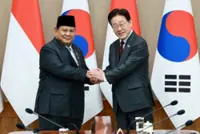
The economy is on a “wartime footing” over the Iran conflict, President Lee Jae-myung said, after the government proposed a US$17.2bil (RM69.2bil) supplementary budget to tackle the crisis.
Oil prices have surged amid the US-Israeli conflict with Iran, raising growth and inflation risks for South Korea, which is heavily reliant on Middle Eastern crude for around 70% of its imports.
“Our government is treating the economy as being on a wartime footing and is making all-out efforts to overcome the crisis,” Lee said in a budget speech to the National Assembly.
“The current crisis is not like a passing shower that will stop, but rather like a massive storm that could last indefinitely,” he added, asking lawmakers to swiftly pass the budget.
The plan allocates 4.8 trillion won (RM12.4bil) in cash handouts of 100,000 to 600,000 won (RM266 to RM1,599) per person for the bottom 70% of income earners, with payments scaled by income.
“Extraordinary measures are needed in times of emergency,” Lee said.
Like other Asian economies, South Korea relies heavily on energy imports, including through the Strait of Hormuz, whose effective closure has driven up energy prices and rattled the global economy.
The conflict has already prompted Seoul to impose a fuel price cap to ease pressure on its energy supply, the first such measure since 1997.
The country’s energy ministry recently issued guidelines urging the public to conserve energy, including by taking shorter showers and charging mobile phones during daytime hours.
“I earnestly appeal to the public to actively participate in energy conservation practices in daily life, such as using public transportation and saving electricity,” Lee said yesterday.
The ruling Democratic Party of Korea and the main opposition People Power Party agreed to vote on the budget Bill on April 10. — AFP