
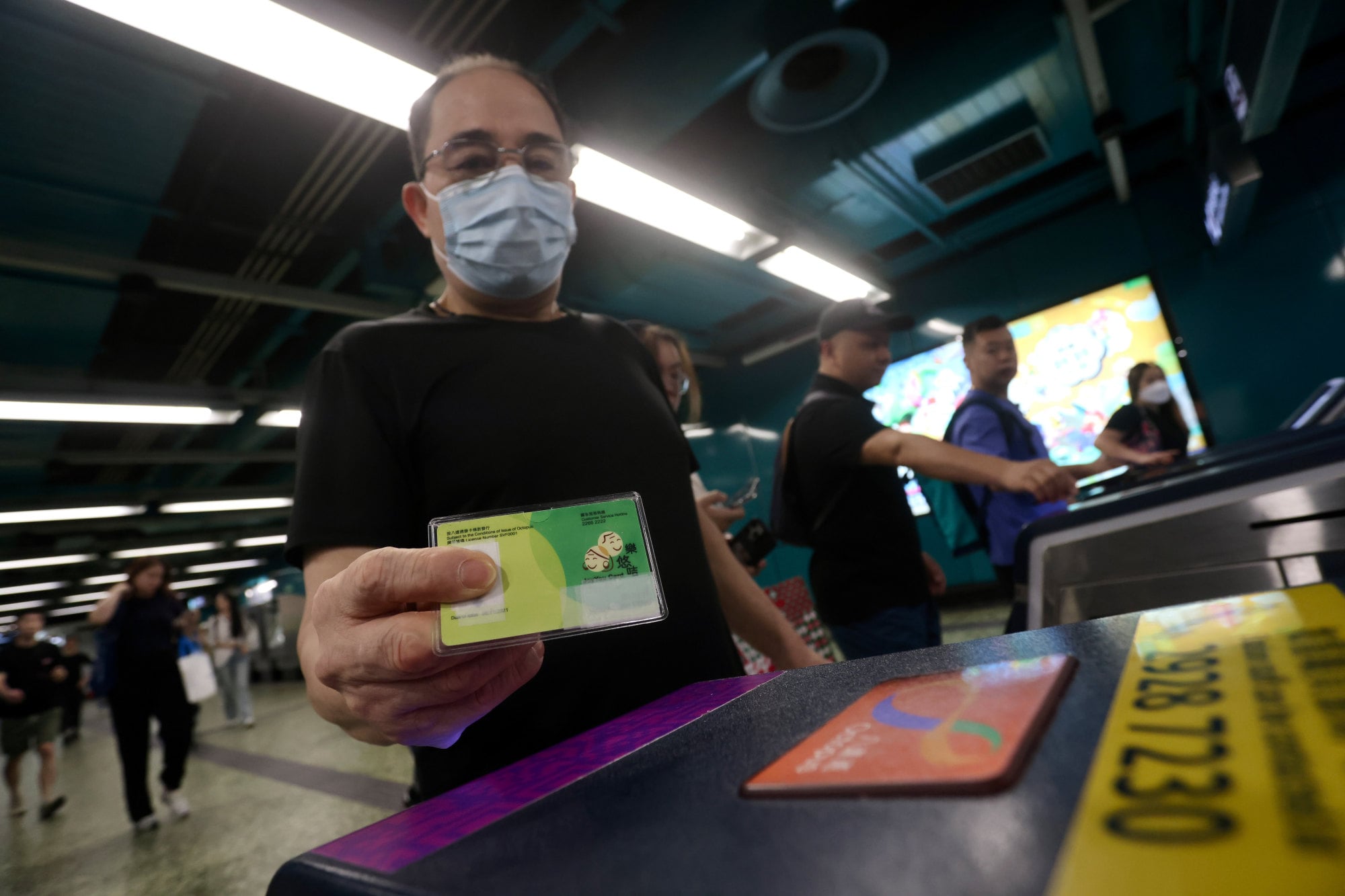
John Hau, a 66-year-old Hongkonger, was frustrated by the government’s decision to revamp the HK$2 (26 US cents) transport subsidy scheme.
The discount allowed him to pay just HK$4 to make the round-trip rail commute from his home in Sham Shui Po in Kowloon to Wan Chai on Hong Kong Island, where he works as a security guard at a hotel.
From Friday, he will need to pay an extra HK$1.20, an amount that does not bother him financially but emotionally.
“The impact on my finances is not substantial, but pennies add up to pounds in the long run, and there are many elderly people still working very hard like me,” he said.
“It is unreasonable for the government to paint everyone with the same brush, without considering if you are a millionaire travelling the world or are still struggling to make ends meet.”
Under the revised scheme, the elderly and people with disabilities holding an Octopus JoyYou Card will pay 20 per cent of fares for trips costing more than HK$10, instead of the HK$2 flat rate.
The revamp is aimed at discouraging them from taking pricier long-haul routes for short journeys, saving the government HK$550 million each year.
As the 2.67 million beneficiaries, or one-third of the Hong Kong population, brace for changes, observers say the extra financial burden on them will be minimal but authorities should be cautious about the effect on elderly employment.
In the 2025-26 financial year, the government reimbursed HK$4.8 billion to public transport operators, a fourfold increase from HK$1.2 billion in 2019-20.
Another revision to the scheme, capping the number of subsidised trips a person can take at 240 a month, will come into effect at least one year later.
The government earlier issued money-saving guides on social media. For example, Wan Chai residents going from Southorn Playground to Pacific Place in Admiralty should take the tram or bus route 1 or 5B, instead of route 960, which could save HK$2.80.
Hau makes about HK$9,000 working overnight shifts and receives a HK$4,000 old-age living allowance each month.
His tiny but tidy subdivided flat, for which he pays HK$6,000 a month in rent, is filled with painkillers and supplements for gout and dry eye syndrome, adding another HK$1,000 to his monthly bills.
The freezer is stocked with packs of frozen buns bought from a mainland Chinese supermarket that he eats daily to cut costs and save for kneecap replacement surgery across the border, as the waiting time at Hong Kong public hospitals is too long.
“I hope the government can distinguish between those who need the HK$2 benefit and those who do not, to make our lives easier ... because I can’t retire soon,” he said.
Nelson Chow Wing-sun, an emeritus professor at the department of social work at the University of Hong Kong (HKU), expected those who were still working to be the hardest hit by the new policy.
“The retirees typically go out to gather with their family and friends, or join activities, which do not require them to travel far and frequently, so the impact will be limited for the majority,” he said.
“The most impacted group will be those aged between 60 and 65 and who still need to take multiple trips to work every day, because they may need to travel all the way from Sheung Shui or Yuen Long to Kowloon or even the Island.”
Chow said the younger elderly were in high demand in the job market and the government should ensure they were not deterred by the new price.
“The financial burden should not be big, but some might consider changing jobs to control the commuting cost, and the Labour Department could come into play to help with the matching process,” he said.
“The employers could also consider giving them extra transport allowance, which would not be costly either.”
Vera Yuen Wing-han, a lecturer of economics at HKU, predicted the revamp would encourage some elderly to be more mindful of the bus they boarded, although she too predicted the overall financial impact on them would be minor.
“The revamp is not a cut to welfare benefits, but a way to rationalise the use of public funds, as taking a long-haul bus for a short journey for convenience and more vacant seats is throwing public money into the sea ... they would not do that if it were from their own pocket,” she said.
“Paying an extra HK$20 or HK$40 a month for commuting should not deter a person from working if he actually needs or wants the job.” -- SOUTH CHINA MORNING POST