
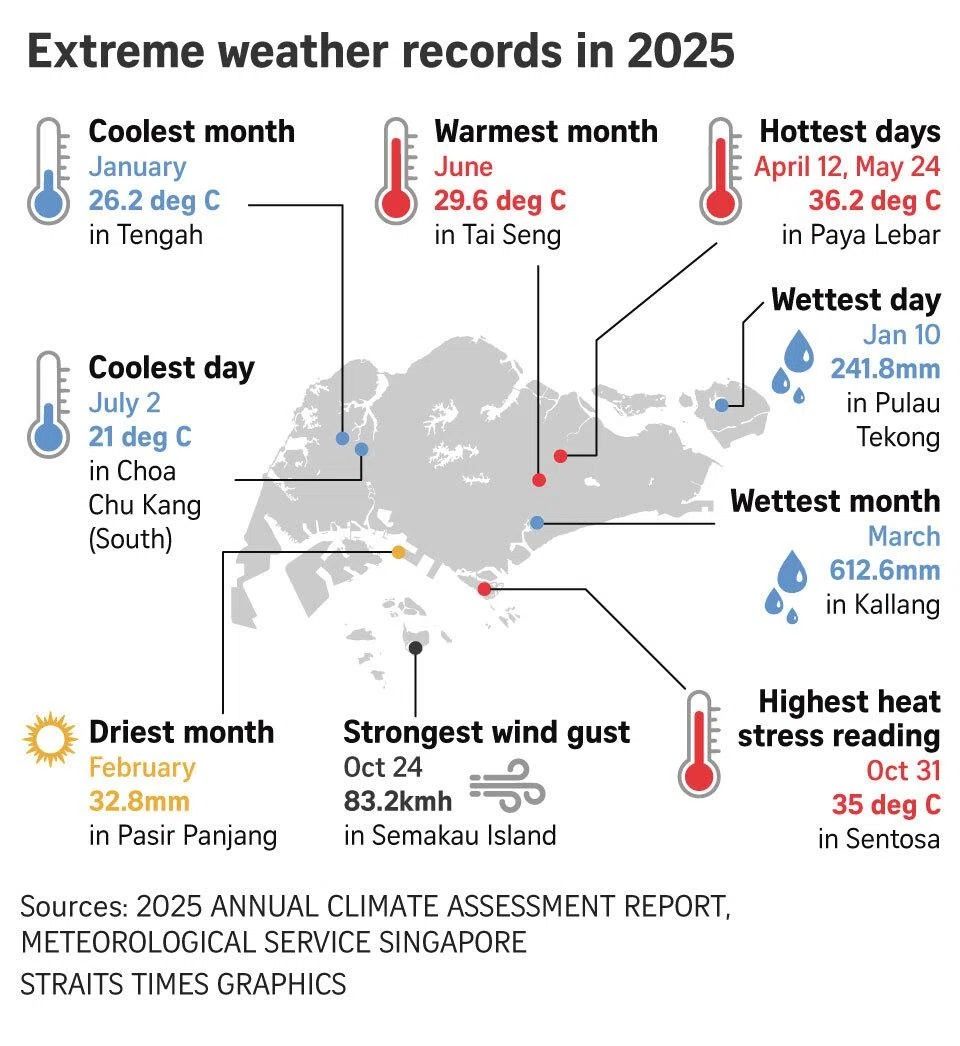
SINGAPORE: The year 2025 was a year of extremes, a new climate report has shown. Singapore’s weather notched a number of records, including the wettest March, as well as the hottest June and November so far.
Singapore also experienced its highest-ever heat stress reading in 2025, when the wet bulb globe temperature (WBGT) hit 35 deg C at Palawan Green in Sentosa on Oct 31.
Heat stress occurs when excess heat builds up in the body, as it is unable to cool itself down sufficiently. WGBT measures heat stress by accounting for air temperature, humidity levels, wind speed and solar radiation.
The data was released by the Meteorological Service Singapore (MSS), a unit under the National Environment Agency (NEA), in its annual climate assessment report on March 23.
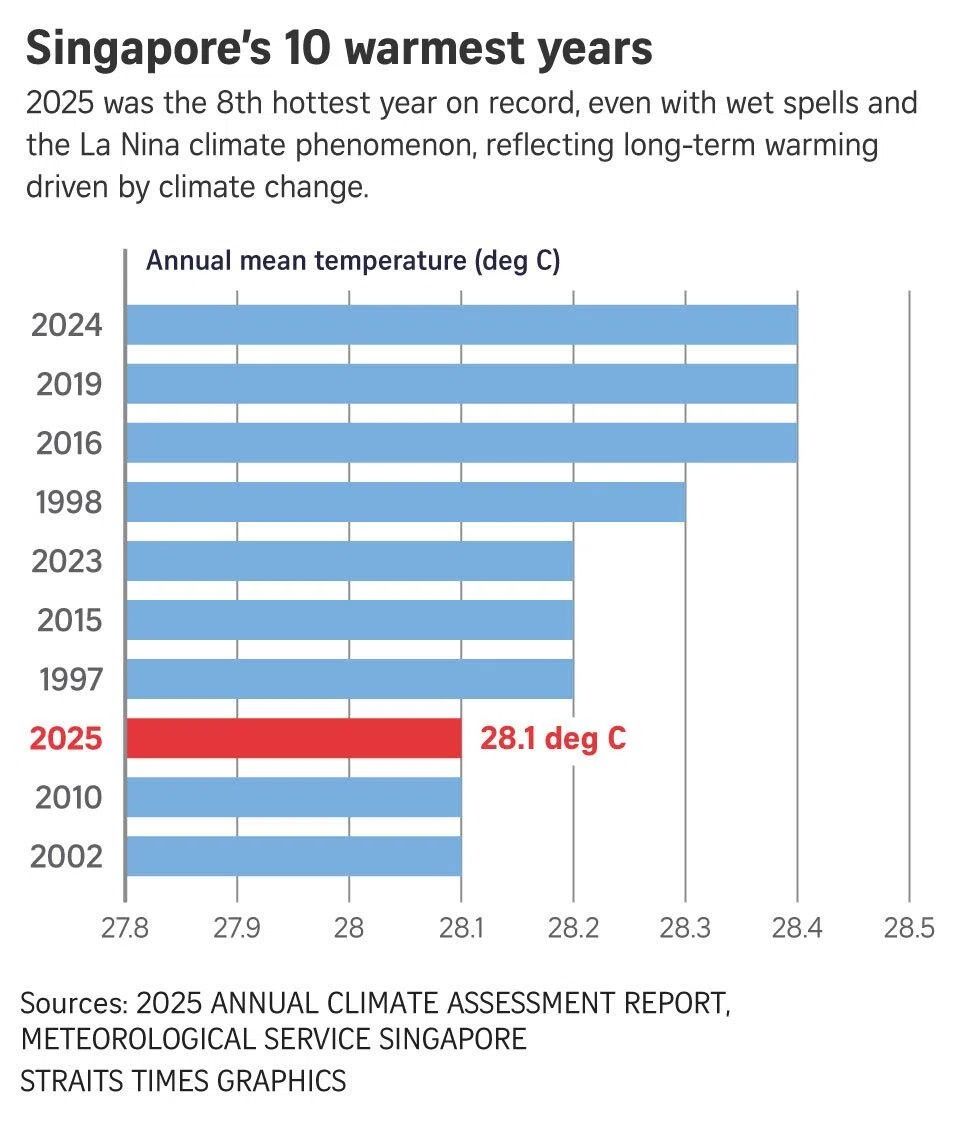
The report also showed that despite the influence of the La Nina climate phenomenon, which usually brings a cool, rainy respite over the region, 2025 ranked as Singapore’s eighth-hottest on record, with an average temperature of 28.1 deg C.
This shows the impact of long-term warming caused by climate change, the report said.
The findings on the rising temperatures and extreme weather events come amid a governmental push for people to make adaptation – or efforts to reduce the impacts of climate change on people and places – a national priority in 2026.
The Ministry of Sustainability and the Environment had designated 2026 as the Year of Climate Adaptation during the parliamentary debate on its budget on March 3. It had also announced a slew of measures to help Singapore adapt, such as a new office to spearhead the Republic’s efforts to tackle heat stress.
Rising temperatures
The climate report noted that Singapore experienced 29 days of high heat stress in 2025, up from 21 days in 2024.
MSS said this increase was partly due to more heat stress sensors being set up islandwide.
A day of high heat stress is determined when an hourly average WBGT of 33 deg C or higher is recorded at a station that can detect heat stress.
Under such conditions, people engaging in outdoor activities are urged to take longer breaks indoors, minimise exertion and drink more fluids, among other precautions.
Explaining the heat stress record logged in Palawan Green on Sentosa in October 2025, the report said it had occurred during a period of intense sunlight and relatively low average wind speeds. Reduced wind speeds limited the dissipation of heat, contributing to the higher WBGT value.
MSS deputy principal research scientist Thea Turkington highlighted how site characteristics also contributed to readings there.
“You may think that the breeze by the coast may help to ventilate the site, but actually the station is sheltered on the southern and western sides,” said the researcher. “This means that during the south-west monsoon season, the winds are blocked, allowing the site to get quite warm.”
During the south-west monsoon season, which usually lasts from June to September, winds blow mainly from the south-west.
The example highlights how the location of stations to monitor heat stress is just as important as having a wide network to detect the effect of heat on the human body, said Dr Turkington.
To enhance monitoring capabilities, MSS further expanded its heat-sensing network by adding five stations in January 2026, bringing the total operational stations in Singapore to 20.
The MSS report also showed that June 2025 was Singapore’s warmest June since 1929, when records began. That month’s record tied with 1997’s.
November 2025 also shattered several heat records, even though the month is not typically associated with extreme weather.
The first half of November 2025 was exceptionally warm, with daytime temperatures exceeding 33 deg C. These were compounded by notably dry conditions across Singapore, as much of the island had below-average rainfall.
On Nov 1, 2025, the highest temperature ever observed for the month was recorded at 36 deg C in Newton.
Wetter weather
The year 2025 was also the seventh wettest year on record, MSS said in the climate report.
It added that Singapore’s rainfall is also increasing, with annual total rainfall rising by 92.5mm per decade from 1980 to 2025.
In 2025, the average rainfall on wet days was 13.8mm, the second highest on record after 2021.
The exceptionally wet conditions of 2025 resulted from three north-east monsoon surges at the start of 2025 and the rain-bearing La Nina.
A monsoon surge occurs when bursts of cold, dry air from wintry regions like Central Asia move over the warm waters of the South China Sea, picking up moisture. This brings extensive rainfall, strong winds and cooler temperatures to Singapore.
The monsoon surge in March helped crown 2025 as having the wettest March on record, with the islandwide average rainfall of 482.9mm that month being 130 per cent above the month’s long-term average.
In terms of rainfall intensity, or how much rain falls over Singapore within a certain period, there has been no significant increase in the intensity of rainfall over the years, the MSS report observed.
However, the report acknowledged that Singapore has experienced short bouts of rain that were so intense that they broke records.
One such event occurred on Feb 14, 2025 at Kranji Reservoir, which set a new record for February’s highest 30-minute rainfall intensity at 72mm. This broke the last record of 70mm set in February 2023 at a nearby rain gauge in Kranji Road.
Said Dr Turkington: “It shows that even if you don’t have a trend, you can still see extreme events happening.”
International climate scientists have warned that higher rainfall patterns are one symptom of climate change. This is because a warmer atmosphere would be able to accommodate more water vapour that would eventually fall back to the ground as rain or snow.
But Dr Turkington noted that this may not be the case for Singapore.
The heavier rainfall in Singapore cannot be directly attributed to climate change, as there are naturally wide fluctuations in the amount of rainfall that the tropics usually receives, she noted. This makes it hard to tease out whether climate change influenced the amount of rainfall.
In tropical regions, rainfall is influenced by many factors, including local weather conditions, as well as large-scale weather patterns like the El Nino-Southern Oscillation (ENSO).
ENSO is a natural cycle in the Pacific Ocean arising from a combination of changes in winds and sea surface temperatures. The El Nino phase results in less rain, longer dry spells and higher-than-usual temperatures for South-east Asia, while its opposite La Nina phase causes more rain and cooler weather.
How ENSO changes under climate change will definitely affect Singapore, more so than temperate countries, said Dr Turkington.
To improve forecasting weather in South-east Asia, the NEA in September 2025 launched the Climate and Weather Research Alliance Singapore, a multi-institute platform that also aims to grow a talent pool of climate scientists.
The research will allow for more timely and accurate weather information, including for extreme weather conditions like heatwaves and heavy rainfall, MSS told The Straits Times.
MSS said it is actively incorporating artificial intelligence into its weather forecasting and prediction work, as well as through projects delivered by the alliance under the Weather Science Research Programme.
MSS said: “Traditional physics-based models have limitations in Singapore’s tropical urban environment, where weather can be highly localised and can change quickly.
“AI complements these models by using large volumes of data to better capture weather features, improving both forecast accuracy and timeliness.”
Projects by the alliance are expected to be completed between 2028 and 2030. - The Straits Times/ANN