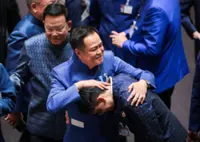
BANGKOK: Prime Minister and Interior Minister Anutin Charnvirakul chaired a meeting at Parliament of the Joint Management and Monitoring Centre for the Situation in the Middle East to address fuel shortages reported at petrol stations on Thursday (March 19).
Representatives from key state agencies and the private sector joined the talks, including the Finance Ministry, Energy Ministry, Interior Ministry, Commerce Ministry, Justice Ministry, Transport Ministry, the Budget Bureau, the National Economic and Social Development Council (NESDC), refinery operators, Section 7 oil traders, and wholesale fuel distributors, or jobbers.
At the start of the meeting, Anutin thanked all parties for attending the afternoon session amid the conflict in the Middle East, which he said was showing signs of becoming prolonged and was likely to affect both the global economy and Thailand to some degree.
He said the government had already adjusted its energy measures to better reflect the situation, including setting a new ceiling for diesel prices, announcing fuel prices to prevent consumers from being exploited, promoting biofuels, and extending delivery times for transporting fuel to service stations.
He said all of these measures were aimed at ensuring motorists could continue buying fuel in the same way they could before the war in the Middle East broke out.
"We are trying to restore fuel distribution to the conditions seen before March 1, when there were no problems.
"On pricing, we have allowed market mechanisms to operate, while the government has sought measures to minimise the impact on the public as much as possible.
"But there are still operational problems, particularly at local level, where people have reported difficulty accessing fuel smoothly and remain concerned about whether supplies are sufficient," Anutin said.
He stressed that Thailand had not, so far, faced any problems with oil reserves or crude procurement, adding that the country was still able to order and import crude from multiple regions around the world.
There was, he said, no sign or indicator suggesting that Thailand’s oil imports would decline.
"Today’s problem is that people are worried even though supply has not fallen. It is similar to cash machines, which need time to be refilled.
"We cannot keep every petrol station fully stocked all the time because there is a delivery cycle.
"So the government will step in on this point. We will find ways to make people feel confident," he said.
Anutin said one of the urgent issues to be discussed at the meeting was easing time restrictions on fuel tanker access to Bangkok, allowing them to enter the capital at any time.
He said the government had already sought cooperation from the national police chief on the matter and regarded it as an important policy aimed at creating public understanding and improving distribution.
On fuel pricing, he said the meeting would have to set out a clear structure covering refinery gate prices, retail pump prices and prices charged through intermediaries or jobbers, with all levels required to remain aligned.
He added that industrial buyers would also have to discuss appropriate supply volumes and pricing.
Anutin said the actions being taken were intended to clearly implement the centre’s resolutions, which would later be published in the Royal Gazette so they would carry legal force and give those responsible for enforcement confidence in carrying out the measures. - The Straits Times/ANN