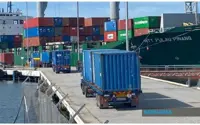
BANGKOK: Thai exports to the Middle East by sea have come to a complete standstill as the escalating conflict between the United States and Israel on one side and Iran on the other disrupts key shipping routes, according to the Thai Chamber of Commerce.
Dr Visit Limlurcha, Vice-Chairman of the Thai Chamber of Commerce, told Thansettakij that the intensifying conflict, which shows signs of becoming prolonged, was having a direct impact on cargo transport to the Middle East, particularly maritime routes that pass through strategic points in the region.
At present, Thai exporters are unable to ship goods to the Middle East by sea because shipping lines have suspended all cargo bookings over safety concerns.
“Right now, nothing can be shipped by sea. It is at zero because shipping lines do not dare operate and are not accepting container bookings,” Dr Visit said.
Shipping freeze hits Thai exporters
The Middle East is an important market for Thailand, accounting for around 4% of the country’s total exports. Key export products include vehicles and auto parts, agricultural goods, processed food, canned fish, and processed fruit and vegetables. Thailand’s main markets in the region are the United Arab Emirates, which uses Jebel Ali Port as a distribution hub, and Saudi Arabia.
However, Jebel Ali Port, Thailand’s main receiving point for goods bound for the region, has become one of the areas affected by attacks since the early stages of the conflict, prompting most shipping lines to suspend operations immediately.
For goods already in transit, exporters now face two options: bringing the goods back to Thailand, which would mean paying freight charges for both the outbound and return journeys, or storing them at ports near the destination market while waiting for the situation to improve.
Conflict risk costs and oil prices rise
Both options involve additional costs, particularly conflict risk insurance, which would rise immediately if shipping services resume. Preliminary rates have been set at about US$2,000 for a 20-foot container, US$3,000 for a 40-foot container and US$4,000 for a refrigerated container.
“Freight rates have risen somewhat, but not by much. The heaviest burden is the conflict risk insurance premium,” Dr Visit said.
At the same time, global crude oil prices have surged to around US$110 a barrel within just one week of the outbreak of war, amid concerns over the security of energy supplies from the Middle East.
Energy costs are a major burden for industry, particularly logistics and heavy manufacturing, where they account for around 2% to 10% of production costs. Higher oil prices also affect fertiliser and chemical prices, both by-products of the petroleum industry, raising the likelihood of higher production costs for agricultural and food goods.
Air freight offers only limited relief
Dr Visit said Thai exports to the Middle East could still move by air in the short term, but this option came with significant constraints. Airlines have only just begun gradually resuming flights, while air freight costs are many times higher than sea freight.
As a result, air transport is only suitable for high-value or perishable goods, such as fresh food, and whether trade can continue will depend on whether buyers and sellers are willing to absorb the higher costs.
China talks seen as possible opening
One of the main hopes for Thai exporters lies in ongoing negotiations between China and Iran. If those talks succeed and allow Chinese shipping lines to resume sailing on Middle East routes first, Thailand may be able to use Chinese carriers as an alternative channel to re-enter the market.
“If Chinese ships can resume sailing first, Thailand will still have a chance to export goods there, but it will depend on whether the higher costs are bearable,” Dr Visit said.
The overall economic risk assessment suggests that if the conflict eases within one month, the impact on global trade and Thai exports would remain limited and recovery could come within six months. However, if the conflict drags on, the consequences could become far more severe. The Middle East market, which accounts for about 4% of Thai exports, could lose half its value or disappear entirely for a period.
In response, the public and private sectors are discussing the establishment of a conflict room, or trade monitoring centre, for the Middle East to coordinate information with Thai trade offices abroad. The aim is to monitor developments in real time and prepare to resume exports immediately once shipping routes reopen.
As part of a longer-term strategy, the private sector has proposed that Thailand accelerate export market diversification to reduce dependence on any single market, while also stepping up free trade agreement negotiations to open new markets. Businesses are also being urged to adapt more quickly in areas such as energy and sustainability, including greater use of renewable energy and solar power, to reduce risks from global energy volatility.
“In the long run, we cannot rely solely on state energy subsidies because the Oil Fuel Fund also has its limits. Businesses must adapt themselves to cope with global uncertainty,” Dr Visit said. - The Nation/ANN