
Chinese Vice-Premier Ding Xuexiang has acknowledged it is no “easy task” to truly implement Hong Kong’s executive-led governance system, stressing that it must be a “shared responsibility” of the legislative and judicial branches and society as a whole.
The state leader also urged the city to “grasp” the opportunities of China’s 15th five-year plan as he highlighted key areas such as quantum technology, aerospace and the low-altitude economy, while calling on local entrepreneurs to proactively participate in the development of the Northern Metropolis, according to attendees at a meeting with him on Friday.
Ding, head of the Central Leading Group on Hong Kong and Macau Affairs, said an executive-led governance system was “important and essential” for the city to align with the country’s 15th five-year plan and advance its integration with mainland China.
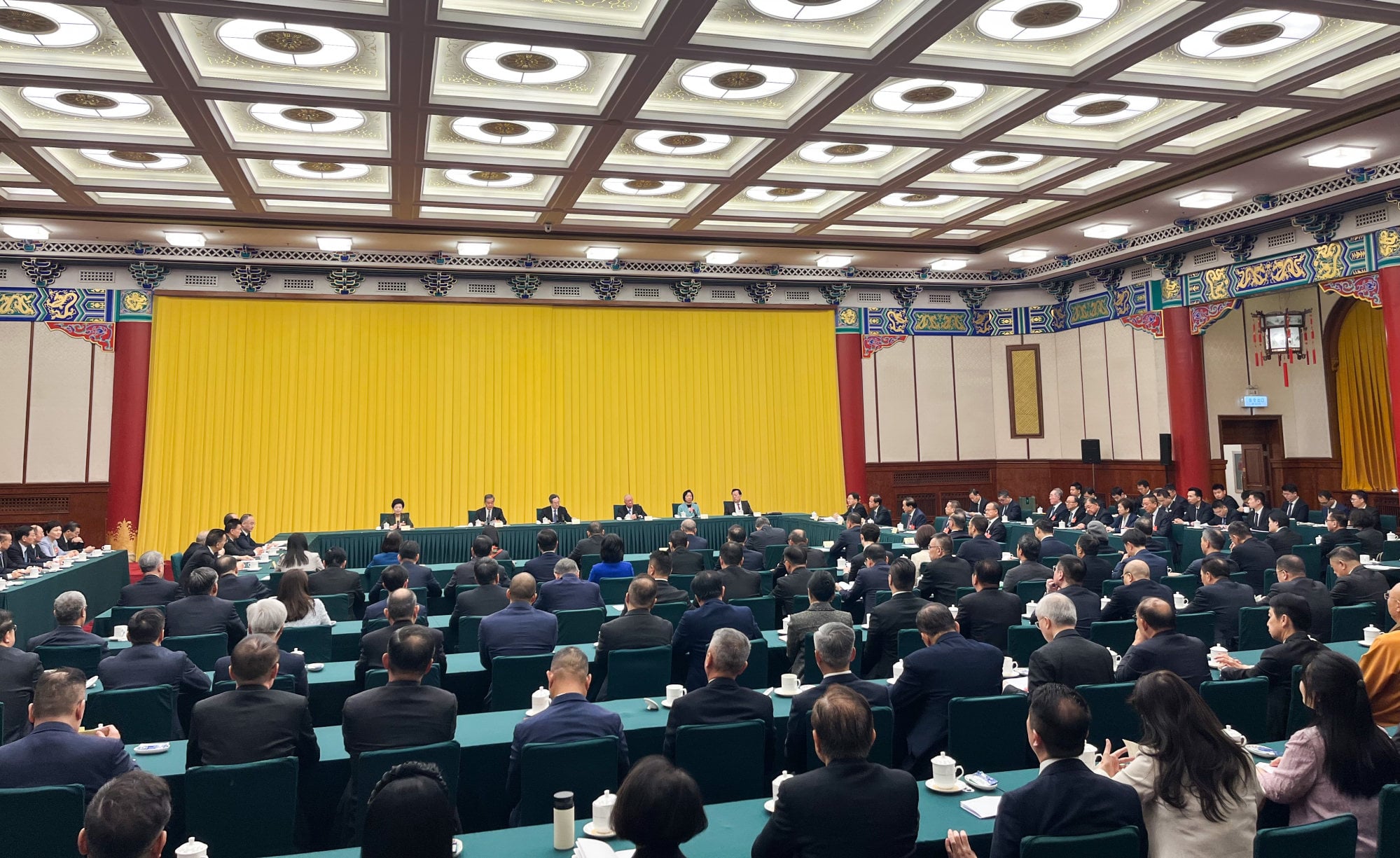
“To genuinely implement [the executive-led system] is not easy,” Ding said at the two-hour meeting with Hong Kong and Macau members of the Chinese People’s Political Consultative Conference (CPPCC), the country’s top political advisory body.
“It requires the chief executive and the government to strengthen their sense of being the head [of the city], and will need coordination from all sectors of society.”
Ding, the sixth-ranked Politburo Standing Committee member, added that putting the executive-led system into effect also required support from the legislature and judiciary.
“[Implementing] the executive-led governance is not just the business of the chief executive. It is also the shared duty of the Hong Kong and Macau governments, the public of Hong Kong and Macau and all sectors of society,” he said.
In a government work report delivered on Thursday, Chinese Premier Li Qiang called on Hong Kong to boost its governance efficiency and leverage its “unique strengths” of enjoying the country’s support while maintaining global connections.
Beijing has repeatedly urged Hong Kong to strengthen its executive-led governance model since Chinese President Xi Jinping delivered the message during a meeting with Chief Executive John Lee Ka-chiu in Beijing last December.
In January, Xia Baolong, director of the Hong Kong and Macau Affairs Office, also called on the city to enhance its executive-led governance model, saying the legislative and judicial branches should perform “on the same stage”.
Henry Tang Ying-yen, a member of the CPPCC Standing Committee, said Ding had encouraged local delegates to provide better support and help the chief executive and government implement the executive-led system.
“[He has said that the model] is a vital lifeline for ‘one country, two systems’. Losing the executive-led system will affect society as a whole,” he said.
“Ding has not said we did not perform well, but instead encouraged us to continue to support and participate [in the process].”
Tang added that Ding had urged Hong Kong to “grasp the opportunities” of the latest five-year plan, which sets out the nation’s economic and social development targets between 2026 and 2030. The city should be bold enough and know how to seize those many opportunities, the state leader reportedly said.
Tang, a former Hong Kong chief secretary, said that the city’s own five-year plan, to be set by the incumbent government, should be followed by the next administration for policy continuity.
He added that Ding concluded the city government had appropriately handled the aftermath of the Tai Po blaze, which killed 168 people last November.
CPPCC member Johnny Ng Kit-chong said Ding had highlighted several areas with immense potential for Hong Kong and the nation, including quantum technology, aerospace, the low-altitude economy and embodied intelligence.
“[Ding said] finance is essential for developing high-end technology, which highlights Hong Kong’s critical role in I&T financing,” Ng said.
“He added that Hong Kong attracts a large pool of high-calibre talent, which is essential for I&T.”
Ng added that Ding had encouraged the city’s entrepreneurs to invest more proactively in the innovation and technology sector, even as many had traditionally focused on and succeeded in the real estate business.
According to several local delegates who spoke on condition of anonymity, Ding had urged them to fully support the development of the Northern Metropolis, including active participation and investment in the megaproject, particularly among the entrepreneurs attending the meeting.
Another member said Ding had flagged that Hong Kong’s investment in scientific and research equipment remained insufficient.
Lau Siu-kai, a consultant to the semi-official Chinese Association of Hong Kong and Macau Studies think tank, said Ding could be referring to political opposition when he said implementing an executive-led system was not easy.
But he said political obstruction had been minimised following the “patriots-only” electoral revamp, noting that another obstacle would be whether the executive branch could enhance its capability.
“The missions of formulating the city’s five-year plan and promoting Hong Kong’s integration into national development are arduous,” he said. “The chief executive and the government should showcase the advantages of an executive-led system and improve governance efficiency.”
Lau suggested that top officials should strengthen their ability to formulate strategies and policies, as well as to coordinate internal and social resources in implementing them.
He added that society, including professional sectors, should support the overall development direction, while the business sector, with its financial resources, also had a role to play.
At last year’s meeting, Ding asked Hong Kong to make use of its resources to support the nation’s technological advancement, reiterating Beijing’s strong commitment to the city’s role as an international financial centre.
He also urged the city to remain confident amid economic challenges while staying alert to potential national security risks.
Zhou Ji, director of Beijing’s liaison office in Hong Kong, on Thursday described the 15th five-year plan as offering the city “new historical opportunities” as he addressed the city’s deputies of the National People’s Congress.
Zhou urged the city to “focus its efforts on managing its own affairs well” and to uphold and improve the executive-led system.
He called for Hong Kong to fully support the city leader and his administration in continuously improving governance efficiency while promoting economic and social development.