BEIJING: China cast itself as a “responsible major power” and warned that no country should dominate international affairs, as the country’s annual Two Sessions opened on March 4 against the backdrop of ongoing US-Israeli military strikes in Iran.
“China calls for an immediate cessation of military operations, prevention of further escalation of tensions, resumption of dialogue and negotiations, and maintenance of peace and stability in the Middle East,” said Lou Qinjian, a spokesman for the National People’s Congress (NPC), China’s Parliament, at an annual press conference.

“China is willing to continue playing its role as a responsible major power in this regard,” he added.
Lou was asked for China’s reaction to US military actions in Iran, Venezuela and potentially Greenland, and the increasing propensity for unilateralism and the use of force. He avoided criticising the United States by name.
“No country has the right to control international affairs, dictate the fate of other nations, or monopolise development advantages, much less act arbitrarily in the world,” he said.
While China is not directly involved in the Iran conflict, which entered its fifth day on March 4, Beijing has significant energy stakes in the crisis. China is the main buyer of Iranian oil, which accounts for about 13 per cent of its crude imports, and roughly one-third of its oil supplies pass through the Strait of Hormuz, a key maritime chokepoint off Iran.
Asked about China’s relations with Japan and other neighbouring countries, Lou reiterated that the Taiwan issue is China’s internal affair and “the core of China’s core interests”, saying Beijing “firmly opposes” what it described as erroneous remarks by Japanese leaders on the self-governing island.
Relations between Japan and China have deteriorated sharply after Japanese Prime Minister Sanae Takaichi suggested in 2025 that a Chinese attack on Taiwan could trigger a Japanese military response.
On US-China ties, Lou said that the overall relationship between the two countries has remained “stable and positive”, but did not give further details of an expected meeting between Xi and US President Donald Trump in China.
The White House has said Trump will visit China from March 31 to April 2, but the Chinese government has not confirmed the dates, and would say only that both sides “remain in communication” over the summit.
US and Chinese trade negotiators are reportedly set to meet in Paris in mid-March to discuss potential deals, including the sale of Boeing passenger planes, ahead of the leaders’ meeting.
China’s Two Sessions is the country’s most important political event. It involves concurrent annual meetings of the NPC, which will last from March 5 to March 12, and the Chinese People’s Political Consultative Conference (CPPCC), the country’s top political advisory body, which kicked off on March 4 and will end on March 11.
Thousands of delegates from across the country have gathered in Beijing to pass Bills, deliberate proposals and set development targets. They will review the government work plan for 2026 and China’s 15th Five-Year Plan, a sprawling blueprint outlining socio-economic goals from 2026 to 2030, including efforts to boost consumption and support high-tech industries.
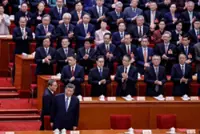
Despite the grey skies and driving snow, the CPPCC meetings opened on March 4 with the usual fanfare and President Xi Jinping in attendance.
CPPCC chairman Wang Huning, No. 4 in the politburo standing committee, urged the more than 2,000 delegates to “truthfully reflect public opinion on key issues in areas such as economic development, technological innovation, reform and opening up, social development, and people’s livelihoods”.
While the CPPCC holds little political power, it debates and advises on a range of political and social issues, and has touched on pollution and poverty alleviation in the past.
Its members come from a range of backgrounds, and include entrepreneurs, scientists and celebrities, with television drama actor Jin Dong among the delegates in attendance this time around.
However, there were also a number of notable absentees at the CPPCC opening on March 4.
Missing from the second row of the stage, where they would normally sit alongside Mr Xi, were Zhang Youxia and He Weidong, two of China’s highest-ranking generals who are under investigation, and Ma Xingrui, formerly the party’s top official in the western region of Xinjiang, who has not been seen in public since October 2025.
Days before the meeting, three retired military generals, including a former commander of the People’s Liberation Army ground force, were also voted out of the CPPCC. No reason was given for their removal. - The Straits Times/ANN