
SINGAPORE: With the local medical school intake increasing by more than a quarter over the past decade, the proportion of foreign-trained doctors in Singapore’s medical workforce has consequently declined and stabilised at about 40 per cent, with more than half comprising Singaporeans returning home to work here.
The Ministry of Health (MOH) and Singapore Medical Council (SMC) jointly announced on Jan 27 that another eight overseas institutions would be added to the list of recognised universities for medicine in Singapore, bringing the total from 112 to 120.
The move “will allow Singapore to better meet the growing demand for doctors as our population ages”.
This is also the second consecutive year that more medical schools are being recognised by Singapore, a move that runs counter to the massive cut in January 2020.
In 2019, MOH accepted SMC’s recommendation to trim more than 35 per cent of recognised medical schools, shrinking the pool from 160 to 103 schools.
The changes included halving the recognised schools in Canada from 14 to seven, and China from eight to four, as well as dropping those in the US from 38 to 30, Japan from eight to three, and India from nine to two.
Five countries had their recognised medical schools totally delisted – Israel, Italy, Norway, Pakistan and Sri Lanka.
Explaining the rationale then, MOH said the total annual intake at local medical schools had risen to about 500 in 2018, and the impact would be fully realised from 2023 when these students graduate, and hence, “we expect our need to recruit overseas-trained doctors to moderate and stabilise in the coming years”.
But demand has not abated for doctors, even as their numbers continue to grow.
In response to queries by The Straits Times about its move to expand the list of recognised institutions, MOH said it expects the trend of increasing numbers of doctors to continue as society ages and demand for healthcare rises.
For Singapore to meet its healthcare needs, “we will need to augment our core of local doctors, with a minority of foreign doctors trained overseas”, added MOH.
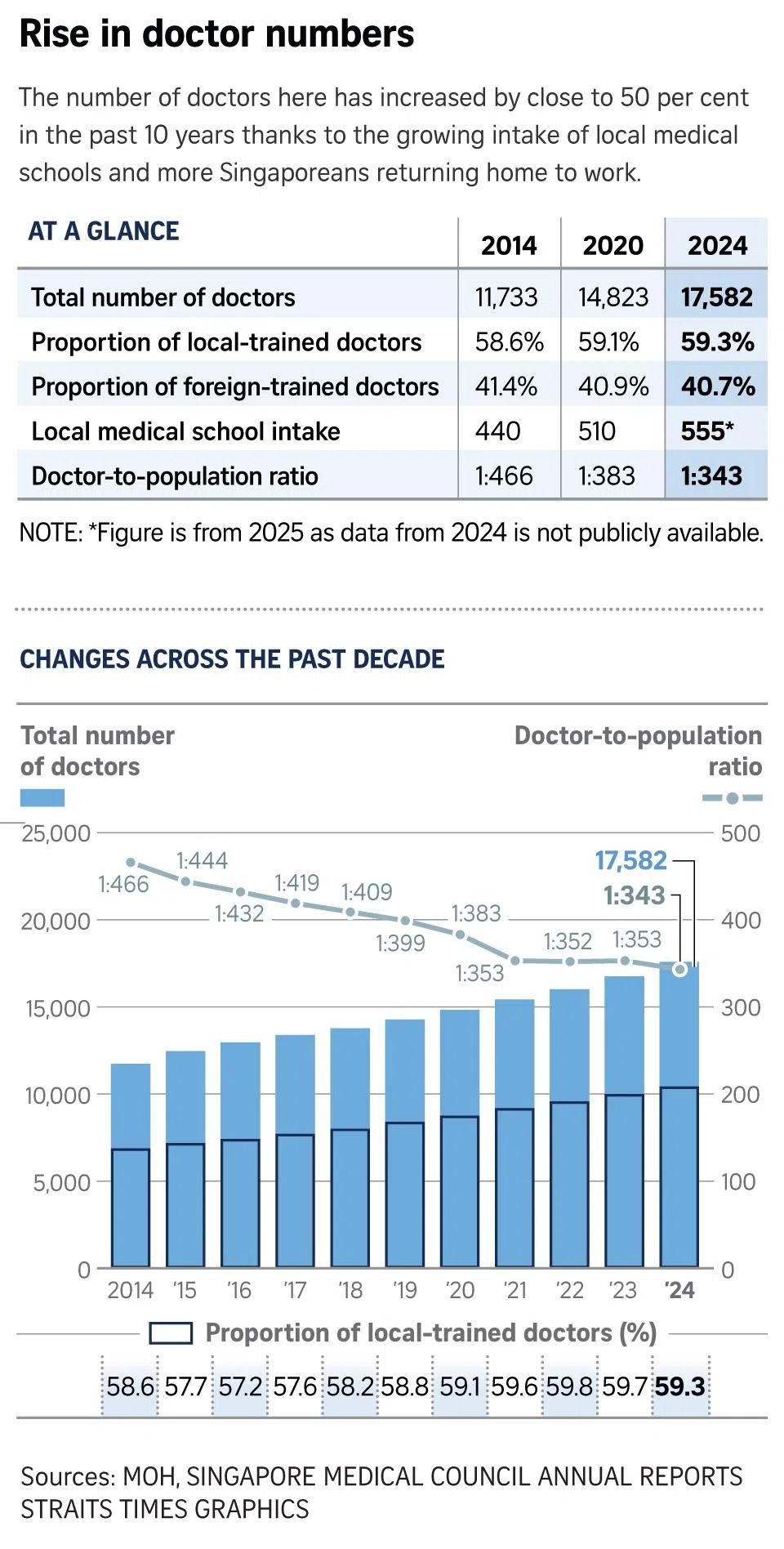
SMC’s latest annual report, published in September 2025, showed that the total number of registered doctors reached 17,582 at end-2024.
This marked an increase of nearly 50 per cent from the 11,733 registered doctors as at end-2014.
With more doctors here, the medical practitioner-to-population ratio has also decreased from one doctor to 466 people in 2014, to one doctor to 343 people in 2024.
The population figure refers to both residents (Singaporeans and permanent residents) and non-residents (foreigners working, studying or living in Singapore without permanent residence status), and excludes tourists and short-term visitors.
The supply of doctors here comes from a growing intake among local medical schools over the years, as well as Singaporeans returning home and foreigners coming here to work.
There are currently three medical schools in Singapore – the Yong Loo Lin School of Medicine at the National University of Singapore, Duke-NUS Medical School, and the Lee Kong Chian School of Medicine at Nanyang Technological University, which was established in 2010.
The combined intake across the schools was around 320 in 2010, around 440 in 2014, and rose to 510 in 2019.
In 2020 and 2021, another 40 medical students were admitted each year when their overseas medical studies were disrupted by the Covid-19 pandemic.
The most recent intake in 2025 was 555 – an increase by a quarter over the past decade.
MOH said the local intake forms “a base to meet our national medical manpower needs”, though it did not reveal if there are plans to increase the intake in the near future and if there are constraints in raising the intake much further.
More than half of foreign-trained doctors here are Singaporeans
Foreign-trained doctors working in Singapore comprise Singaporeans educated and trained in overseas medical schools who returned here to practise medicine, as well as foreigners who chose to pursue their medical careers here.
Of the 17,582 registered doctors, around 78 per cent are Singaporeans, 15 per cent are permanent residents, and the remaining 7 per cent are foreigners.
Close to 60 per cent of doctors here were trained locally. Among the 7,150 foreign-trained doctors, more than half are Singaporeans, and more than 31 per cent are permanent residents.
The proportion of foreign-trained doctors in Singapore has remained largely stable in recent years, at about 40 per cent.
Notably, the proportion went from 36.4 per cent in 2011 to 41.4 per cent in 2014, and reached its peak at 42.8 per cent in 2016 before declining and stabilising.
MOH told ST that foreign-trained doctors are typically granted conditional or provisional registration and have to work under supervision or complete their training before they can be fully registered.
It also said that foreign doctors bring diverse clinical perspectives, experiences and best practices from their overseas training.
It noted that medicine is one of the few professions in Singapore where local professional bodies regulate entry to the profession, based on recognition of universities, on top of the mainstream Employment Pass system.
“This approach doubly ensures that doctors who care for our patients are trained up to certain standards, thereby safeguarding public health and safety”, said MOH.
Graphic on rise in number of doctors in Singapore.
Newly recognised schools include two whose international rankings dipped in 2025
In the January 2026 announcement, MOH and SMC said that factors in deciding which schools to recognise include the school’s international ranking, if the language of instruction is English, as well as the performance of doctors from these universities.
Based on the Britain-based Quacquarelli Symonds (QS) World University Rankings of all medical schools, six of the eight newly recognised schools had either improved their QS ranking or maintained them in the same range.
However, Aga Khan University Medical College in Pakistan and Manipal Academy of Higher Education’s Kasturba Medical College in India saw their rankings in the range of 201 to 250 in 2024 drop to a range of 251 to 300 in 2025.
QS rankings by subject are compiled from data such as student experience, university partnerships, research activity and faculty qualifications.
When asked about this, MOH reiterated that apart from international rankings, SMC also considered factors such as the performance track record of doctors from these universities and whether the language of instruction is compatible with local practice.
MOH also said that “listing of an overseas medical school does not mean we are actively targeting doctors who graduated from there”.
Separately, “if the foreign doctors are from reputable medical schools with good standards, we should not reject them”, added the ministry. - The Straits Times/ANN