SINGAPORE: The authorities in Bangladesh have frozen the bank accounts of a naturalised Singaporean billionaire amid probes into business dealings.
Muhammed Aziz Khan, who is originally from the South Asian country, and members of his family and their associates have had their bank accounts frozen and their land seized in Bangladesh over money laundering allegations, claims which the businessman denied in comments to The Straits Times.
Khan confirmed that he has been contacted by the Anti-Corruption Commission, Bangladesh Securities and Exchange Commission, Registrar of Joint Stock Companies and Firms and the income tax authorities.
“Our people are supporting the government of Bangladesh’s any inquiry, as we are supposed to... We are fully supportive of their inquiry because we know we will come out smelling of roses,” added Khan.
He said that no charges have been brought against him and his companies, adding: “As of now, there are no cases against me or my companies in Bangladesh.”
Khan’s brother, who was the civil aviation and tourism minister in Bangladesh, was arrested in 2024 in connection with the alleged murder of a political activist and is currently in jail awaiting his trial.
Khan had appeared on Forbes’ 2025 list as Singapore’s 49th-richest person, with a net worth of US$1.1 billion (S$1.42 billion).
The 70-year-old is the chairman of Summit Group, which has interests in power, ports, fibre optics and real estate, all in Bangladesh.
His flagship company is Summit Power International, a Singapore-based business incorporated in 2016 and currently located at One Raffles Place. It describes itself as “a leading infrastructure developer and operator in South Asia”.
In 2019, Japanese energy giant JERA Co bought a 22 per cent stake in Summit Power International for US$330 million, valuing the company at US$1.5 billion.
Khan, who has director or shareholder positions in 10 other active companies in Singapore, first arrived here in the 1970s as an 18-year-old Master of Business Administration graduate.
He worked for a company dealing in thermoplastics and other goods before setting up a company, and eventually widened his business ventures to include the export of fertiliser and molasses, before later pivoting to power generation.
Khan established the first independent power plant in Bangladesh in 1997. Summit Power International now operates 11 power plants as the nation’s largest independent power producer.
He became a Singapore permanent resident in 1988. ST understands that he became a Singapore citizen some time between April 2023 and February 2024.
According to his biography on the Summit Power International website, Khan is a member of the Unicef International Council. He also served as the honorary consul general of Finland to Bangladesh from 2016 to 2025.
Khan’s recent issues began in 2024, following the ouster of former prime minister of Bangladesh Sheikh Hasina.
Student-led protests brought an unexpected end to her rule in August 2024, with Hasina leaving for India.
She was sentenced to death in absentia in November 2025 for ordering a deadly crackdown on protesters. Hasina was also later found guilty of corruption.
Dr Muhammad Yunus, the 2006 Nobel Peace Prize winner, succeeded her as interim leader in August 2024, but he will soon make way for Tarique Rahman following the Bangladesh Nationalist Party’s victory in the Feb 12 general election.
Khan is not the only Bangladeshi-born Singaporean being investigated by the authorities there.
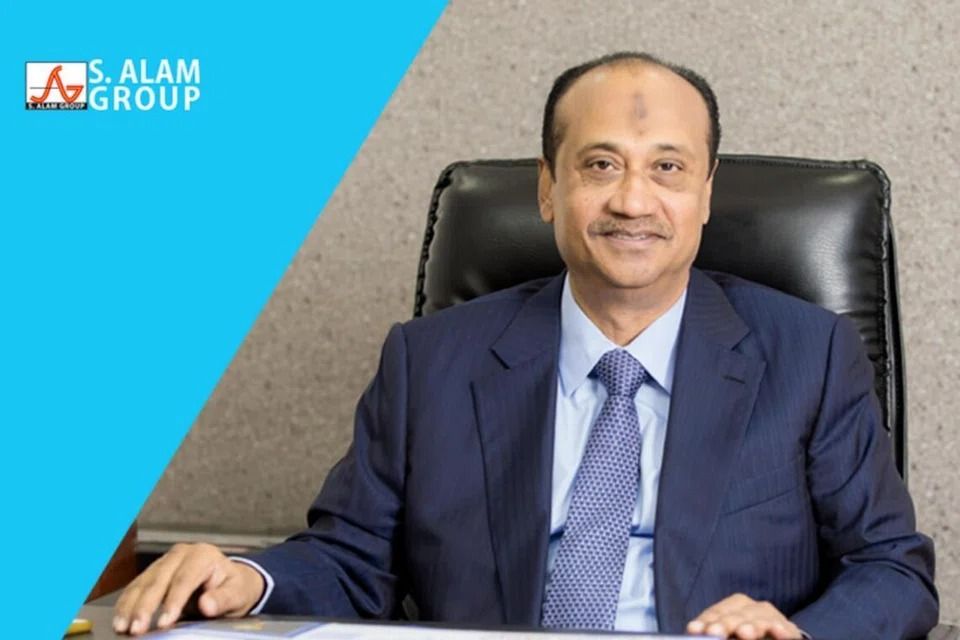
Billionaire Saiful Alam Masud and his family are also being investigated by the authorities in Bangladesh.
Alam is the founder and chairman of the S. Alam Group, which is involved in industries as diverse as food, manufacturing, energy, transportation, real estate and telecommunications.
The businessman, or entities linked to him, also owns several hotels and a commercial property in Singapore and Malaysia.
Alam, members of his family and their associates, particularly those linked to the S. Alam Group, have seen financial crime cases filed against them.
The courts in Dhaka have also suspended an order from the previous Hasina administration that permitted Alam to voluntarily renounce his Bangladeshi citizenship.
They have also ordered the Anti-Corruption Commission to request Interpol Red Notices against Alam and members of his family.
S. Alam Group founder and chairman Saiful Alam Masud, members of his family and their associates, particularly those linked to the group, have seen financial crime cases filed against them.
His American lawyers from Quinn Emanuel Urquhart & Sullivan have hit back by filing an international arbitration claim with the World Bank’s International Centre for Settlement of Investment Disputes in Washington.
They say their client is the victim of a “targeted campaign of arbitrary asset freezing, confiscation and value destruction”.
Alam’s lawyers from Singapore firm WongPartnership told ST that their client had suffered “grave economic” and “severe reputational damage” as a result of the “unlawful, arbitrary and discriminatory” actions and will quantify the damages “at the appropriate juncture”.
According to media reports, there has been a crackdown on individuals and business conglomerates perceived to be connected to the Hasina administration.
In December 2025, the National Coordination Committee on the prevention of money laundering and recovery of laundered funds revealed that it had seized assets worth 66,146 crore Bangladeshi taka (S$683 million) from 10 major business groups, including Summit and S. Alam Group, and members of Hasina’s family.
It comes 12 months after a White Paper commissioned by Dr Yunus found that during Hasina’s second stint as prime minister, which lasted over 15 years, an estimated US$234 billion might have been illegally siphoned out of the country.
The Yunus administration cancelled a liquified natural gas project with Khan’s Summit Group after the venture was flagged in the White Paper in December 2024.
In a press release, the company said: “Summit Group has always respected and adhered to the laws of both Bangladesh, where Summit Corporation Limited operates, as well as Singapore, where Summit Power International is domiciled.”
The White Paper identified Summit Group as one of “selected large conglomerates” which enjoyed “exemptions on project income” and an “exemption on income arising from power generation”.
Summit Power International rebutted that claim, saying that “these exemptions were not exclusive to Summit Group but were reflective of a sector-wide strategy to enhance Bangladesh’s energy capacity”.
Since 2025, the courts in Bangladesh have ordered the seizure and freezing of more cash and assets belonging to Khan and his family members, including €4.1 million (S$6.1 million) worth of Khan and his family’s shares in Luxembourg, and at least 41.74 crore Bangladeshi taka and 38,800sq ft of land in Bangladesh.
Khan added that the ongoing investigations and legal actions in Bangladesh have not had a detrimental impact, noting that “for each of our businesses, it has gotten better”.
However, they have had ramifications for his future plans.
He said: “The whole world is crying for electricity. Bangladesh has excess electricity. We want to build data centres...
“We can do that with an investment of about $1 billion. We are not being able to process that. That, in my opinion, is the biggest challenge to our business and our intention of removing data poverty in Bangladesh... In the past, we have removed electricity poverty of the country...
“The current situation is delaying the process.”
Khan said he has not been contacted by the Singapore authorities regarding his legal issues in Bangladesh.
ST reached out to the Anti-Corruption Commission for more details on its investigations into and cases against Khan and Alam, but did not receive a reply.
ST also sent queries to Singapore’s Ministry of Home Affairs about the allegations and cases pertaining to both individuals, and also asked if it has received requests for legal assistance from the Bangladeshi authorities.
The ministry referred ST to the statement it provided in 2024.
It said then: “Under the Mutual Assistance in Criminal Matters Act, Singapore can provide mutual legal assistance to foreign jurisdictions, including through information sharing on the movement of assets and the enforcement of foreign confiscation orders.
“Singapore authorities also work together with foreign authorities on issues of asset sharing and the return of assets on a case-by-case basis.” - The Straits Times/ANN