
HO CHI MINH CITY (VNExpress): As the Lunar New Year (Tet) approaches, workers are braving the heights of Ho Chi Minh City skyscrapers to paint, repair, and wash windows, earning approximately VND800,000 (US$31) a day for their high-stakes labour.
A team of workers suspend themselves from a 17-story tower to apply a waterproof coating to the building's exterior on Jan. 24.
Among them was 32-year-old Truong Van Luu (L), who noted that the weeks leading up to Tet are the most lucrative of the year. During this pre-holiday rush, many buildings undergo extensive maintenance and major clean-ups, providing high-rise painters with their busiest and most stable period of income.
On the rooftop, workers secure thick ropes to heavy anchor points before rappelling down the side of the building to begin their shift. Before accepting any contract, the team carefully inspects the strength and stability of rooftop pillars to ensure they can withstand the rigorous demands of the descent.
The standard safety setup consists of two support ropes and a dedicated lifeline, each engineered to bear a load of approximately 2,000 kg. Tran Truong Sinh, 28, emphasized the critical nature of this equipment, noting that the lifeline is the most vital component because it serves as the final fail-safe should any part of the primary system fail.
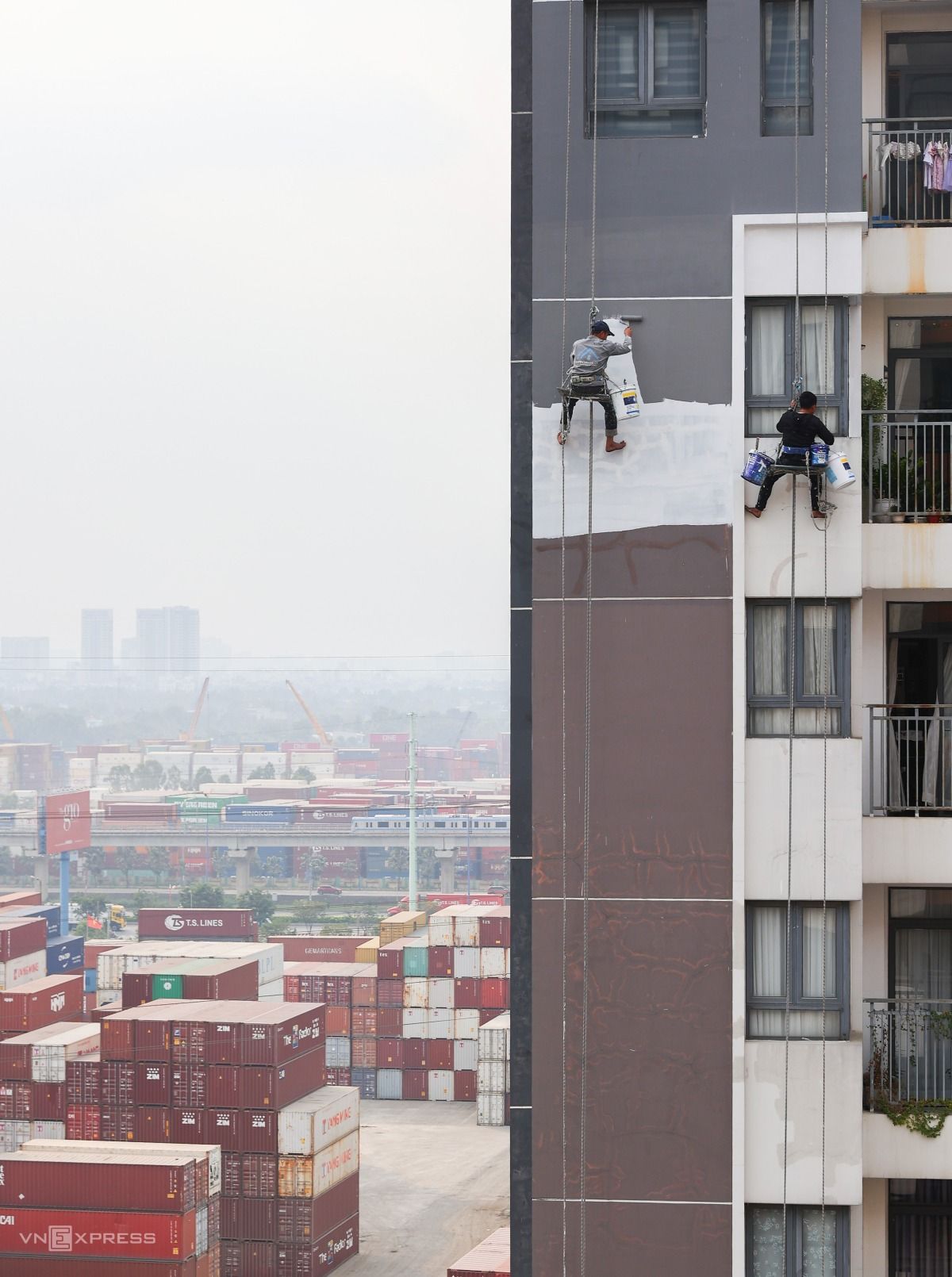
Every time the workers ascend, descend, or shift positions, they must meticulously recheck every rope and connection, as even a minor oversight could prove fatal.
Once Da was securely positioned in his seat, his teammates lowered the paint buckets down to him to begin the application.
“When I first started, I took a one-week occupational safety course, but I was still terrified the first time I hung from a building, even at a low height,” said Da, an ethnic Khmer worker who, at 27, is the youngest member of the team.
Now a veteran with four years of experience, he explained that he only transitioned to skyscrapers after gradually building his confidence and skills on smaller structures.
A typical team consists of approximately five workers who rotate through the grueling shifts on the ropes. While their base pay is around VND800,000 per day, they often supplement this income by taking on additional painting and repair tasks requested directly by building residents.
Sinh, a veteran with over 10 years in the trade, noted that the demand during this period is relentless. "Tet is the busiest time for painting and window cleaning," he said. "We work nonstop every day and sometimes have to turn down jobs because there simply isn't enough time."
Depending on a building's requirements, workers perform a range of tasks including painting, applying waterproof coatings, cleaning walls, and washing windows.
This work is carried out systematically from top to bottom, as the mechanical setup of the ropes is designed primarily for downward movement.
Because of this limitation, technicians must handle corners and edges with extreme precision; if the results are unsatisfactory, the team is forced to re-rig the entire rope system from the rooftop, a process that consumes considerable time and effort.
While cool and calm weather provides the ideal conditions for window cleaning, workers face many physical challenges when the environment shifts. They particularly dread scorching heat, which rapidly drains their stamina, and strong winds, which can cause dangerous swaying while they are suspended hundreds of feet in the air.
Their midday breaks last more than an hour. Meals typically consist of simple boxed rice, while naps are taken wherever space allows: on rooftops, stair landings, or within emergency exits.
Sinh packs away his equipment into storage after finishing work at 5 p.m. Safety regulations prohibit rope-access painters from working after dark.
Despite the inherent risks of the profession, Sinh maintains a disciplined outlook on the dangers he faces daily. “This job is dangerous for everyone who does it, but if safety rules are strictly followed, it can be safe,” he said. - VNExpress