SINGAPORE: Committees formed to conduct Singapore’s Economic Strategy Review (ESR) are asking the Government to take calculated risks and try new ideas to protect growth and jobs as protectionism and technology reshape the global economy.
The five ESR committees, which were formed in August 2025, have submitted a midterm update of their work with seven recommendations.
These included proposals on sustaining economic growth at the higher end of the 2 per cent to 3 per cent average over the next 10 years, as well as suggestions on creating good jobs for Singaporeans and preparing them to take advantage of artificial intelligence (AI).
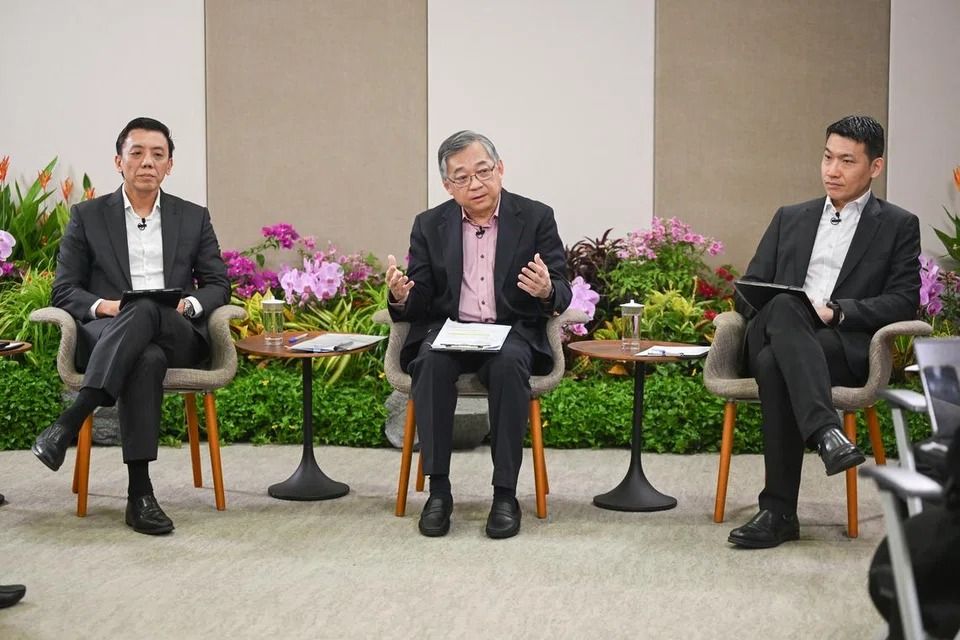
The proposals were unveiled at a Thursday (Jan 29) media briefing chaired by Deputy Prime Minister Gan Kim Yong, Acting Minister for Transport and Senior Minister of State for Finance Jeffrey Siow, and Acting Minister for Culture, Community and Youth and Senior Minister of State for Education David Neo.
The ministers noted that the global economy is going through a fundamental change, where the open trade and investment rules that Singapore has benefited from are giving way to a world shaped by rivalry between major powers, security concerns and national interests.
Meanwhile, businesses and jobs are being disrupted by rapid technological advancements and climate change. In addition, Singapore’s ageing population and falling birth rates mean the Republic will have to contend with slower workforce growth.
DPM Gan, in a separate media interview, said the situation that Singapore now faces is very different from previous crises, such as the Asian financial crisis in the 1990s, the global financial crisis of 2008 and the Covid-19 pandemic.
“Today’s crisis is very different. It is going to be a different world that we are going to emerge from. We are never going to go back to where we were,” said DPM Gan, who is also Minister for Trade and Industry.
“And therefore, some of the recommendations and measures that we need to think about have to be quite different from what we were doing before.”
He said ESR proposals are mid- to long-term in nature and help the Government in planning an economic strategy that allows Singapore to embrace change while remaining competitive and relevant globally. At the same time, they are aimed at making sure economic progress is inclusive and continues to create good jobs.
Below are the seven recommendations developed by the ESR committees after consulting businesses and workers over 60 engagements, events and company visits. The proposals will be finalised by the middle of 2026.
The Government will respond to some of these recommendations during Budget 2026 and when it is debated.
1. Extend global leadership in key growth areas
Singapore is already a global node in key manufacturing sectors, such as semiconductors, healthcare, speciality chemicals and aerospace.
However, rapid technological advancements mean future manufacturing will be more tech-reliant, flexible and sustainable.
To stay ahead, Singapore will need to invest more in AI and automation, as well as emissions-reducing technologies, to transform its manufacturing industry into best-in-class and sustainable operations. It must also direct national-level research and development resources to secure global leadership in high-value industries.
Singapore can also capitalise on its trusted reputation as an open and connected global hub to offer new risk management technologies in modern services, such as cybersecurity; AI assurance; and testing, inspection and certification.
Lim Hock Heng, former vice-president of British pharmaceutical firm GSK and a member of ESR’s global competitiveness committee, said there are opportunities in the challenges associated with the shift in global supply chains.
“Singapore can be more than just a regional hub. We have the chance to become the global benchmark for advanced manufacturing and modern services, a place where the future of the industry takes shape,” said Lim.
2. Pursue emerging opportunities to create new economic growth engines
Emerging technologies in areas such as quantum computing, decarbonisation and space can drive breakthroughs across the economy. To enable these technologies, Singapore should go beyond attracting multinational corporations and nurture a new generation of enterprises and start-ups that dream big and take risks.
Singapore should find new ways of identifying, attracting and supporting these emerging champions to use the Republic as their home base by helping high-potential, fast-growing start-ups gain access to capital and top-tier talent, enabling them to scale globally.
3. Establish Singapore as an AI leader with an AI-empowered economy
Singapore must stay ahead of the curve to capture the transformative power of AI.
While the Republic has embarked on the journey with its National AI Strategies, which had been launched in the past several years, it can do more to position itself as a location of choice for companies and talent to come together to develop, test, deploy, and scale innovative and impactful AI solutions.
Singapore should also push for AI adoption across the economy to drive overall productivity.
4. Strengthen connectivity and linkages to global markets, and support firms to internationalise
The Republic should “aggressively support” leading Singapore firms to expand their businesses abroad and encourage them to take greater risks. Ultimately, these firms will keep Singapore relevant to the global economy and bring back additional revenue and higher-value jobs for Singaporeans at home and abroad.
Marcus Tan, co-founder of Carousell – a leading Singapore-based online classifieds marketplace – said: “My journey with Carousell has proven that backed by Singapore’s strategic ecosystem support, Singapore companies can build the kind of resilient, high-value business models that can compete on the global stage.
“I look forward to helping shape a blueprint that empowers our next generation of founders to punch above their weight and scale into global champions.”
5. Broaden the range of good jobs
To ensure that growth is inclusive and translates into shared progress for all, Singapore should broaden the range of good jobs to meet the aspirations of the people and make the best use of their skills.
Singapore’s AI ambitions will create new technical jobs, such as AI research and engineering, and non-technical roles – for example, project management. However, these roles may be more concentrated in certain sectors.
Hence, Singapore should make efforts to uplift and transform jobs in sectors that may be more resilient to global shifts. These could range from skilled trades, such as technicians, to jobs in care and social services.
6. Make lifelong learning a practical reality
Singapore’s economic transformation will create new roles and reshape existing ones. Hence, workers here will need to be more agile in acquiring new skills, be more proactive in career planning and be entrepreneurial in seizing new opportunities.
This requires Singapore’s skills and training models to be more flexible, blending training and work to develop industry-relevant skills throughout careers. The Republic should also develop a national AI workforce strategy to build AI literacy and fluency across its workforce.
The Government should conduct a review of how it organises itself to provide stronger end-to-end support for Singaporeans in bridging skills to jobs.
7. Enable businesses to proactively navigate transition
Just as workers need to adapt and upskill, businesses must also continually innovate and reposition themselves to remain competitive.
Singapore needs to enable businesses to make transition plans, including rationalising or offshoring parts of their operations to seize new opportunities. - The Straits Times/ANN