MANILA: As a Singapore-flagged cargo ship capsized off Scarborough Shoal, its captain ordered his crew to jump ship amid cargo “liquefaction” and bad weather, an act the Philippine Coast Guard (PCG) hailed as “heroism”.
This account of the instructions of Captain Elimar Jucal, who is still missing, was relayed by sunken bulk carrier Devon Bay’s 15 survivors, who were brought to Manila by PCG ship Teresa Magbanua, which arrived at port early on Jan 26.
The survivors declined interviews, so Captain Alvin Dagalea of the Teresa Magbanua relayed their ordeal after their turnover from the Chinese Coast Guard (CCG) to the PCG.
The crew members “jumped based on the captain’s instruction to abandon the ship”, Capt Dagalea said in an interview with reporters. “He was the last to get out of the ship.”
“The captain was the last to leave before it sank,” he added. “After that, they did not see him again.”
Capt Jucal is among four Devon Bay crew members still missing, while the bodies of two deceased crew members were also brought aboard the Teresa Magbanua.
PCG chief Ronnie Gil Gavan expressed optimism that Capt Jucal could still be found, as the armed service’s BRP Cape San Agustin vessel and the PCG Islander aircraft remain deployed in search and rescue operations for the missing crew members.
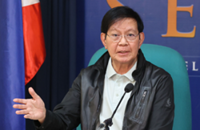
Admiral Gavan hailed Capt Jucal’s “heroism”, calling it “an inspiration to every marine”.
“I want to highlight the heroism of the captain,” he said. “He did not neglect his fellow crew members.”
He added: “It is basic that the captain should be the last to leave his ship and he demonstrated this as expected.”
Bad weather, ‘liquefaction’ blamed
According to Adm Gavan, initial findings suggest that the liquefaction of its cargo and bad weather caused the Devon Bay to capsize on Jan 23, which Capt Dagalea said occurred 60 nautical miles north-east of Scarborough Shoal.
Citing the crew, Adm Gavan said the vessel was carrying 55,000 tonnes of nickel ore. The PCG initially reported the cargo as iron ore.
“The moisture content of the cargo caused the weight to shift to the left, or port side, which is why it listed,” Adm Gavan said.
“And the weather was unfavourable; the waves were quite high,” he added.
Thanks to their split-second decision to jump overboard, the survivors were later rescued by a CCG ship.
They were then received during a turnover operation conducted between the PCG and CCG approximately 161 nautical miles west of Tambobong, Pangasinan.
Capt Dagalea said the CCG deployed five rescue boats, while the PCG launched two rigid-hull inflatable boats to transport the 15 survivors and two cadavers.
“The transfer was very smooth. Both sides were very cooperative,” Capt Dagalea said.
This stands in contrast to previous incidents at Scarborough Shoal that were marked by tensions between the CCG and PCG, including the Aug 11, 2025, collision involving a CCG vessel and a Chinese Navy warship.
Beijing claims sovereignty over almost the entire South China Sea, but Manila took the matter to an international court in 2013, a year after the Scarborough Shoal stand-off.
The landmark international tribunal ruling in 2016 affirmed the Philippines’ sovereign rights over the area. The ruling also recognised Scarborough Shoal as a traditional fishing ground for the Philippines, China and Vietnam.
Despite this, China has continued to enforce what experts call an “exclusion zone” around the shoal, limiting access to Filipino fishermen since its effective takeover in 2012 after the stand-off.
Adm Gavan emphasised that saving lives takes precedence over territorial and jurisdictional disputes. - Philippine Daily Inquirer/ANN