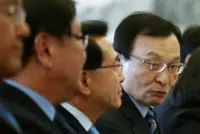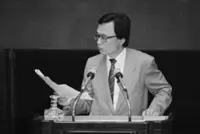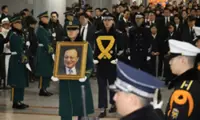
SEOUL/HANOI (Korea Herald/ANN): Lee Hae-chan, a towering figure in South Korea’s liberal politics who rose from a jailed democracy activist to a dominant prime minister, master election strategist and seven-term lawmaker, died Sunday. He was 73.
Across successive Democratic Party administrations — from Kim Dae-jung and Roh Moo-hyun to Moon Jae-in and Lee Jae Myung — Lee played a pivotal role as a strategist, organizer and unifying force within the liberal camp.
Lee, who also served as leader of the Democratic Party, had been executive vice chair of the Peaceful Unification Advisory Council, a presidential consultative body tasked with shaping bipartisan and pan-national policy on democratic and peaceful unification.
Lee collapsed at an airport in Ho Chi Minh City shortly before departure on Friday while traveling to attend a regional advisory committee meeting. He was transferred to a hospital, where only his heartbeat was restored.
"Lee was diagnosed with a myocardial infarction and underwent stent placement, but despite the best efforts of local medical staff, he did not regain consciousness and died at 2:48 p.m. local time on Sunday," the Peaceful Unification Advisory Council said in a statement.
A graduate of Seoul National University’s sociology department, Lee served seven terms as a lawmaker — elected in the 13th, 14th, 15th, 16th, 17th, 19th and 20th National Assemblies — never losing a race, earning him the sobriquet “the king of elections.”
Lee served as education minister under President Kim Dae-jung from 1998 to 1999, as prime minister under President Roh Moo-hyun from 2004 to 2006, and as leader of the Democratic Party in two separate stints, in 2012 and from 2018 to 2020.
In his memoir, "When Dreams Gather, History Is Made," Lee described himself without hesitation as a reformist.
“I never denied that I was a reformist,” he wrote. “Our society must move forward through reform. Doctrinaire class struggle or revolution was never the answer.”
Reflecting on his intellectual foundations, Lee added: “There is a principle I took to heart while studying the history of social thought: learn values from history, but find methods in reality.”
From democratic activist to legislator
Born in 1952 in Cheongyang, South Chungcheong Province, Lee graduated from Seoul National University before becoming a democracy activist in the harsh political climate of the 1970s.
Lee joined the student movement to oppose the 1972 Yushin Constitution — a system that entrenched one-man rule by granting President Park Chung-hee sweeping, near-dictatorial powers — and was imprisoned in 1974 in the National Democratic Youth and Students League case.
Lee's resistance did not end with his release. In 1980, he was again jailed in connection with the fabricated insurrection conspiracy case in which the new military regime accused Kim Dae-jung and other activists of plotting rebellion under North Korean direction.
As a dissident outside institutional politics, Lee ran the “Dolbegae” publishing house in Sillim-dong beginning in 1978. In 1987, he participated as a founding member of The Hankyoreh newspaper.
Lee entered the National Assembly in 1988, winning a seat in the 13th general election in an upset that drew early notice: He defeated Kim Chong-in. Lee was 36.
That same year, a bipartisan agreement in the Assembly led to hearings to uncover the truth about the May 18 Gwangju Democratic Uprising. Lee quickly emerged as one of the proceedings’ breakout figures, earning a reputation for incisive, relentlessly detailed questioning, and was remembered by many as a defining image of democratic-era oversight.
From the 13th through the 20th National Assembly, Lee won seven consecutive elections, recording an unbroken seven-for-seven district victory streak. Lee served five terms in Seoul’s Gwanak district and later two terms in Sejong.
Education reform — and the Lee Hae-chan generation
Lee’s first ascent to the heart of government came in 1998, when he was appointed education minister under President Kim Dae-jung. Lee was tapped to take a scalpel to an education system widely seen as both rigid and corrosively competitive.
Lee reinforced the high-school equalization policy and moved to curb exam-driven schooling, including late-night self-study and frequent testing. Lee also introduced a test-free admissions track, cracked down on corrupt practices such as illicit teacher payments, and lowered the teacher retirement age from 65 to 62.
The reforms, however, produced consequences that critics seized upon. With exam structures dismantled, students often left school early and flowed directly into private tutoring — a shift that, in the public debate, was blamed for deepening class-based learning gaps. The phrase “the Lee Hae-chan generation” entered the lexicon, capturing both the ambition of his reforms and the disruption they caused for a cohort that came of age under the new system.
Prime minister as real power and Sejong city
Lee’s greatest concentration of authority arrived in 2004, when he was appointed prime minister under President Roh Moo-hyun following the resolution of Roh’s impeachment crisis.
From June 2004 to March 2006 — a period that would define his political legacy — he functioned not merely as a presidential deputy but as the government’s chief operating officer.
Under the Roh administration’s unique division of labor, the president focused on long-term strategic leadership while Lee took full command of state administration and policy implementation. By coordinating ministries and driving complex decisions to closure, he effectively popularized the concept of a powerhouse prime minister or "silse chongri" in Korean in South Korea’s modern political lexicon.
One of his most enduring political legacies was the creation and advancement of Sejong City. Lee led the drive for a new administrative capital and, even after the Constitutional Court struck down the original relocation plan, pushed forward an alternative in the form of an administrative-centered city, refusing to let the project stall.
Lee's premiership was also marked by a politically fraught decision that had resisted resolution for nearly two decades: the siting of a nuclear waste repository. Under Lee’s leadership, the government finalized Gyeongju as the site in November 2005, an outcome widely seen as a rare instance of decisive closure on a long-frozen national dispute.
Party leader and architect of continuity
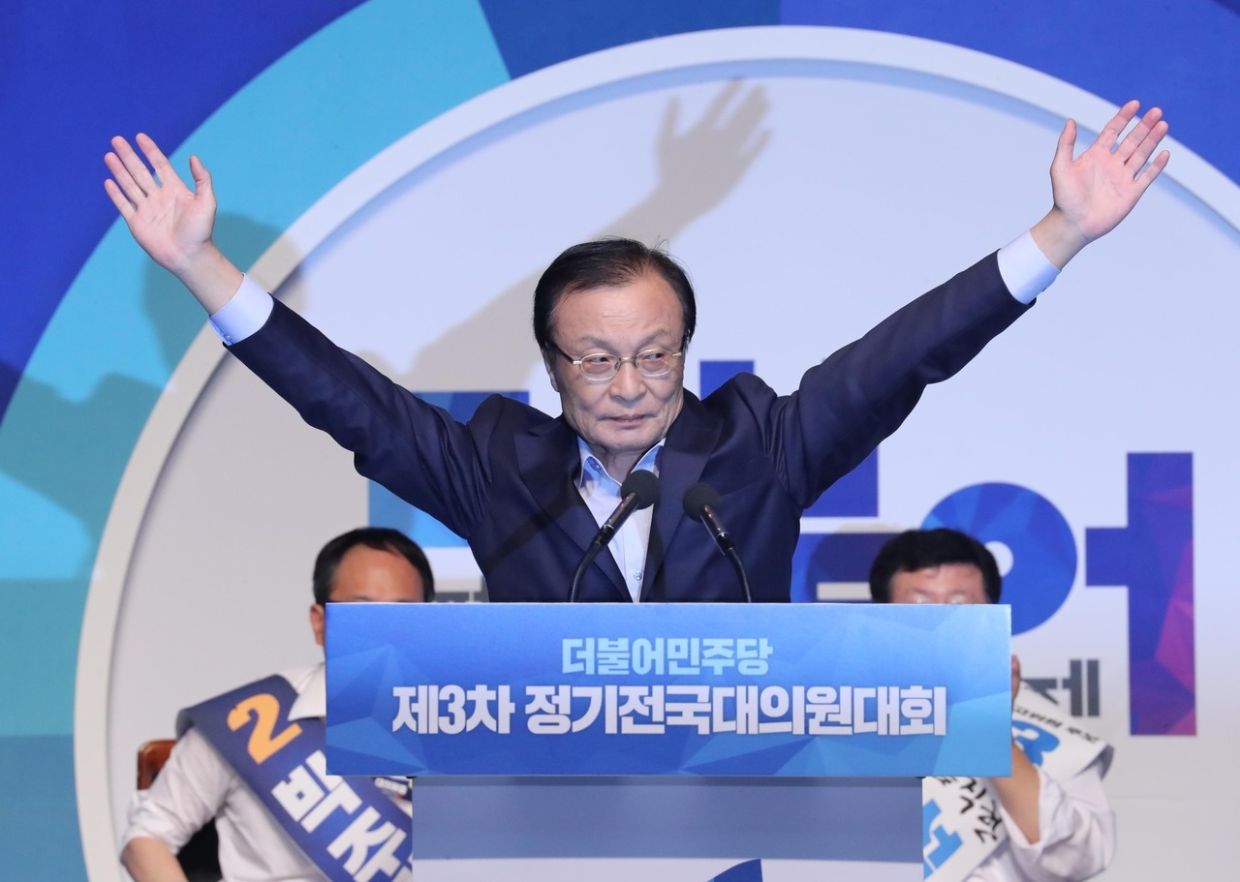
In 2012, Lee became leader of the Democratic United Party, a predecessor of the Democratic Party, as the party struggled to regroup after its April 11 general-election loss. His tenure ended early amid deadlocked negotiations to unify the presidential bids of Moon Jae-in and Ahn Cheol-soo, but his return to the leadership in 2018 proved decisive.
From 2018 to 2020, as leader of the Democratic Party, Lee advanced a vision in which parties were governed not by fandom or faction but by rules — a system that set nomination procedures in advance and sought to reduce internal warfare.
Lee also publicly argued that reform required time and continuity, proposing what became known as a “20 years in power” thesis for the progressive camp. The “20 years in power” thesis was a slogan Lee put forward at the Democratic Party’s national convention in August 2018.
“In the 220 years since the death of King Jeongjo, the 22nd ruler of the Joseon Dynasty, in 1800, reformist forces have held power for only 10 years — during the Kim Dae-jung and Roh Moo-hyun administrations. To attempt a restoration from this imbalance, reformist forces must remain in power steadily for at least 20 years.”
The 2020 general election, in which the party and its allied list secured a sweeping victory of 180 seats, cemented Lee’s reputation as a strategist who turned elections into structure rather than spectacle.
On Aug. 29, 2020, he formally announced his retirement from frontline politics. In his farewell remarks, he urged Koreans to take pride in the country’s democratic achievements and resilience.
“What I am saying is that our people should have confidence that they are as capable as those of any country in the world, and that the Republic of Korea is strong,” Lee said.
“We have built a democracy, and among the countries that gained independence after World War II, we are the only one to have joined the ‘30–50 Club’” — the small group of economic powerhouses with a per capita income of more than $30,000 and a population exceeding 50 million.
Lee would step away from frontline politics the following day after 32 years in public life.
“Going forward, I intend to make a variety of efforts for peace on the Korean Peninsula. Throughout my life as a public servant," Lee said, "I have received the people’s support at every critical juncture, and I will never forget it. I will always pray for your happiness and for the continued development of the nation.”
Final turn to peace
After leaving electoral politics, Lee remained active in public life. He served as a senior adviser to the Democratic Party and took on roles in civic and peace-related organizations.
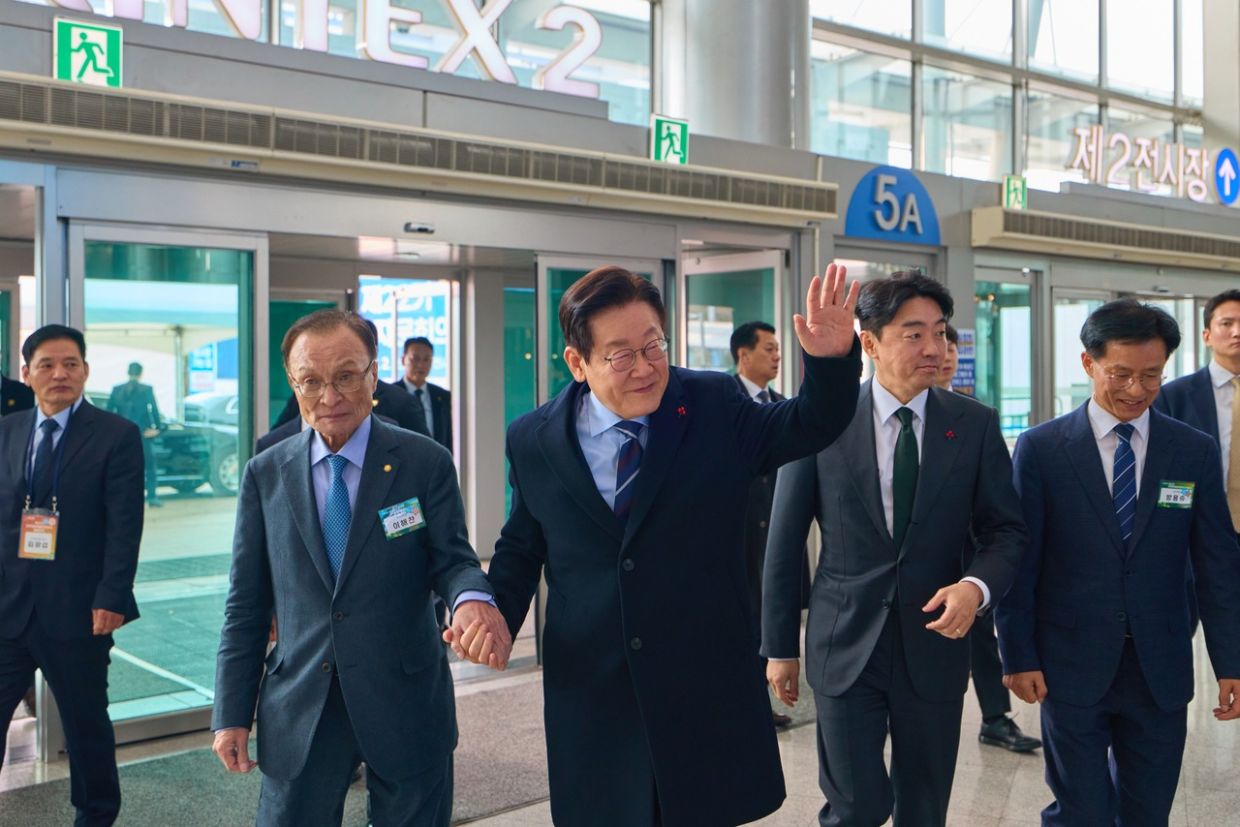
In November 2025, at 73, Lee returned to official service under the Lee Jae Myung administration as executive vice chair of the Peaceful Unification Advisory Council — his final public post, one he took up just months before his death, in the name of long-term peace and institutional planning.
When he assumed the post, Lee called for what he described as a cultural shift essential not only to daily politics but also to unification.
“Our daily lives — and even unification — are hindered by a backward culture that takes the ‘difference’ between you and me and dismisses it as the other person’s ‘wrongness,’” he said. “It is a culture that looks down on others, belittles them and discriminates against them. We must reform it boldly.”
Lee called Koreans to move forward, he said, with “the bright energy of inclusion, integration and solidarity,” reiterating that the country must “create a new space for peaceful unification.”
“Inclusion and integration are the starting point for a Korean Peninsula of ‘peaceful coexistence and shared prosperity. They are a stepping stone toward a better future,” Lee said. “This is the path we must take. This is what we must accomplish.” -- THE KOREA HERALD/ASIA NEWS NETWORK