SINGAPORE: Nearly 10 secondary schools in Singapore are installing mobile phone lockers in 2026 to store students’ devices during school hours.
Unlike general lockers which are managed by the students and can hold items such as files and textbooks, these lockers are specifically for mobile devices and are typically handled by school teachers.
This follows new guidelines announced by the Ministry of Education (MOE) in November 2025, banning the use of smartphones during the entire school day.
Previously, restrictions applied only to regular curriculum time, with some schools allowing phone use during break times.
Under the stricter rules that kicked in from January 2026, secondary school students are not allowed to use their devices outside lesson time as well. This includes during recess, periods between lessons and co-curricular activities (CCAs).
Madam Agnes Monica, 49, whose son studies at St Gabriel’s Secondary School, said she supports the stricter phone use guidelines.
At her son’s school, security guards remind students to switch off their phones upon entry, and devices are kept in general lockers outside the classroom.
“Recess should be a time to engage with friends and take a mental break from gadgets. It’s a short moment to breathe,” she said.
Madam Agnes, who works in hospitality, said the school has offered an alternative for parents to reach their children, directing them to its general hotline for emergencies.
“If it’s really urgent, the school is very cooperative in getting our child to call us back,” she said.
Her son, Lashaun G’haran, 13, admits that he wishes he were free to use his phone outside of lessons, although he was used to doing without devices in primary school.
Now during recess, he has his meal before exploring the school grounds, sometimes on his own or with a friend. The Secondary 1 student said he enjoys learning about the school’s history during these breaks.
“If I had my mobile phone with me, I’d probably just be at a table with all my friends, playing games on our phones,” he said.
While MOE said that students’ devices would have to be kept in designated storage areas such as lockers or in their bags during school hours, some schools have opted for mobile phone lockers.
Nearly 10 schools expressed interest in purchasing phone lockers in late 2025 and early 2026, based on tender documents on government procurement portal GeBIZ.
These include secondary schools like Cedar Girls’ Secondary, Hai Sing Catholic, Admiralty Secondary and Hillgrove Secondary.
Wide-Links, an importer and supplier of office furniture, told The Sunday Times in January that it had supplied mobile phone lockers to more than 40 schools, including primary schools, in 2025.
These can be locked by students using digital combination locks or smart cards, with teachers having master keys for access.
Christine Cheong, the company’s marketing director, said schools install the lockers in places that can be monitored through CCTV cameras, such as along corridors or outside the general office.
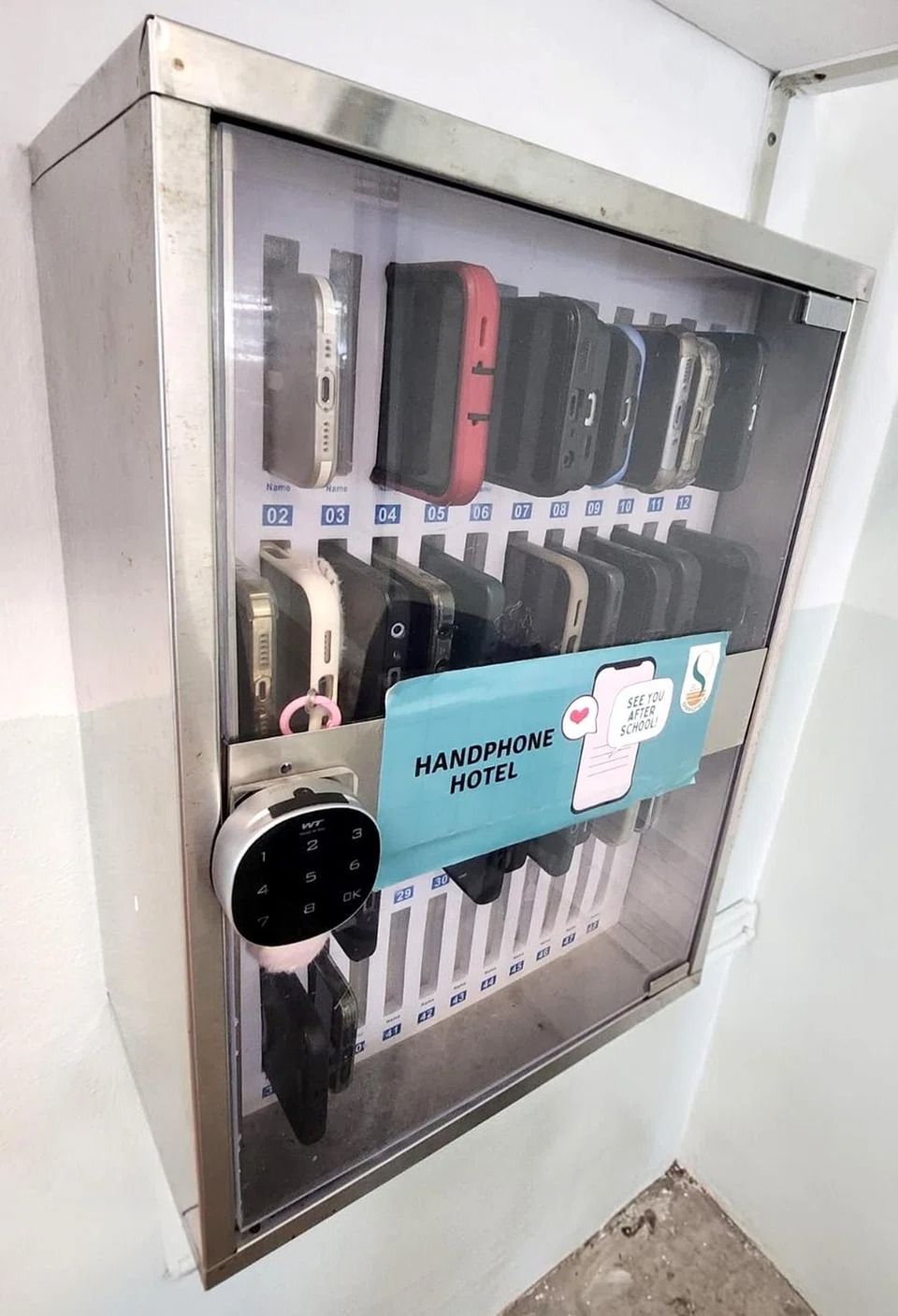
Springfield Secondary School has in the past two years managed to curb excessive device use among students with the help of “handphone hotels”.
In 2023, after the Covid-19 pandemic, the school had observed that students were glued to their phones.
“At lunch or recess, they would be sitting together, but they’d either be gaming or on social media,” said its principal, Eleanor Chia.
She added that policing device use during lessons was also difficult, as students hid phones under tables, behind books, or used them during toilet breaks.
“We felt that our students did not yet have the self-discipline to manage their device use,” she said.
At that time, the students had to keep phones in their bags and were allowed to use them only during breaks and after school.
To address the issue, the school sourced for mobile phone lockers.
It spent less than $6,000 on online platform Shopee to buy about 40 mobile phone lockers that were installed in classrooms, and four portable mobile phone lockers for teachers to use during learning journeys or CCAs.
Each locker has 48 slots, and is mounted on a wall next to the teacher’s desk in the classrooms.
Students switch off their phones before depositing them each morning. Teachers then use a digital lock to secure the locker, preventing access to the devices for the school day.
As expected, the move initially drew resistance from students when it was announced at the start of Term 2 in 2023, Chia said.
“There was a huge groan from the students when we announced it, but they understood the ‘why’,” she said, adding that the school educated students about phone addiction and its harmful effects.
Teachers have since observed greater focus during lessons and spent less time on classroom management, while social interaction among students has also improved.
“In early 2023, if you go to the canteen, you will see everybody’s head down, eyes on their devices. Now... everyone is chatting, talking about their day,” said Chia. More groups of students also play sports on school grounds.
The school has also seen a drop in disciplinary cases, such as students gathering in toilets to smoke or plan mischief.
“They couldn’t coordinate any more because there were no phones,” she said.
Attempts to bypass the system, such as submitting dummy phones or claiming not to have brought a device, were more common in the first year but have since declined.
Several schools have approached Springfield to learn from its experience. Some have even visited the school to view the lockers and see how they work.
While Chia said each school needs to consider its own context, she described the initiative as beneficial for Springfield, where the lockers are now known as “handphone hotels”.
She tells the students this: “Your phones have worked very hard, so they deserve a vacation while you’re in school.” - The Straits Times/ANN