
SINGAPORE: As its research prowess moves from strength to strength, Singapore is looking to ride the next wave of innovation, with S$37 billion committed over the next five years to transform discoveries into both money-makers as well as solutions to national problems.
A special focus will be on keeping the population healthy and sharp, as the nation steadily greys.
Laying out the Research, Innovation and Enterprise (RIE) 2030 plan at a Friday (Dec 5) press conference, Senior Minister Lee Hsien Loong said: “Research and innovation will become increasingly important as our economy matures.
“It will drive economic growth and help us to address national priorities and challenges”.
The RIE plan is a strategic roadmap that outlines Singapore’s key directions, priority areas and programmes to further strengthen its research capabilities, drive impactful innovation, and grow a vibrant talent ecosystem for Singapore.
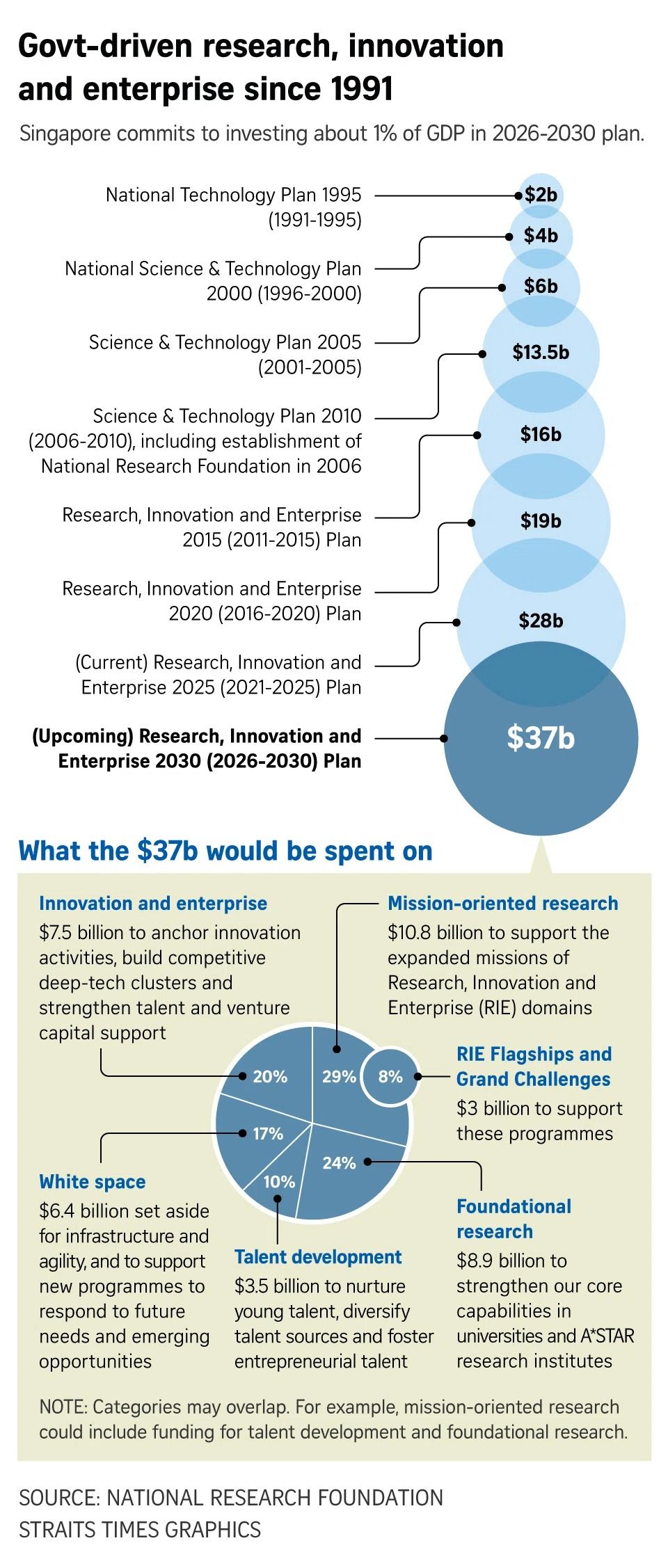
The new tranche is a 32 per cent increase from the current RIE2025 funding of $28 billion. It kicks in from April 2026, and like previous years, amounts to around 1 per cent of the nation’s gross domestic product (GDP).
This puts Singapore puts on a par with other small advanced economies such as Sweden and Denmark.
From this new round of RIE2030 funding, $3 billion will be set aside to launch two new high-level research programmes – the RIE Grand Challenges, which drive more impact in national strategic priorities, and RIE Flagships, which push for creation of economic value.
The first Grand Challenge will focus on the ageing population, especially in the areas of maintaining brain health and physical function.
Today, Singaporeans live about 11 years longer than the period they stay healthy. Studies have shown that among those aged 60 and above, around 8.8 per cent live with dementia, with the figure rising to as high as about 50 per cent for those aged 85 and above.
Funding will go towards tackling the specific scientific gaps in the knowledge of dementia, such as understanding the interplay between the most common forms – vascular dementia and Alzheimer’s disease – and eventually creating a new and larger wave of interventions with better preventative and management outcomes.
An equally important concern is frailty and sarcopenia, an age-related disease characterised by the progressive loss of muscle mass, strength and function.
Such musculoskeletal problems account for about one-fifth of the number of years seniors here live with disability, and often lead to poorer recovery, longer hospital stays and higher care needs.
With a diverse multi-ethnic Asian population and established research expertise, Singapore offers an ideal environment to conduct healthy longevity research, and a test bed for real-world solutions. These can, in turn, benefit people worldwide.
Separately, the first Flagship project will focus on semiconductors, to establish Singapore as a strategically important R&D node in this industry.
The project will work on deepening capabilities in high-impact technology areas, such as advanced packaging, heterogeneous integration, and advanced photonics.
Singapore is currently an integral part of the global semiconductor supply chain, accounting for one-tenth of worldwide chip production, and one-fifth of global semiconductor manufacturing equipment production.
New growth opportunities are emerging in this industry, with revenue expected to reach $1 trillion by 2030, and Generative AI possibly bringing in an additional $300 billion in revenue.
These two high-level research programmes will be funded under their respective pillars, but will see more concerted efforts to coordinate research across institutions.
The four key pillars of RIE2030 remain the same – human health and potential; manufacturing, trade and connectivity; urban solutions and sustainability; and smart nation and the digital economy.
Where the money will go
The lion’s share of funding allocation – 29 per cent or $10.8 billion – will go towards “mission-oriented” research in these four key domains, which encompass emerging sectors that could become key contributors to Singapore’s economy, such as the space economy and bioeconomy - a sector that provides opportunities in areas such as sustainable products and alternative feedstocks.
$8.9 billion will go to strengthening the nation’s research foundation, including training scientists who can utilise AI and data to deliver better research in universities, as well as the research institutes under the Agency for Science, Technology and Research (A*STAR).
$7.5 billion is to spur innovation and enterprise such as growing the talent, tools and infrastructure needed for rapid AI engineering and deployment.
$6.4 billion is for white space programmes that may arise in the next few years in new or emerging areas of research, as well as infrastructure renewal.
$3.5 billion is to support talent development, such as through the National Research Foundation’s (NRF) new postdoctoral award, which provides a $250,000 research grant and up to four years of salary support.
NRF chairman Heng Swee Keat said at the press conference: “The most critical success factor is the breadth and depth of talent... While continuing to develop our talent base, we will also diversify our talent mix. Beyond scientists focusing on basic research, we will include science innovators, entrepreneurs and more.”
Other than healthy longevity, RIE2030 will also look into harnessing precision medicine in cancer, cardiovascular and metabolic diseases.
On sustainability efforts, RIE2025 made progress in higher yields of vegetables through advanced seed genetics and breeding techniques; and recycling construction materials to be used to protect shorelines from erosion.
RIE2030 seeks to accelerate Singapore’s transition to a climate-resilient and sustainable future, including significantly stepping up efforts to make low-carbon technologies feasible for various sectors.
On the digital economy front, RIE2030 builds on the key thrusts of RIE2025 to develop capabilities in AI and quantum, as well as digital trust and security.
RIE funding is behind much of the progress that Singapore has made in research over past decades, said the NRF. Since the RIE2015 Plan, $63 billion has been used to support RIE activities, and with the new funding, the total will reach $100 billion.
The fruits of research
The number of industry researchers increased by 25 per cent, from 18,600 in 2012, to 27,100 in 2022, putting Singapore on a par with other small advanced economies. NRF said international rankings also show that RIE institutions and researchers are highly regarded, and their studies have gained influence.
A*STAR continues to train a steady stream of Singaporean PhD scholars. More than 80 per cent of the 1,900 scholars trained locally and abroad since 2001 are currently active in Singapore’s RIE ecosystem.
Business expenditure on R&D has increased from over $4 billion in 2013, to over $7.2 billion in 2022, and increased another 11.9 per cent to over $8.1 billion in 2023, with multinational corporations continuing to be the largest contributor.
The ratio of private to public R&D spending has also grown. For every dollar spent on R&D in the public sector, businesses’ spending increased from $1.49 in 2019, to $1.79 in 2022, based on the latest data from the 2022 National Survey of RIE in Singapore, conducted by NRF and A*STAR.
Successful homegrown biomedical firms include Mirxes, whose flagship product became the world’s first molecular blood test approved for early gastric cancer detection. It has since expanded into lung, liver, and colorectal cancer diagnostics. It became Singapore’s first biomedtech unicorn (a startup valued at over US$1 billion) when it was listed on the public markets in May.
In addition, silicon photonics spin-off Advanced Micro Foundry was acquired by GlobalFoundries in November.
Singapore’s startup ecosystem continues to thrive and mature, with deep tech start-ups attracting at least $1 billion of venture capital funding annually, in the past five years.
SM Lee, who chairs the RIE Council that endorsed the RIE2030 plan, said: “The Government believes in sustaining stable and consistent investments in RIE, through thick and thin, over the long term.”
Asked whether Singapore might increase the GDP proportion for RIE funding in the future, SM Lee said this is not currently planned for, nor is the Government constrained by this percentage.
He emphasised the importance for R&D investments to be on a sustained and long-term basis, rather than a “feast and famine” approach which sees fundings cut when budgets are constrained - something which happens in other countries.
Sustained investments will allow others to launch projects or programmes with confidence of continuity, so the nation has decided to keep this proportion stable, and focus on programmes which will bring about significant contributions and which are scientifically valuable to conduct.
This is why it has sustained such funding at about 1 per cent of the country’s GDP for close to two decades.
“RIE2030 will enable Singapore to remain a place where diverse minds can collaborate effectively, to push the boundaries of knowledge and its application, and at the same time, to propel Singapore’s development and improve lives for all of us”, said SM Lee. - The Straits Times/ANN