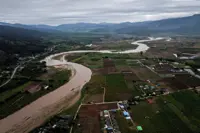
THA TON, Thailand: For most of her life, 59-year-old farmer Tip Kamlue has irrigated her fields in northern Thailand with the waters of the Kok River, which flows down from neighbouring Myanmar before joining with the Mekong River that cuts through South-East Asia.
But since April, after authorities warned residents to stop using the Kok's water because of concerns over contamination, Tip has been using groundwater to grow pumpkins, garlic, sweet corn and okra.
"It's like half of me has died," Tip said, standing by her fields in Tha Ton sub-district, and looking out at the river that she is now forced to shun.
Across mainland South-East Asia, more than 2,400 mines - many of them illegal and unregulated - could be releasing deadly chemicals such as cyanide and mercury into river water, according to research from the US-based Stimson Centre think tank released on Monday (Nov 23).
"The scale is something that's striking to me," said Brian Eyler, senior fellow at Stimson, pointing to scores of tributaries of major rivers, like the Mekong, the Salween and the Irrawaddy that are probably highly contaminated.
The Stimson report marks the first comprehensive study of potentially polluting mines in mainland South-East Asia. Researchers analysed satellite imagery to identify mining activity including 366 alluvial mining sites, 359 heap leach sites and 77 rare earth mines draining into the Mekong basin.
Most alluvial mining sites are gold mines, though some also extract tin and silver. Heap leach mining sites include those for gold, nickel, copper, and manganese extraction.
The Mekong is Asia's third-largest river and supports the livelihood of more than 70 million people as well as the global export of farm and fisheries products. It was previously perceived to be a clean river system, said Eyler.
"Because so much of the Mekong Basin is essentially ungoverned by national laws and sensible regulations, the basin is unfortunately ripe for this kind of unregulated activity to occur at a high level of intensity and the huge scale that our data reveals," he said.
The toxic chemicals released through unregulated rare earths mining include ammonium sulphate, and sodium cyanide and mercury that are used for two different types of gold mining, according to Stimson researchers.
That exposes not only the millions of people who live along the Mekong in South-East Asia to health risks, but also consumers elsewhere.
"There is not a major supermarket in the US that doesn't have products from the Mekong Basin, including shrimp, rice and fish," said Eyler.
The emergence of new China-backed rare earth mines in eastern Myanmar, not far from the mountainous border with Thailand, initially set off concerns among researchers of the danger of downstream pollution along the Kok River, including areas like Tha Ton. The contamination pattern on samples from the Kok River shows the presence of arsenic - linked to rare earth and gold mining - alongside heavy rare earths like dysprosium and terbium, said Tanapon Phenrat of Thailand Science Research and Innovation, a Thai government research agency.
"It has only been two years since the rise of rare earth and gold mining in Myanmar at the Kok River's source," said Tanapon, who conducted testing of the waters this year and warns of a sharp rise in contamination levels unless mining is stopped. Tanapon was not involved in the Stimson study.
Myanmar, which erupted in conflict after the military seized power in 2021, is one of the world's largest producers of heavy rare earths, critical minerals infused into magnets that power the likes of wind turbines, electric vehicles and defence systems.
From mining sites in Myanmar, the raw material is transported for processing to China, which has a near-monopoly over production of these vital magnets, with Beijing deploying rare earths as leverage in its tariff war with the US. Mines across Myanmar and Laos use in-situ leaching for rare earth elements that was initially developed within China, according to Stimson's Eyler.
"In general, Chinese nationals work on these mines as managers and technical experts," he said.
In response to questions from Reuters, China's foreign ministry said it was not aware of the situation.
"The Chinese side has consistently required overseas Chinese enterprises to conduct their production and business operations in accordance with local laws and regulations, and to adopt stringent measures to protect the environment," it said.
The Thai government has established three new task forces to coordinate international cooperation, monitor the mines' health impact and secure alternative supplies for communities along the Kok, Sai, Mekong and Salween rivers, said Deputy Prime Minister Suchart Chomklin.
In northern Tha Ton, signs still hang on a bridge over the Kok River, calling for authorities to shut down the rare earths mines upriver, and farmers like Tip are desperate for an intervention.
"I just want the Kok River to be the way it used to be - where we could eat from it, bathe in it, play in it, and use it for farming," she said.
"I hope someone will help make that happen." - Reuters