VIENTIANE (Laotian Times): Starting immediately, households in Laos that use up to 300 kilowatt-hours (kWh) of electricity each month will see their utility bills reduced, thanks to a government subsidy approved on Nov 14 worth US$8 million to US$10 million, which will cut the transmission fee households pay from LAK 260 (0.5 US cents) per kWh to LAK 109 per kWh (1.2 US cents).
The move comes amid growing frustration over living costs and is meant to give low-income families some relief as energy and production expenses continue to creep upward.
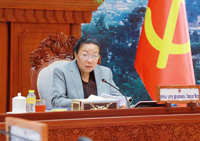
During the National Assembly, Minister of Industry and Commerce Malaythong Kommasith reported that the adjustment is expected to lower the tariff for the lowest consumption band to LAK 521-1,063 (2.4-4.9 US cents) per kWh, trimming about 0.7 cents from earlier rates.
According to Malaythong, the revised prices place Laos below its neighbors in terms of household electricity costs and follow recommendations made by lawmakers during the previous assembly session.
The meeting also revisited the debate over electricity prices, which flared up earlier this year after the former Ministry of Energy and Mines proposed a 2025–2029 tariff roadmap that would gradually raise rates to help cover Électricité du Laos’ financial needs.
Although the government said earlier increases were unavoidable, Malaythong stressed that any future adjustments will be introduced slowly to avoid placing extra pressure on families.
Under the upcoming system, tariffs will be split into three groups: households, agriculture and industry. In agriculture, irrigation systems and small household farms will get the lowest non-residential rate at 6.09 US cents per kWh, while larger commercial farms will pay 7.91 US cents. Industrial rates will differ for processing plants, special economic zones and mining operations, with processing facilities set at 7.94 US cents per kWh.
The ministry plans to work with finance, banking and agriculture agencies to develop more support for farmers and certain processing industries. It also wants to promote solar rooftops, biomass and other renewable options, and encourage industrial zones to produce some of their own electricity, with Électricité du Laos stepping in when their supply falls short.
The roadmap has faced pushback from lawmakers and the public, who argue that higher tariffs don’t match current income levels.
Malaythong also gave an overview of the wider power sector. Laos has grown from just four small power sources in 1975 to 109 today, with over 12,235 MW of installed capacity and household electrification above 96 percent.
But despite this expansion, the sector still struggles with high operating costs, heavy debt, uneven supply in some areas and the long-standing problem of exporting large amounts of electricity at low prices while domestic customers pay comparatively high rates. -- Laotian Times