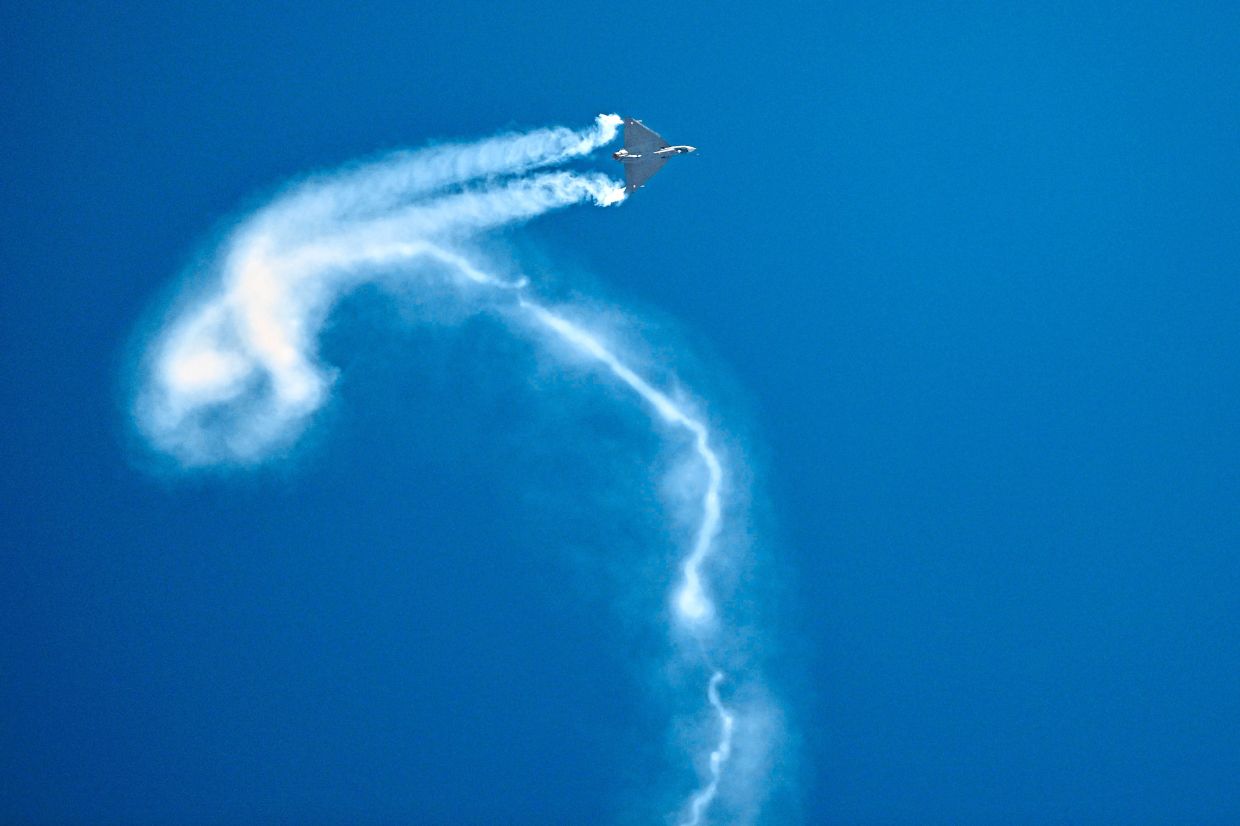
The crash of India’s Tejas fighter in front of global arms buyers at the Dubai Airshow is the latest blow to a key national trophy, leaving the jet reliant on Indian military orders to sustain its role as a showcase of home-built defence technology.
The cause of Friday’s crash was not immediately known but it capped a week of jockeying for influence at the event, attended by India’s arch-rival Pakistan six months after the neighbouring foes faced off in the world’s largest air battle in decades.
Such a public loss will inevitably overshadow India’s efforts to establish the jet abroad after a painstaking development over four decades, experts said, as India paid tribute to Wing Commander Namansh Syal who died in the crash.
“The imagery is brutal,” said Douglas A. Birkey, executive director of the US-based Mitchell Institute for Aerospace Studies, referring to the history of crashes at air shows where nations and industries seek to tout major national achievements.
“A crash sends quite the opposite signal: a dramatic failure,” he said, adding however that while the Tejas would suffer negative publicity, it would most likely regain momentum.
Dubai is the world’s third-largest air show after Paris and Britain’s Farnborough, and accidents at such events have become increasingly rare.
In 1999, a Russian Sukhoi Su-30 crashed after touching the ground during a manoeuvre at the Paris Airshow, and a Soviet MiG-29 crashed at the same event a decade earlier.
All crew ejected safely and India went on to place orders for both jets.
Fighter sales “are driven by high order political realities, which supersede a one-off incident,” said Birkey.
The Tejas programme began in the 1980s as India sought to replace vintage Soviet-origin MiG-21s, the last of which retired as recently as September after numerous extensions due to slow Tejas deliveries by Hindustan Aeronautics Ltd (HAL).
The state-owned company has 180 of the advanced Mk-1A variant on order domestically but is yet to begin deliveries due to engine supply chain issues at GE Aerospace.
A former HAL executive who left the company recently said the crash in Dubai “rules out exports for now”.
Target markets included Asia, Africa, and Latin America, and HAL also opened an office in Malaysia in 2023.
“The focus for the coming years would be on boosting production of the fighter for domestic use,” the former executive said, requesting anonymity.
But the Indian Air Force is worried about its shrinking fighter squadrons, which have fallen to 29 from an approved strength of 42, with early variants of the MiG-29, Anglo-French Jaguar and French Mirage 2000 set to retire in coming years.
“The Tejas was supposed to be their replacement,” an IAF officer said. “But it is facing production issues”. — Reuters