
Hong Kong’s economy is expected to continue growing after a strong performance in the last quarter, supported by a moderate global economic outlook, a vibrant financial market and an interest rate cut, the city’s leader has said.
He made the assessment at a forum on Tuesday on Hong Kong’s role in the global economy that also featured a central figure from the Chinese Academy of Social Sciences, a prominent Beijing-based research institute and think tank, as well as local, mainland Chinese and overseas policymakers, experts and sector representatives.
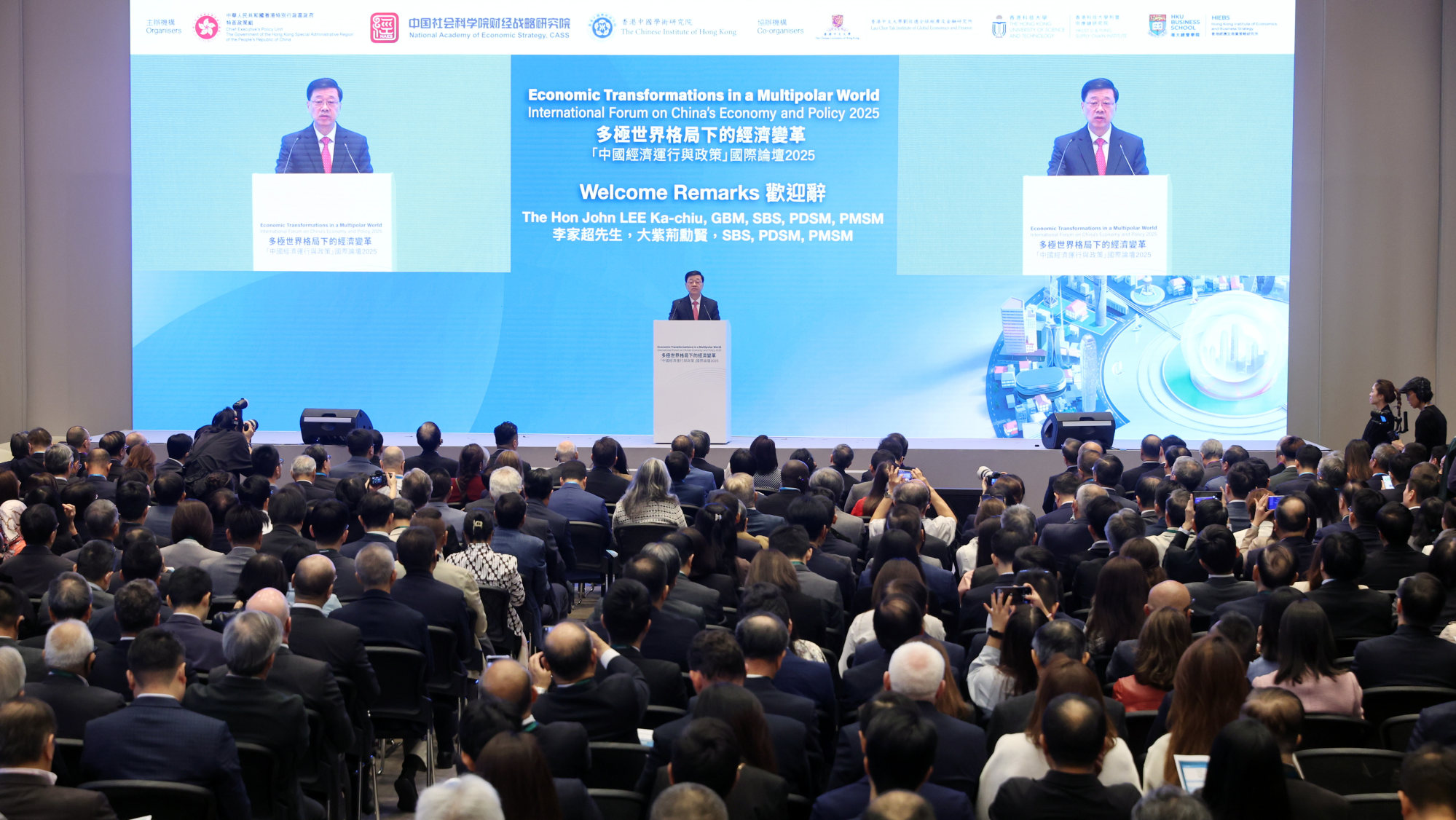
Chief Executive John Lee Ka-chiu said that a strong and steady rise in exports and sustained increase in domestic demand had contributed to the city’s “robust” economic performance in the third quarter, recording 3.8 per cent growth, despite turbulence in the global environment.
“Looking ahead, the Hong Kong economy should see further solid growth, supported by sustained moderate global economic growth, vibrant financial market activity, interest rate cuts in the US, a continued increase in visitor arrivals and so on,” Lee said in his speech at the international forum on the mainland’s economy and policy.
The event was co-organised by the Chief Executive’s Policy Unit, the National Academy of Economic Strategy under the Chinese Academy of Social Sciences, and the Chinese Institute of Hong Kong.
Lee highlighted that Hong Kong had remained a “resilient and resourceful economy”, with its achievements recognised in various global rankings, such as being named the world’s freest economy and ranking third in the World Competitiveness Yearbook.
According to Lee, such international recognition underscored the city’s economic strengths, supported by the rule of law and a common law system, both offering vital assurances to investors.
He added that Hong Kong continued to serve as a financial hub open to the world and was committed to free trade in times of global economic uncertainty. He emphasised the city’s role as a “superconnector” and “super value-adder” in fostering mutual opportunities worldwide.
Lee also said that Hong Kong, the mainland’s most internationalised city, was actively aligning itself with the country’s 15th five-year plan to fulfil its responsibilities and seize abundant opportunities.
Speaking at the same event, academy Secretary General Zhao Zhimin emphasised that the city should maintain long-term stability and prosperity during the five-year period from 2026 to 2030.
“In the context of a multipolar world order, how to maintain Hong Kong’s unique status and advantages, continuously enhance its development momentum and write a new chapter in the cause of ‘one country, two systems’ in the new era, is Hong Kong’s important mission,” Zhao said.
The city should harness its unique advantages of strong national support and close global connectivity, while deepening integration and cooperation with the mainland, particularly within the Greater Bay Area, he added.
Zhao further stressed the need to consolidate Hong Kong’s international standing in the finance, aviation, shipping and trade sectors, and to accelerate its development as a global centre for technology and innovation.
He added that the city would play a stronger role in supporting China’s high-level opening up and continue to shine as the enduring “Pearl of the Orient” in a multipolar world marked by uncertainty.
Among the speakers at the event were Nobel Prize-winning economists Professor Joseph Stiglitz and Professor Michael Spence.
Both expressed their optimism for Hong Kong’s economy and also met Lee in his office on the sidelines of the forum.
Stiglitz pointed to Hong Kong’s common law system and use of English as an official language as advantages, saying the city possessed great flexibility and adaptability as a small jurisdiction.
Spence said he remained “cautiously optimistic” about Hong Kong’s future development, as the city was more than a financial hub, being also a “gigantic marketplace” within the Greater Bay Area.
At the forum, mainland Chinese businesses expressed confidence in Hong Kong’s business environment and long-term prospects, calling on the government to take the lead in driving innovation across sectors.
Zhu Shihui, chairman of rare metals firm Vital Technology Group, said Hong Kong was well-positioned to develop its innovation and technology sector as the country sought to strengthen technological self-reliance. He argued the city could build on its long-established institutional, legal, financial and logistical advantages to achieve this goal.
He urged the government to play a more active role in coordinating different parts of the supply chain, rather than leaving everything solely to the market.
“In the technology sector, [China is] like an 18-year-old young person, while the United States is like one in his fifties in a monopolistic position, with rich experience and a PhD degree,” he said.
“If there is no support from the government or collaboration in the supply chain, we could not compete with such a strong economy like the US.”
Meanwhile, Guo Guangchang, chairman of mainland healthcare conglomerate Fosun International, said Hong Kong had long supported mainland enterprises – including a few of Fosun’s subsidiaries – with financing, thanks to ongoing innovation in the city’s financial policies.
He highlighted the introduction of chapters 18A and 18C of the Hong Kong stock exchange listing rules, which allow pre-revenue biotechnology and specialist technology companies to list in the city.
Chapter 18A, covering biotechnology firms, was introduced in 2018, while Chapter 18C, introduced in 2023, applies to companies in a range of innovative sectors such as next-generation information technology, advanced materials and new energy.
“In recent years, the strong rebound of the innovative medicine sector has directly driven the recovery of the Hong Kong stock market,” Guo said.
“This fully showed the stimulating effects on the market of the institutions of 18A and 18C, and [Hong Kong] will continue to be a go-to destination for global innovative companies.”
Looking ahead, Guo called on the city’s government to play a greater role in commercialising technological innovation and to refine its talent policies by attracting more professionals in infrastructure and architecture.
He also suggested expanding labour import schemes in areas such as childcare and laboratory assistance, allowing local professionals to focus more on innovation.
“Fosun looks to share our global resources and experience, combined with the capital advantages in Hong Kong, to help nurture more local innovative firms that can reach the world,” he said. -- SOUTH CHINA MORNING POST