In a central Wuhan shopping centre, a banner for a new Pop Mart hangs where an Air Jordan store once stood. When the store famous for the wildly popular Labubu figures opens early next year, it will sit next to a Tiffany & Co boutique and across from a Prada shop on the ground floor – space traditionally reserved for high-end purveyors of apparel, jewellery and cosmetics.
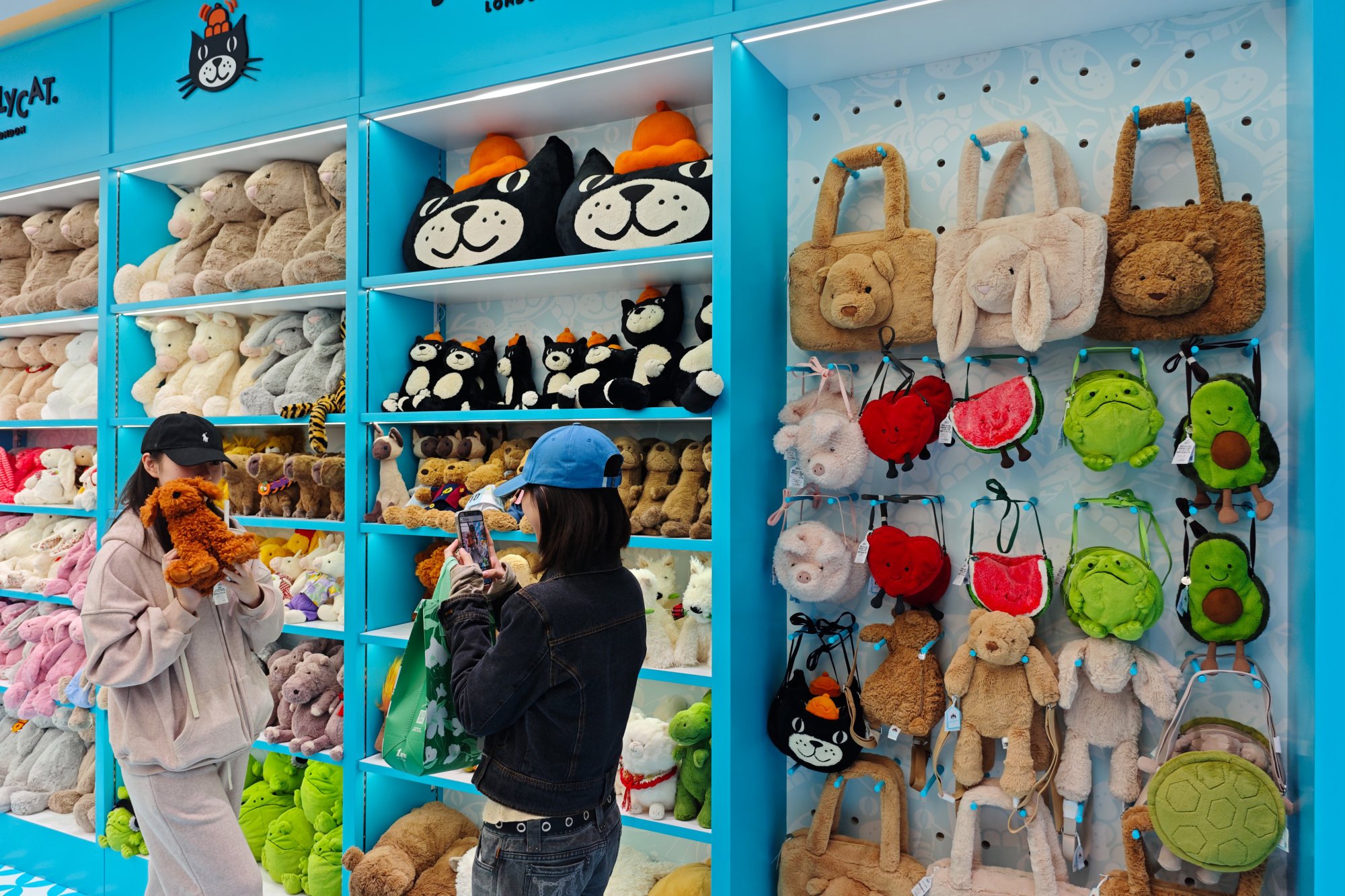
The mall in the capital of central China’s Hubei province is not an isolated case. Pop Mart and fellow makers of collectible toys like Jellycat and Top Toy are increasingly taking over prime locations as China’s shopping malls embrace a new reality; consumers are spending less overall but are more willing to pay for small but emotionally satisfying purchases.
Emotional spending, or the pursuit of non-functional satisfaction, is reshaping China’s malls, according to Jacky Zhu, head of retail research at JLL China. “Where does such satisfaction come from?” he said. “Trendy collectible toys could be one.”
The trend also embraced everything from milk tea to perfume stores and outdoor gear to climbing gyms, he added, with malls also adding larger halls with more greenery – anything to create a joyful experience or foster connections between shoppers and their peers or the community.
China has faced sluggish consumer demand since a decades-long period of rapid growth reversed during the Covid-19 pandemic, leaving behind a slow economy and uncertain job prospects. The world’s second-largest economy is now in the fifth year of a property downturn, during which many households have suffered losses in the value of their homes.
Retail sales grew 3 per cent in September, according to data from the National Statistics Bureau, a far cry from growth that topped 10 per cent in most years over the two decades leading up to the pandemic.
China’s luxury market has been declining after a sales peak in 2021 at 471 billion yuan (US$66 billion), according to Bain & Co. In 2024, sales dropped about 20 per cent to 380 billion yuan, and the sector faces another 2 to 5 per cent contraction in 2025.
At the same time, brands that have come to embody emotional value, including Pop Mart and tea drink chain Mixue, have seen their sales surge. For the third quarter of this year, Pop Mart said its revenue shot up about 245 per cent from a year earlier, while Mixue’s rose 39 per cent.
China’s shopping malls have seen rental income drop and vacancy rates grow in the past few years. The national average vacancy rate was 10.5 per cent at the end of September, compared with 10.2 per cent at the end of 2024 and under 8 per cent in 2019, according to Zhu. The vacancy rate across China’s four top-tier cities – Beijing, Shanghai, Guangzhou and Shenzhen – was 8.3 per cent at the end of September, up from 7.3 per cent at the end of last year and around 6 per cent in 2019.
The national average retail rent was 24.16 yuan per square metre per day in the first half of 2025, according to China Index Academy, a real estate research firm, which sampled the main commercial streets in 16 cities. That is about 6 per cent lower than a peak of 25.60 yuan in the first half of 2019.
Meanwhile, mainland China’s creation of retail outlets has slowed, with completion of new floor space this year reaching only 25 per cent of 2021’s level, according to Anson Bailey, head of retail and consumer at KPMG China.
Apparel stores, which as high-margin businesses traditionally pay higher rents, were under great pressure, which forced commercial landlords to make changes, said JLL’s Zhu.
“Retail projects with a higher proportion of apparel tenants have to make more substantial adjustments,” Zhu said.
To embrace the new consumption trend, Chinese shopping malls have been reallocating space, filling prime locations with shops for toys, outdoor gear, gold jewellery and electric vehicles. Some have redesigned to allow more natural light and more open space, and made room for more indoor trees to create appealing spaces for a younger generation of consumers.
Hong Kong developer Hang Lung Properties reported that rental income from commercial assets in mainland China in the first six months of 2025 fell 2 per cent from a year earlier to HK$3.19 billion (US$410 million).
In a letter to shareholders in the company’s interim report, chairman Adriel Chan said Chinese households, on average, still maintained a relatively high level of wealth.
“There remains both a desire and the ability to spend, but not in the same ways as before,” he said. “Spending patterns are shifting, which has created a ‘new consumption’ paradigm in China, focusing on emotional value as well as financial value.”
Pop Mart, Mixue and Chinese jeweller Laopu Gold are the three widely acknowledged champions of this new consumption wave, according to Chan, who said Hang Lung had introduced these brands to the company’s malls. - SOUTH CHINA MORNING POST