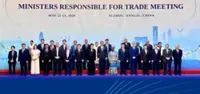
GYEONGJU, South Korea (AP): Leaders of 21 Asia-Pacific Rim nations wrapped up their annual summit Saturday with a statement underscoring regional economic cooperation, just days after the presidents of the United States and China agreed to dial down their trade war.
After two days of the Asia-Pacific Economic Cooperation summit in the South Korean city of Gyeongju, Apec leaders issued a joint statement pledging greater cooperation to overcome shared challenges in a global economy hit hard by trade tensions between the U.S. and China, the world’s two largest economies.
On Thursday, U.S. President Donald Trump and China's Xi Jinping - who met on the sidelines of the Apec summit - dialed back earlier steps and agreed to de-escalate trade tensions. Trump, known for his dismissal of multilateralism, quickly left South Korea after the agreement with Xi, allowing the Chinese president to steal the limelight at the summit.
The joint statement declared that the Apec leaders "acknowledge the global trading system continues to face significant challenge.”
"We reaffirm our shared recognition that robust trade and investment are vital to the growth and prosperity of the Asia-Pacific region,” it says.
Jeonghun Min, a professor at South Korea’s National Diplomatic Academy, said the statement avoided direct language supporting "free and open trade,” but still managed to endorse economic cooperation and multilateralism, which embody "the very purpose of free trade
"It wasn’t possible to leave that out entirely,” said Min.
The joint declaration also said that Apec members remain committed to the Putrajaya Vision 2040, a new 20-year growth vision adopted in 2020 that calls for a trade environment that’s "free, open, fair, non-discriminatory, transparent and predictable.”
On Friday, Xi told the summit that China would support global free trade and supply chain stability - an apparent effort to position his country as an alternative to Trump’s protectionist policies. In written remarks sent to a CEO summit held in conjunction with APEC, Xi said that "investing in China is investing in the future.”
Xi also met with his Japanese, Canadian and Thai counterparts bilaterally on Friday. He met South Korean President Lee Jae Myung on Saturday for one-on-one talks that Seoul officials said would touch on efforts to achieve denuclearization of the Korean Peninsula.
That agenda has apparently angered North Korea, a non-Apec member. North Korea’s Vice Foreign Minister Pak Myong Ho on Saturday slammed South Korea for talking about "its daydream” of realizing North Korea’s denuclearization.
He said North Korea will show how such a push is "a pipedream" that can never be realized. Park's statement was seen as applying pressure ahead of the Xi-Lee meeting.
Lee, an advocate of reconciliation with North Korea, said Saturday he would take "more active preemptive steps” to lower military tensions with the North, stressing that peace on the Korean Peninsula is essential to the prosperity of the Asia-Pacific region.
Trump earlier repeatedly expressed his desire to meet North Korean leader Kim Jong Un during his visit to South Korea, but North Korea did not respond. Trump and Kim met three times in 2018-19, but their nuclear diplomacy eventually collapsed.
North Korea has since vowed not to place its advancing nuclear program on a negotiating table, but experts say the North would aim for winning extensive sanctions relief in return for a partial surrender of its advancing nuclear program.
While the summit's opening session on Friday focused on ways to boost trade and investment, Saturday's meeting had cooperation in the field of artificial intelligence, demographic challenges and cultural industries on its agenda.
APEC leaders also issued two separate statements on Saturday. One called for a coordinated approach to the changes brought by AI, which they described as a potential economic catalyst that also poses challenges in rapidly evolving digital environments. The other urged cooperation to address declining birth rates, aging populations and accelerated urbanization.
Established in 1989, APEC champions free and open trade and investment to promote regional economic integration. But the region now faces challenges such as the U.S.-China rivalry, supply chain disruptions, aging populations and the impact of AI on jobs.
The U.S. strategy recently shifted to economic competition with China rather than cooperation, with Trump’s tariff hikes and "America first” agenda shaking markets and threatening decades of globalization and multinationals. - AP