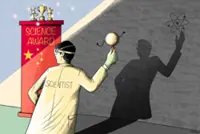
BEIJING: China grabbed headlines by flaunting its advanced military platforms at a Beijing parade on Wednesday (Sept 3) - only its second such event to commemorate the end of World War II which also ended Japan’s invasion of the country.
Apart from being a show of deterrence and unity, the parade also reveals something else - that Beijing increasingly sees China’s wartime history as crucial in underpinning the country’s credentials as a major international power, as it positions itself as a force for multilateralism and stability.
Chinese President Xi Jinping said at the parade that the end of the World Anti-Fascist War - as the Chinese also call WWII - marked China’s “first complete victory in modern times against foreign invasion”. Beijing considers the war as beginning in 1931 with Japan’s invasion; during that period of 14 years, some 35 million Chinese people were killed or wounded.
WWII history is hence a crucial milestone, as the ruling Communist Party of China (CPC) seeks to draw a timeline from China’s “century of humiliations” beginning with the first Opium War in 1839 - when it was dominated by foreign powers - to the CPC’s supposed key role in achieving victory in the Eastern Front of the World Anti-Fascist War.
However, as a legacy of the Chinese civil war, grappling with how to treat the contributions during the war of China’s previous ruling party Kuomintang (KMT) continues to be a tricky issue for Beijing, particularly as its ties with Taiwan, where KMT is now the main opposition party, have worsened.
The foundation for today’s version of history was set in 2014, when China’s parliament - the National People’s Congress - officially designated Sept 3 as “Victory Day”, a day after the Japanese surrendered formally in 1945. In 2015, China held its first parade on Sept 3 to mark the occasion.
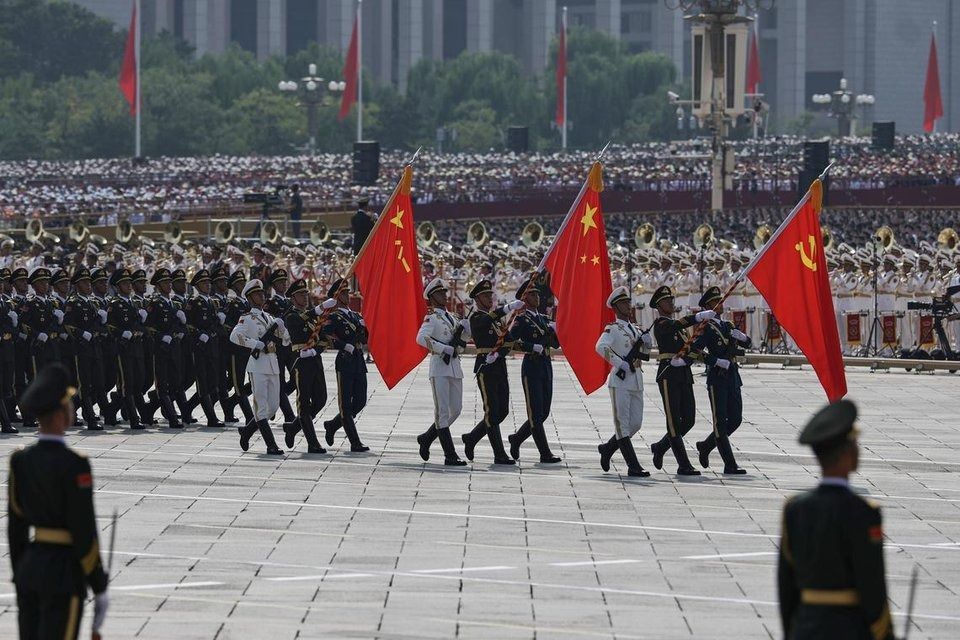
At the 60th anniversary in 2005, however, there was no parade of military hardware. Then, under Chinese President Hu Jintao, a wreath-laying ceremony was held at Tiananmen Square, followed by a meeting at the Great Hall of the People where speeches were delivered.
Wang Junwei, director of the Academic and Editorial Committee of the CPC’s Institute of Party History and Literature, said the 14-year war must be viewed in context, from the period of the first Opium War, in 1839.
“Viewing this century-long history as a continuous narrative allows us to grasp more profoundly how the victory in the War of Resistance established a historic turning point, lifting the Chinese nation from a profound crisis towards great rejuvenation,” he told a press conference in July, to discuss the official view of the war.
China also refers to its war against the Japanese as the Chinese People’s War of Resistance Against Japanese Aggression. This is often mentioned in the same breath as the World Anti-Fascist War, connecting China’s war experience to a larger, morally justified cause. Thus, Sept 3’s parade celebrates the 80th anniversary of the victory of the Chinese People’s Resistance Against Japanese Aggression and the World Anti-Fascist War.
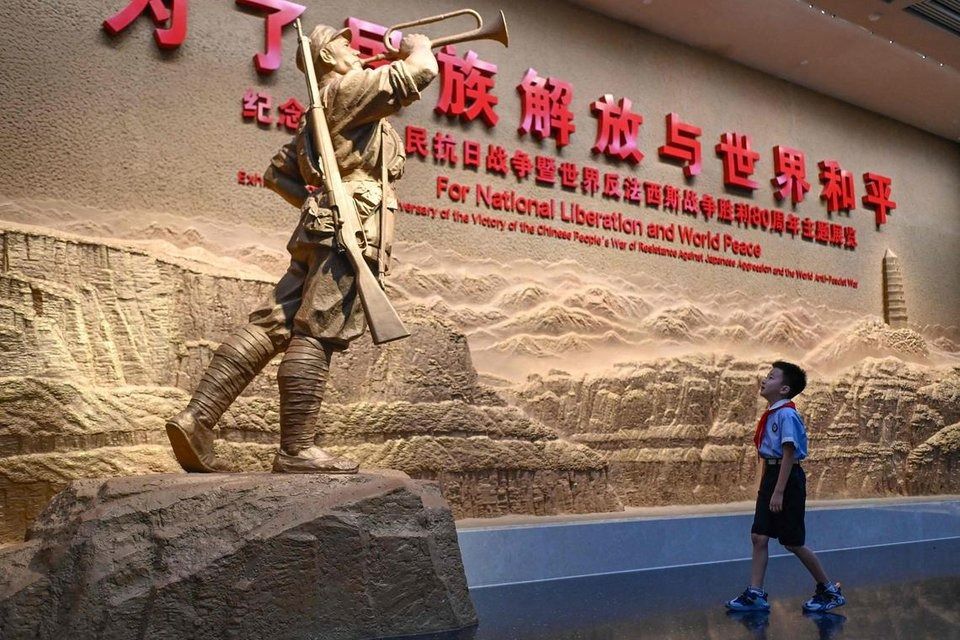
The Museum of the War of Chinese People’s Resistance Against Japanese Aggression in Beijing - China’s biggest devoted to the war which recently reopened to the public in July - highlighted a quote by CPC revolutionary leader Mao Zedong to this effect.
“The great Chinese resistance is not just China’s matter, or that of the East, but also one for the world… Our enemies are the world’s enemies, and China’s resistance is a global resistance,” said the quote.
British historian Rana Mitter, who has written a book about how China’s remembrance of the war has changed over the years, said that in recent years China has stressed the point that its permanent membership of the United Nations Security Council is a result of its wartime contributions.
“The irony of course is that China entered the UN in 1945 under the Nationalist government… but that point is rather glossed over by Beijing today,” said Professor Mitter, who is ST Lee Chair in US-Asia Relations at the Harvard Kennedy School.
In his 2020 book, China’s Good War, he suggested that for China, WWII still has strong ideological power, because, at least “when seen through a haze of nostalgia, the war was a time of commonality, of sacrifice, of collective values overcoming consumerism”.
“It was the one time in that era when China had a clearly defined external enemy; in all the other conflicts, Chinese were fighting other Chinese,” he wrote.
A key problem for the CPC in styling itself the main defender of China during the war of resistance against the Japanese is that this role was played by the KMT, now an important political party in self-governing Taiwan that Beijing claims as its own territory.
Assistant Professor James Char, who researches Chinese history at the S. Rajaratnam School of International Studies, said that the narrative in 2025 seeks to portray the CPC as the “central pillar” of the Chinese resistance against Japan, despite the fact that it was Chiang Kai-shek’s Nationalist forces that led the defence of China.
One of the narratives Chinese state media have been emphasising this time as part of its 80th anniversary propaganda is about the “recovery” of Taiwan from Japanese colonial rule in 1945, said Prof Char. “Of course, the CPC neglects to mention that it was the ROC government that had taken over Taiwan in 1945”.
The reopened war resistance museum portrayed the San Francisco Conference of 1945 - a pivotal event in the founding of the UN - as being attended by the CPC’s Dong Biwu. Although Dong was present, China’s delegation was led by Foreign Minister Soong Tzu-wen of the Republic of China.
The ROC government on the Chinese mainland lasted until 1949, when the Communist Party defeated the KMT and founded the People’s Republic of China (PRC). But the ROC government, which had fled to Taiwan and set up a rival political entity there, held China’s UN seat until 1971.
For the Battle of Shanghai of 1937 - a pivotal engagement with Japanese troops that was led by the KMT forces - the exhibition panel at the museum said Chinese soldiers led by commander Yao Ziqing put up fierce resistance, but did not mention that he was from the KMT.
Ultimately, China’s narrative on the War of Resistance today is as much CPC history as it is Chinese history. Xi, at the parade, made no mention of the KMT and called for the country to unite under leadership of the CPC to achieve “national rejuvenation”.
Prof Char said that WWII history has gained greater significance for Beijing, with its opposition to “historical nihilism” - that is, historical narratives that run counter to its official version of the past, particularly how the country only managed to overcome its “century of humiliation” thanks to the CPC.
“In the PRC, history is less about seeking truth from facts, and more about undergirding the Party’s regime legitimacy,” he added. - The Straits Times/ANN