At a glance, the kebaya may appear delicate, with its sheer fabric adorned with intricate lacework. But beneath its graceful silhouette lies a legacy of quiet power, a symbol of cultural pride and the enduring strength of Indonesian women throughout history.
Presidential Decree No. 19 of 2023 acknowledges this legacy by establishing July 24 as National Kebaya Day.
Since then, the date has been marked by parades, fashion shows and community events across the country – celebrating not just the garment, but also the resilience and dignity of the women who wear it.
On National Kebaya Day this year, Komunitas Perempuan Berkebaya, a leading kebaya community in the country, organised a fashion show, contest and talk show at Museum Mandiri in Jakarta.
The event brought together women from across Indonesia, along with foreign dignitaries.
Approximately 200 participants attended in their brightest, most elegant kebaya ensembles.
“The growth of kebaya communities in the country has been truly incredible,” said Nita Trismaya, a lecturer at the Jakarta Arts Institute (IKJ) and an expert on kebaya history.
Nita began researching kebaya in 2016.
“Since then, I’ve observed kebaya communities flourishing organically, not just in Jakarta, but also in many cities across Indonesia,” she said.
The movement gained momentum in December 2024, when Unesco recognised the kebaya as a shared intangible cultural heritage across five Asean countries, including Indonesia.
The recognition stirred national pride and renewed appreciation for the garment.
Grace and resistance
According to the Unesco dossier, the kebaya is a traditional blouse or tunic, often enhanced with fine embroidery.
It features a front opening, with a neckline that curves from the nape to the chest, following the edge of the front panels.
Typically, it is worn with a sarong or kain, a length of traditional fabric wrapped around the waist.
Scholars believe Indonesian women began adopting the kebaya between the 13th and 16th centuries, shaped by the influences of Islam and European cultures. Yet, its exact origins remain uncertain.
“There seems to be a missing link between our tradition of wearing kain wrapped around the body and kebaya,” Nita noted.
“We still lack historical evidence or reliable literature that explains how the shift from draped cloth to a tailored garment actually occurred.”
But the kebaya is more than just a garment in Indonesia.
It is regarded as a symbol of empowered femininity and resistance against colonial domination.
RA Kartini (1879–1904) and Dewi Sartika (1884–1947), two of Indonesia’s most prominent women’s education pioneers, both wore kebaya.
“Female students at the Taman Siswa school also wore kebaya as a way of affirming their Indonesian identity and resisting Western influence,” said Indiah Marsaban, a lecturer at Universitas Indonesia and a kebaya expert.
At the first Indonesian Women’s Congress in Yogyakarta in December 1928, over a thousand women gathered to discuss national unity and women’s rights.
Most of them wore kebaya, quietly asserting their cultural identity while pushing for change.
After independence, president Sukarno encouraged his family members and female officials to wear kebaya at state functions, reinforcing Indonesian identity on the global stage.
One of the most defining moments in the garment’s political history came on July 24, 1964, during the 10th Indonesian Women’s Congress at Istora Senayan in Jakarta.
Over 7,000 women from across the archipelago assembled – a sea of kebayas in every colour and silhouette.
“It was in that defining moment that Soekarno acknowledged the critical role women played in the country’s fight for independence,” Nita said.
“He reminded the nation that Indonesia could never have achieved its strength without the contribution of its women.”
In the same speech, Sukarno urged women to take an active role in shaping the young republic.
“So, by wearing kebaya, women were not only dressing with elegance but also asserting their rightful place in society,” the scholar reiterated.
“They were no longer second-class citizens. They were partners in building Indonesia’s future.”
Reclaiming the kebaya today
Despite its deep historical roots and symbolic importance, the kebaya is rarely seen outside formal or traditional events.
“My main concern is that people often put kebaya in a box, as if it only belongs to the past or should only be worn for national ceremonies or cultural occasions,” said actress Maudy Ayunda during a press conference at Galeri Indonesia Kaya in Jakarta on July 22.
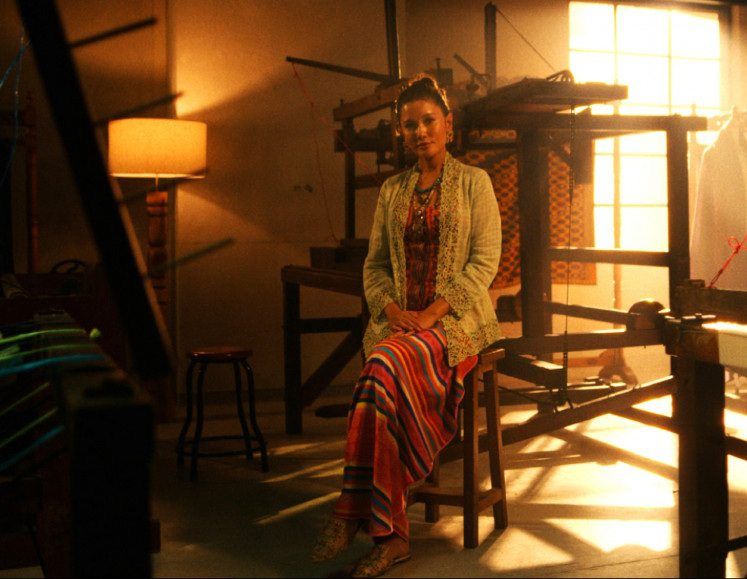
Maudy brought this concern to the screen in #KitaBerkebaya, a short film released by the Bakti Budaya Djarum Foundation on YouTube to mark National Kebaya Day 2025.
In the film, she plays a young woman concerned with how empty and forgotten her sister’s kebaya shop has become.
Moved by this decline, she rallies the community to reignite interest in wearing the kebaya.
Responding to her call, women from various professions – depicted in the film as a bus driver, a radio announcer, an entrepreneur and a photographer – begin incorporating the kebaya into their daily routines.
They do so with ease and confidence, pairing the kebaya with kain, mini skirts, denim or even leggings.
“We can actually adapt kebaya to fit our urban lifestyles,” Maudy said.
“We can wear it to work, to a cafe or when hanging out with friends. We can personalise it to reflect who we are today.”
The film also highlights the rich ecosystem surrounding the kebaya, from textile weavers to beauty salons.
As the kebaya is often paired with traditional fabrics and hairstyles like konde, the garment naturally supports a network of creative and artisanal industries.
“We want the kebaya to return to daily life, not only as a cultural symbol, but also as an empowering economic force for the weavers, tailors, batik artisans, fashion designers and creative workers across Indonesia,” said Renitasari Adrian, programme director of Bakti Budaya Djarum Foundation.
Since its release, the film has garnered nearly 2.5 million views.
Actress and drummer Titi Radjo, who also appears in the film, applauded its role in preserving the kebaya’s heritage.
“We all know that documentation is something our country often falls short on,” she said.
“That’s why I’m thrilled to see more and more efforts to archive and celebrate the kebaya, and this film is a powerful step in that direction.”
Titi also expressed her joy at the rise of kebaya communities across Indonesia.
“Each member acts like an influencer, inspiring other Indonesian women to wear kebaya,” she said.
“And the more they post their daily kebaya on social media, the more others see it as something cute, fun and worth trying.”
As a self-proclaimed tomboy, Titi admitted that wearing the kebaya changes her energy.
“Whenever I put on a kebaya, my posture immediately straightens,” she said.
“I also find myself speaking more gently, with more grace. And that, to me, reflects the true essence of Indonesian women.”
Titi observed that more women across the country are beginning to incorporate the kebaya into their everyday wardrobes.
“I see more and more women embracing the kebaya in their daily lives,” Titi said.
“To me, that means we are slowly but surely reclaiming our identity as Indonesian women, women who wear the kebaya.”
The kebaya is not just a relic of the past. It lives on in the choices of those who wear it – not just as a symbol, but as part of how they live and express themselves daily. — The Jakarta Post/ANN