Entertainment companies riding the Korean Wave, or Hallyu, are scrambling to widen their global reach as Asia’s fourth-largest economy bets on cultural exports at a time of growing protectionist barriers for traditional manufacturers.
Although growing fast from a low base, thanks to substantial government support and high visibility on the world stage with some recent dramatic successes, the industry’s contribution to the economy is still only a fraction of that of manufacturing.
The home of industry giants Samsung and Hyundai is basking in the success of boyband BTS, Oscar-winning film Parasite, the television show Squid Game, the novel The Vegetarian, whose author Han Kang won the Nobel literature prize in 2024, and, most recently, the musical Maybe Happy Ending.
India, Latin America and the Middle East, in particular, are promising new markets for Korean cultural products that have proved global hits, executives of major production firms said in interviews.

“The Latin American region, recognised as the birthplace of Latin music, is a key area of focus,” said Jason Jaesang Lee, chief executive of K-pop agency HYBE, which manages BTS, in the spotlight for its return planned next spring.
The agency is also running auditions in Latin America to launch another boyband, following last year’s US debut of girl group Katseye, whose six members hail from four countries.
“It is time to re-examine the definition of Hallyu,” Lee said.
“If content is created abroad but produced by a Korean company, or even by an overseas entity backed by Korea capital, I believe it should still be considered part of Hallyu.”
Still, it is unlikely that cultural exports will replace regular manufacturing anytime soon.
South Korea’s exports of intellectual property (IP), from music and movie to games, more than tripled over the last decade to US$9.85bil (RM41.64bil) in 2024, yet form just a fraction of goods exports, which rose 13% to stand at US$696.2bil (RM2.94 trillion), central bank data shows.
Another firm expanding global business this year is CJ ENM, producer of Parasite, which started to supply “K-dramas” to the Middle East and North Africa through a partnership with a regional streaming platform in June.
“In the case of the Middle East, we see it as a market that is promising in the long term, because the popularity of Hallyu is high among the younger generation,” said Sean Cho, executive vice-president of the global business division.
In the major markets of Japan, South-East Asia and the United States, the company is widening partnerships, most recently with Amazon Prime Video, to deliver joint productions melding Korean elements with local culture, Cho added.
For the game industry, a cash cow that accounts for more than half of South Korea’s IP exports and is famed for Krafton’s accolade-winning PUBG: Battlegrounds, India promises to be the next growth market, though it is just a 10th of South Korea’s.
“India’s game market is still at the early stage compared with other advanced countries,” said Sean Hyunil Sohn, CEO of game publisher Krafton India, which plans to exploit the potential for growth by adding new genres and types of games.
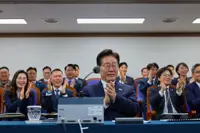
President Lee Jae-myung, who took office on June 4, has pledged support and investment to make South Korea a “big-five soft power”, aiming to grow the market to 300 trillion won (RM912bil) in value and exports to 50 trillion won (RM152bil) by 2030.
“But we can’t just leave it up to individual companies,” Lee told a recent talk show with Maggie Kang, director of K-Pop Demon Hunters, and K-pop artistes.

“The government will play the role of laying a strong foundation and it starts now.”
The “big five” refers to the categories of music, dramas, webtoons, beauty products and food that are key elements in Lee’s efforts to rebrand South Korea as a cultural power.
Industry leaders warned that the cultural sector faces rising production costs, weak box-office returns and falling advertising revenue while grappling with changes in streaming services and video use, as well as the threat from AI.
For success in the long run, industry experts, and even the central bank, have called for legislative frameworks to help domestic companies compete with global giants such as Netflix.
Rising exports of media content were fuelled by the work of 13,000 people in 2022, more than triple the 2020 figure of 4,000, with most such jobs attractive to young, highly-educated and skilled workers, the Bank of Korea said in a report in May.
Jobs created by goods exports grew at a slower rate of 9.9%, although they still accounted for vastly more of the job force, at more than 3.4 million.
“Cultural policy has been regarded as a subsidiary tool for foreign, economic and industrial policies, but going forward, it will have to be the key policy leading other sectors,” said Ko Sam-seog, a former senior official of the Korea Communications Commission.
South Korea’s services sector makes up 58% of gross domestic product, lower than manufacturing-oriented peers Japan and Germany at 70% and 64% each respectively, and most other advanced economies, World Bank data shows. — Reuters