One of the world’s strongest earthquakes struck Russia’s Far East early yesterday, an 8.8-magnitude temblor that caused tsunami waves in Japan and Alaska and prompted warnings for Hawaii, North and Central America and Pacific islands south toward New Zealand.
Ports on the Kamchatka Peninsula in Russia, near the quake’s epicentre, flooded as residents fled inland, and frothy, white waves washed up to the shore in northern Japan.
Cars jammed streets and highways in Honolulu, with standstill traffic even in areas away from the shoreline. People were advised to move to higher ground around much of the Pacific and warned that the potential danger may last for more than a day.
Most places where tsunami waves have already washed ashore have reported no significant damage so far.
A tsunami height of 3 to 4m was recorded in Kamchatka, 60cm on Japan’s northern island of Hokkaido, and under 30cm above tide levels were observed in Alaska’s Aleutian Islands.
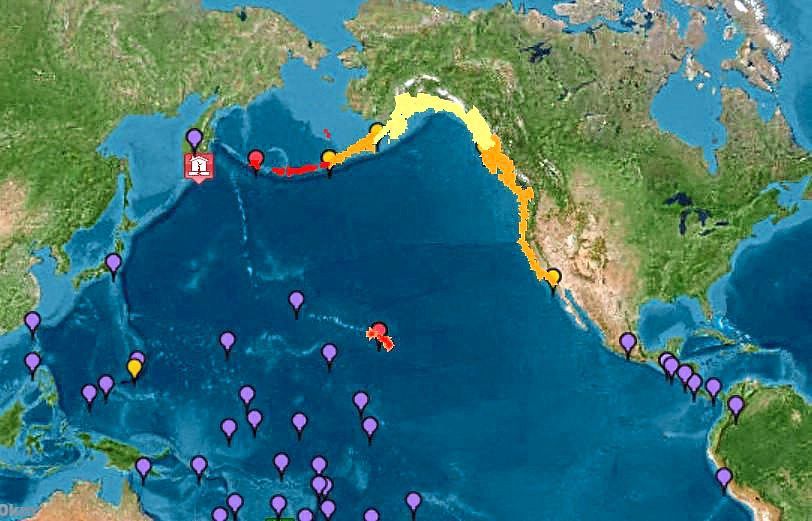
The impact of the tsunami could last for hours or perhaps more than a day, said Dave Snider, tsunami warning coordinator with the National Tsunami Warning Center in Alaska.
“A tsunami is not just one wave,” he said. “It’s a series of powerful waves over a long period of time.
“Tsunamis cross the ocean at hundreds of miles an hour – as fast as a jet airplane – in deep water.
“But when they get close to the shore, they slow down and start to pile up. And that’s where that inundation problem becomes a little bit more possible there.”
“Because of the Earth basically sending out these huge ripples of water across the ocean, they’re going to be moving back and forth for quite a while,” which is why some communities may feel effects longer, he said.
The quake at 8.25am Japan time had a preliminary magnitude of 8.0, Japan and US seismologists said. The US Geological Survey later updated its strength to 8.8 magnitude, and the USGS said the quake occurred at a depth of 20.7km.
The quake was centred about 119km east-southeast from the Russian city of Petropavlovsk-Kamchatsky, which has a population of 180,000, on the Kamchatka Peninsula. Multiple aftershocks as strong as 6.9 magnitude followed.
The first tsunami wave hit the coastal area of Severo-Kurilsk, the main settlement on Russia’s Kuril Islands in the Pacific, according to the local governor Valery Limarenko.
He said residents were safe and staying on high ground.
About 2,700 people were evacuated to safe locations on the Kuril Islands. Buildings were damaged and cars swayed in the streets in Petropavlovsk-Kamchatsky.
Russian news agencies quoted the regional Health Ministry saying several people sought medical help in Kamchatka after the earthquake, but no serious injuries were reported.
The earthquake was reported to be the strongest in the world since the 9.0 magnitude earthquake off northeastern Japan in March 2011, which caused a massive tsunami that triggered meltdowns at the Fukushima nuclear power plant.
The tsunami alert disrupted transportation in Japan, with ferries, trains and airports in the affected area suspending or delaying some operations.
A tsunami of 60cm was recorded at Hamanaka town in Hokkaido and Kuji port in Iwate, according to the Japan Meteorological Agency. Several areas reported smaller waves, including 20cm in Tokyo Bay five hours after the quake.
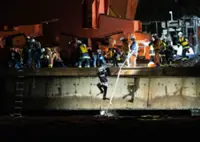
In Japan’s northern coastal town of Matsushima, dozens of residents took refuge at an evacuation centre, where water bottles were distributed and an air conditioner was running.
One person told NHK she came to the facility without hesitation based on the lesson from the 2011 tsunami.
Japanese nuclear power plants reported no abnormalities.
The operator of the Fukushima Daiichi plant damaged by the 2011 tsunami said about 4,000 workers are taking shelter on higher ground at the plant complex while monitoring remotely to ensure plant safety.
Philippine authorities advised people to stay away from the beach and coastal areas.
“It may not be the largest of waves, but these can continue for hours and expose people swimming in the waters to danger,” Teresito Bacolcol of the Philippine Institute of Volcanology and Seismology told The Associated Press. — AP