Brazilian President Luiz Inácio Lula da Silva rebuked US President Donald Trump for his latest tariff threat against Brics nations on Monday, while the bloc as a whole offered no public response to what critics called an alarming act of economic intimidation.
“I don’t think it’s very responsible and serious for a president ... of a country the size of the US to threaten the world over the internet – it’s not right,” Lula said during a news conference at the conclusion of the Brics leaders’ summit in Rio de Janeiro.
He said the members of the group of emerging economies were “sovereign countries” and noted that other nations had the same right to levy taxes as Washington.
“The world has changed. We don’t want an emperor,” Lula added.
“Frankly, there are other things and other ways for the president ... to talk to other countries. People need to understand that respect is good – we like to give it, and we like to get it in return,” he said.
The Brazilian president was reacting to comments Trump made on Sunday that he would impose an additional 10 per cent tariffs on imports from Brics members and aligned countries that pursue what he called the group’s “anti-American policies”.
Brics had earlier issued a leaders’ declaration condemning tariffs, unilateralism and protectionism without naming the US.
Lula said that Trump’s threats were not discussed during the Brics meetings, but contended that some critics had been rattled by the bloc’s growing success in uniting the Global South and amplifying its voice on the world stage.
In Washington on Monday, White House press secretary Karoline Leavitt told reporters that Trump was “closely monitoring” the Brics summit.
However, she said, he did not “perceive these countries as growing stronger”.
“He just perceives them as trying to undermine the United States’ interests.
“And that’s not OK with him, no matter how strong or weak a country is,” Leavitt added.
As an organisation, Brics did not issue any official response to Trump’s comments. But some member nations acknowledged them.
Kremlin spokesman Dmitry Peskov told reporters on Sunday that Trump’s latest statement on Brics had been “noticed”, Russia’s Tass reported.
Beijing also reacted to Trump’s comments, with Chinese Foreign Ministry spokeswoman Mao Ning saying on Monday that Brics “is not a bloc for confrontation, nor does it target any country”.
“As for the US tariff hikes, China has made its position clear more than once,” she added. “Trade war and tariff war have no winners, and protectionism leads nowhere.”
Trump did not specify which policy or language in the declaration he considered anti-American. In January, shortly after returning to the White House, he declared that Brics was “dead” and claimed no one wanted to join the bloc.
He also threatened 100 per cent tariffs against Brics members over the group’s push for “de-dollarisation” and use of local currencies in internal trade.
On Sunday, the Brics leaders’ declaration called for Israeli troops to withdraw from Gaza on the eve of Trump’s scheduled meeting on Monday with Israeli Prime Minister Benjamin Netanyahu in the White House.
Although the document condemned recent Israeli and US military strikes on Iran’s nuclear facilities as a “violation of international law”, it did not explicitly name either country. Iran became a full Brics member in January.
Brics, an acronym denoting the earliest members Brazil, Russia, India, China and South Africa, has since added Egypt, Ethiopia, Indonesia, Iran and the United Arab Emirates to its group of emerging economies.
Brics members including India, China and Indonesia are currently engaged in trade negotiations with the Trump administration.
Last week, Vietnam, a Brics partner country, reached a trade deal with the US.
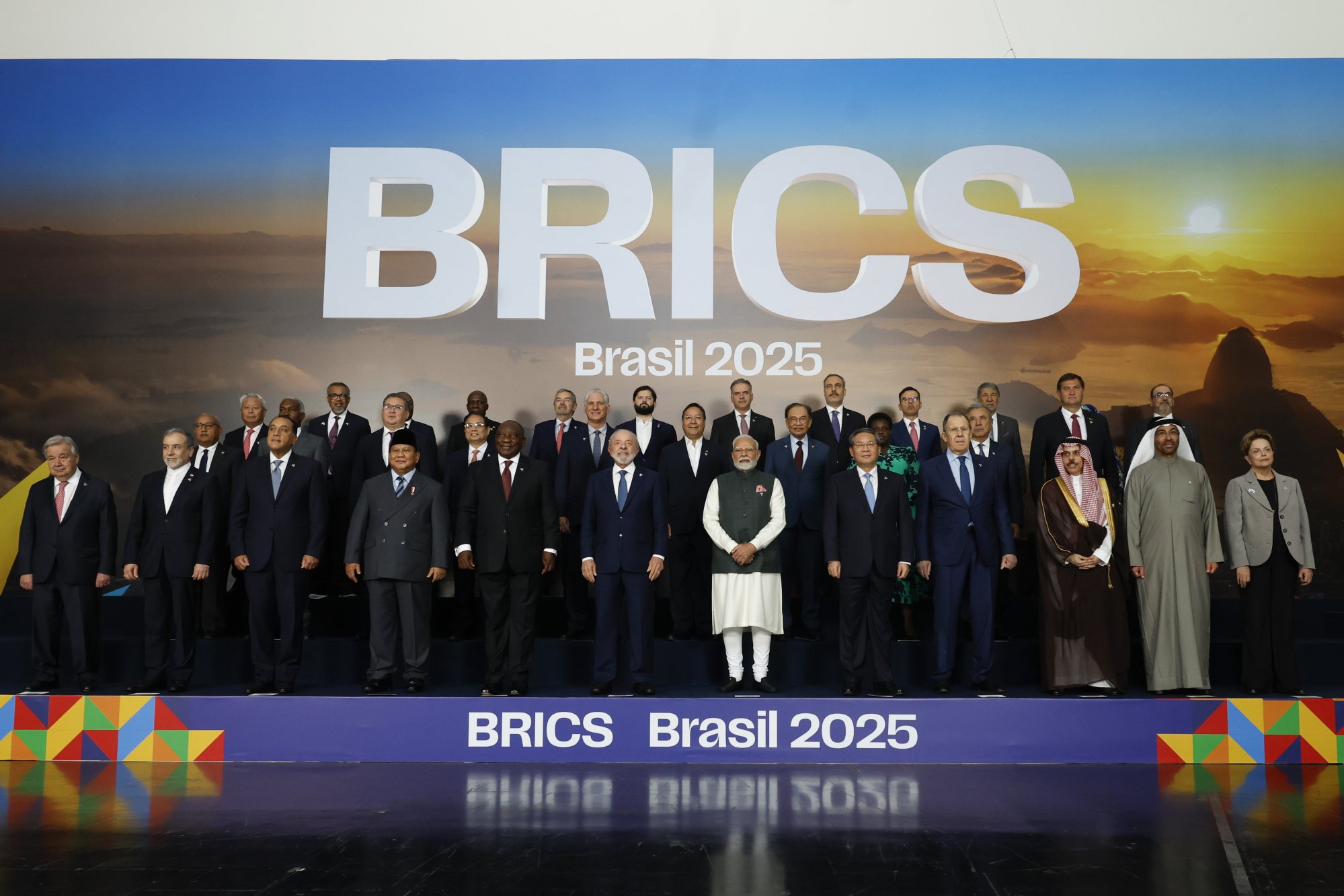
On Monday, Lula participated in a new group photograph that, in addition to 10 Brics full members, included UN Secretary General Antonio Guterres, World Health Organization Director General Tedros Adhanom Ghebreyesus, and the presidents of Chile, Uruguay, Uganda and Bolivia.
Gustavo de Carvalho of the South African Institute of International Affairs in Johannesburg did not expect any “war of words” between Brics and Trump unless the US takes direct action toward bloc members and partner countries.
He said that many Brics members preferred “not to be seen as an anti-Western type of group, but rather as a representative of a non-Western group”.
He contended that Trump’s threats would not deter new countries from joining the bloc – unless those threats materialise. He argued that “the US would have to be far more aggressive than it has been so far to really reduce that level of interest”.
Such threats, he said, were part of “seeking leverage between the US and other economies”, providing the US with better terms when trading with countries that several Brics members also engage with.
Farwa Aamer of Asia Society in New York, noting long-standing divisions within Brics, said that while existing members were unlikely to leave Brics, Trump’s posture “could deter some Global South countries from joining any time soon, especially those looking to maintain stable ties with the US”.
“Given those dynamics, we’re more likely to see a muted or fragmented response, if any. Most will likely adopt a wait-and-see approach rather than escalate tensions, especially with uncertainty around the trade and economic landscape,” she said.
Also on Monday, the US said that Secretary of State Marco Rubio would travel to Malaysia, a Brics partner country, from Tuesday to Saturday, to take part in the Asean-United States Post-Ministerial Conference, the East Asia Summit Foreign Ministers’ Meeting and the Asean Regional Forum Foreign Ministers’ Meeting.
Speaking at the Brics business forum last week, Malaysian Prime Minister Anwar Ibrahim urged Brics countries to learn from Asean on how to challenge Western dominance.
Anwar said that the Global South should speak “from a position of strength” in international matters and he encouraged the bloc to continue discussions on reducing its dependence on the US dollar as a reserve currency.
“Of course, we’re not talking about de-dollarisation, because there’s a long way to go, but at least we try – Malaysia with Indonesia, Malaysia with Thailand, and together with China – trying to use our own local currency,” he added. “Even beginning with 10 or 20 per cent, it makes a difference.” - SOUTH CHINA MORNING POST