THE ending of India's prize-winning movie Dangal, there was a statement made. The heroine of the movie won a Commonwealth Games gold medal at the end movie and after the prize presentation ceremony, a young girl got up and proudly said “Bharat Mata Ki Jai”, or “Long live Mother Bharat”.
The great actor and legend Amitabh Amitabh Bachchan also tweeted “Bharat Mata Ki Jai”, or “Long live Mother Bharat" just recently.
And this word Bharat is now just about the talk of town in almost everywhere when India is concerned. It began with a dinner invitation. How it ends could affect more than a billion people.
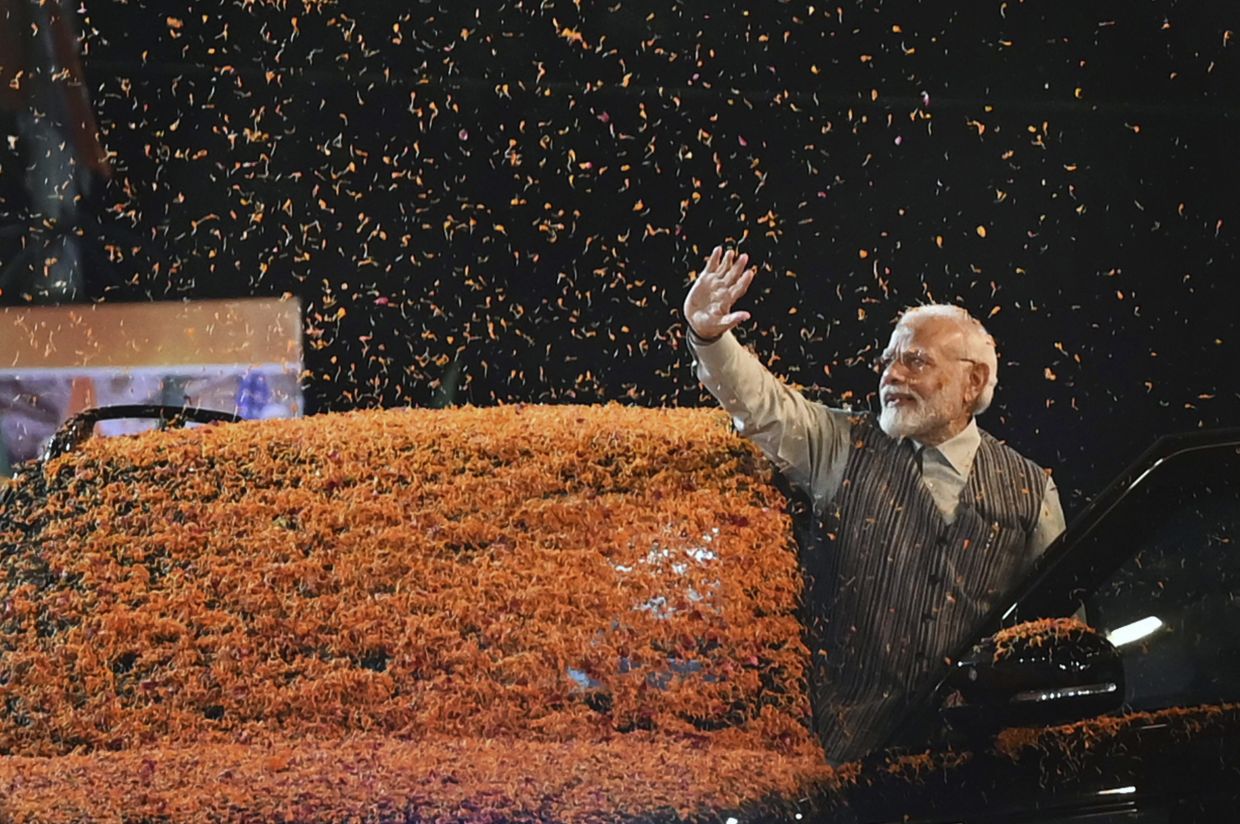
Prime Minister Narendra Modi’s government had replaced the name India with a Sanskrit word in dinner invitations sent to guests attending last week’s Group of 20 summit, in a move that reflects his Hindu nationalist party’s efforts to eliminate what it sees as colonial-era names.
Indian President Droupadi Murmu is referred to as “President of Bharat” instead of “President of India” in the invitation sent to G20 attendees. The nation of more than 1.4 billion people is officially known by two names, India and Bharat, but the former is most commonly used, both domestically and internationally.
Bharat is an ancient Sanskrit word which many historians believe dates back to early Hindu texts. The word also means India in Hindi.
Why is it such a hot topic ... The change in nomenclature is backed by officials of Modi’s Bharatiya Janata Party. They argue that the name India was introduced by British colonials and is a “symbol of slavery.” The British ruled India for about 200 years until the country gained independence in 1947.
Or maybe it's just plain hatred of what the English did to India when they invaded the country and took over the land in such cunning and bad ways.
Many Indians just feel hurt of how their ancestors were treated during the British rule, the millions who perished during the British iron-fisted ways and famine that was actually started by the English empire. Food which was for Indians were stolen for the British people and soldiers. And then the uncountable numbers who were just shot dead for speaking up and the list goes on and on and on.
The facts that remains that many Indians just feel hurt of what their ancestors went through during the British and also the Muslim Mughal rule, which was before the British rule and also much derided by many Indians. It is just plain hurt.
Many feel it was during this time that many Indians were forced to leave their homes and today call countries in North America, Europe, Asia and even Africa their home now. And how their ancestors were even forced as slaves in many other countries and died without their family members not even knowing their fate.
It's just hurt and more hurt. The want to change India's name to Bharat is not surprising anyway. Many Indians say it is the same but the things is British went with the India name.
Not to mention it was the British who broke the land into two sections in 1947 - when the land of Bharat became India and Pakistan (and please let us not even go in the amount of dead people during the dreaded partition). Many and still many blame that carnage to the British.
“Another blow to slavery mentality,” the top elected official of Uttarakhand state, Pushkar Singh Dhami, said on X, formerly known as Twitter. Dhami, who is a leader of Modi’s governing party, and shared the dinner invitation sent to G20 guests in his post.
Modi’s party has also long tried to erase names related to India’s Mughal and colonial past.
In 2015, New Delhi’s famous Aurangzeb Road, named after a Mughal king, was changed to Dr. APJ Abdul Kalam Road after protests from Modi’s party leaders. Last year, the government also renamed a colonial-era avenue in the heart of New Delhi that is used for ceremonial military parades.
Modi’s government says the name changes are an effort to reclaim India’s Hindu past. They have done it in the past anyway.
For instance, Bombay is now Mumbai, Madras is Chennai, from Calcutta to Kolkata, from Pondicherry to Puducherry, from Bangalore to Bengaluru and the list just goes on and on.
And all the time, it was always supported widely by the local living in these cities. They just want their identity and name back. As long it wipes out the memory of the invaders, do it for the sake of the Indian people.

And for the record, the Indian government usually uses “India” when the text is in English, and “Bharat” when it is in the Hindi. They just want to make it all the way now. Many Indians says it is the right move.
However, no official agency has confirmed such a change, but with national elections due in 2024, the Hindu nationalist BJP has rekindled an old debate that has now seen lines drawn between secularism and Hindu nativism.
Goes without saying that an alliance of 28 opposition parties, including the Congress Party, in July, said it was a not good move. India’s opposition parties are currently criticising the move at every chance they get.
“While there is no constitutional objection to calling India “Bharat,” which is one of the country’s two official names, I hope the government will not be so foolish as to completely dispense with “India,” which has incalculable brand value built up over centuries,” opposition lawmaker Shashi Tharoor said on X, in a report by AP.
Tharoor said Indians should “continue to use both words rather than relinquish our claim to a name redolent of history, a name that is recognized around the world.”
Disputes over “India” versus “Bharat” have gained ground since opposition parties in July announced a new alliance — called INDIA — to unseat Modi and defeat his party ahead of national elections in 2024. The acronym stands for Indian National Developmental Inclusive Alliance.
Since then, some officials in Modi’s party have demanded that the country be called Bharat instead of India.
AND SINCE THEN, Prime Minister Narendra Modi ’s ministers, his Hindu nationalist supporters followed by Bollywood stars and cricketers have made similar public proclamations: India should officially be rebranded as Bharat.
As stated earlier, India is known by two names: India, used worldwide, and the Sanskrit and Hindi nomenclature of "Bharat.” Now, Modi’s government is signaling that Indians should shed the name India and instead call their country Bharat.
And always when India do battle especially in sports they are always called 'Bharat Army'. And so are the fans.
The possibility is resonating with Hindu nationalists who form the prime minister’s core vote base. Their stated reason: the name "India” is tied to colonialism and slavery, a sentiment that Modi’s ruling Bharatiya Janata Party has long shared. But the reasons - political, cultural, historical - run far deeper.
A name - be it of a person or an entire country - is many things. It's descriptive, emotionally important and deeply wrapped up in identity. So when it comes to a whole nation, a name change is not a small thing.
Around the world, there have been some notable national rebrandings in recent decades as nations shed names inflicted by colonial rulers. Ceylon was changed to Sri Lanka in 1972. Rhodesia got rebranded as Zimbabwe in 1980. Burma became Myanmar in 1989. And last year, Turkey was officially changed to Türkiye. The list goes on - Cambodia to Kampuchea (and eventually back again), Swaziland to Eswatini.
In India, the country’s renaming demands stem from a more cultural and religious perspective. They are often invoked by Hindu nationalists who say the name Bharat is more authentic to the nation’s past.
Officially, the Indian government has made no decision and issued no statement, and one senior leader dismissed the speculations of a name change as "just rumours.” But India’s foreign minister, Subrahmanyam Jaishankar, seemed to advocate the increased use of Bharat this week.
"‘India, that is Bharat’ - it is there in the constitution. Please, I would invite everybody to read it,” Jaishankar said Wednesday.
Indeed, India's constitution uses the term Bharat just once: "India, that is Bharat, shall be a Union of States.” Everywhere else, the country is referred to as India in English.
The name Bharat is an ancient Sanskrit word that many historians believe dates back to early Hindu scriptures. "India” has etymological roots in the Indus River, which was called "Sindhu” in Sanskrit. Another popular but not legally recognized name for the country is Hindustan, which means "land of the Indus” in Persian. All three names were in use long before British rule.
But Modi’s government, which won 2014 national polls and returned to power in 2019, has a penchant for changing names.
It has done so with various cities, towns and prominent roads that were long associated with the British rule and Muslim heritage, arguing it is an ongoing effort to salvage the country from the taint of colonialism and so-called Muslim invaders. Prominent among such efforts is the government’s renaming of the northern city of Allahabad - named by Muslim Mughal rulers centuries ago - to the Sanskrit word "Prayagraj.”
The name-changing exercise is fraught with a political motivation that is an essential ingredient of the ruling government’s revisionist agenda and has, under Modi’s rule, come amid increasing attacks by Hindu nationalists against minorities, particularly Muslims. A largely Hindu country that has long proclaimed its multicultural character, India has a sizable Muslim minority - 14% of the population.
Efforts to change India’s name have been made in the past through court cases, but judges have so far steered away from the issue. However, an upcoming session of the federal Parliament - a surprise announcement made by the Modi government without disclosing any agenda - has prompted speculation. Opposition parties say an official rebranding could very well be in the cards.
And how a simple yet so authentic name like Bharat will ultimately effect billions of people in India, among the powerhouse economic country in the world now, and also outside the country. Maybe it will be just that as that little girl proudly announced in the movie Dangal: 'Bharat Mata Ki Jai'.
(For the record - a walk down history's writing: "'Bharat', the name for India in several Indian languages, is mainly derived from the name of the Vedic tribe of Bharatas who are mentioned in the Rig Veda as one of the principal kingdoms of the Aryavarta. It is also variously said to be derived from the name of either Dushyanta's son Bharata of Mahabharata.
When it comes to 'Bharat', historians have said says that the term first comes from the Rig Veda as well. It is a reference to Bharata, king of the Bharata clan, who won the battle of ten kings. And hence called the country 'Bharat'.
And the framers of the Indian Constitution also deliberated on this matter. Given India's linguistic and cultural diversity, it was decided to use both "Bharat" and "India" in the Constitution. Article 1 of the Indian Constitution states, "India, that is Bharat, shall be a Union of States.)
Already a subscriber? Log in
Get 20% OFF The Star Digital Access
Cancel anytime. Ad-free. Unlimited access with perks.