MANILA (The Straits Times/Asia News Network): United States President Joe Biden is welcoming Philippine President Ferdinand Marcos Jr to the White House on May 1, with their meeting set against the backdrop of heightened tensions with China.
White House Press Secretary Karine Jean-Pierre said the two leaders will discuss their countries’ efforts to uphold international law and promote a free and open Indo-Pacific, where Beijing is exerting its influence.
They will review opportunities to deepen economic ties and tackle issues like clean energy transition, climate change and human rights.
“During the visit, President Biden will reaffirm the United States’ iron-clad commitment to the defence of the Philippines, and the leaders will discuss efforts to strengthen the longstanding US-Philippines alliance,” Jean-Pierre added.
The two leaders first met in September 2022 on the sidelines of the United Nations General Assembly in New York, where Marcos raised mention of China’s rising military aggression in the South China Sea. Manila and Beijing have competing claims over the disputed waterway.
The White House announcement came amid China’s displeasure over the Marcos government giving the US access to four more military bases under the Enhanced Defence Cooperation Agreement (EDCA), three of which are in two northern Philippine provinces that are only hundreds of kilometres from Taiwan.
This 2014 deal allows the US to rotate troops, bring in equipment and hold joint exercises with their Filipino counterparts in nine mutually agreed military bases in the Philippines.
The Filipino and the US military forces are also holding until April 28 their largest war games yet, aiming to highlight their maritime defence capabilities.
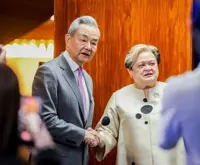
The White House’s press release was made on the same day Chinese State Councillor and Foreign Minister Qin Gang is arriving in Manila to meet Philippine Foreign Affairs Secretary Enrique Manalo.
Experts see the EDCA expansion as a means for the US and the Philippines to deter China’s growing military aggression in the Taiwan Strait and the South China Sea.
Though Manila has no diplomatic relations with Taiwan, it would be caught in the crossfire should tensions escalate between the the island and China.
Manila has said it will not interfere in China’s domestic affairs, and that it will not be used by a third party to advance their cause.
Chinese Ambassador Huang Xilian drew criticism last week for telling the Philippines that if it genuinely cares about the safety of Filipino workers in Taiwan, it should “oppose Taiwan independence” instead of stoking tensions in the region by expanding the Edca.
Marcos, however, downplayed Mr Huang’s controversial statement as having been “lost in translation”. He plans to meet the envoy soon to clarify his remarks that were made at a forum in Manila.
There are about 158,000 Filipinos working in Taiwan.
The Philippines and the US are long-time allies but relations turned cold under former president Rodrigo Duterte. He pivoted away from Washington in favour of getting loans and grants from China.
Relations between Manila and Washington are seeing a reboot under Marcos, who is rekindling defence and security ties with the US as Chinese incursions continue in the eastern parts of the South China Sea that lie within the Philippines’ exclusive economic zone.
Despite the tensions, he is also fostering economic ties with China, which remains as the largest trading partner of the Philippines. He went to Beijing for a state visit in January, where a plan to revive talks on a possible joint and gas exploration in the South China Sea was discussed with President Xi Jinping.
This weekend’s meeting between the Chinese and Filipino foreign ministers will follow up on the agreements made during Marcos’ state visit as well as last month’s bilateral talks that were held in Manila.
Already a subscriber? Log in
Get 20% OFF The Star Digital Access
Cancel anytime. Ad-free. Unlimited access with perks.