JAKARTA, March 20 (The Straits Times/ANN): Doubts are growing over whether Indonesia will move its administrative capital from Jakarta to East Kalimantan, as the government faces the costly tasks of supporting the country's recovery from the pandemic downturn and keeping energy prices affordable at home.
The project is estimated to cost 467 trillion rupiah (S$44 billion). About 80 per cent of the financing will come from private and third-party investors.
Softbank, however, has recently pulled out its investment plan without disclosing any reason. Tempo daily reported that Softbank listed conditions that Indonesia rejected, including setting a minimum number of people moving to the new capital city.
"It needs enormous funding and our priority right now are the pandemic-related measures and efforts to keep energy prices stable domestically. Subsidising petrol price needs huge funding, while our fiscal space is limited," Mr Bima Yudhistira, director at the Centre of Economic and Law Studies in Jakarta, told The Straits Times. "It is a long way to go (before such a plan can be realised)."
Higher global energy prices have put a strain on the Indonesian state budget as the government partly subsidised domestic energy prices to keep them affordable.
The new capital law, passed in January 2022, mandates the government to move the administrative capital to East Kalimantan, in a bid to spread the distribution of income. Today, 58 per cent of the nation's economic activities are centred in the most populous Java Island, where Jakarta is located.
The Nusantara Capital city, located in Penajam Paser Utara regency, is expected to officially open by October 2024, when President Joko Widodo's term ends. The full completion of the mega project is expected within 15 to 20 years.
Jakarta, with a population of more than 10 million, has for many decades been the administrative capital, as well as the financial and business hub.
Dhony Rahajoe, head of the Nusantara Capital City Authority, said the 60,000 civil servants, military and police who will be moving to the new capital will create demand for food, clothes and housing, as well as education, medical services, amusement parks and other facilities.
"All these demands will be opportunities for the investors to cater to," Dhony told The Straits Times via mobile text messages.
Facilities to support the day-to-day running of the government, as well as basic infrastructure such as a clean water processing plant will also be needed, he noted.
"We will open up a wide range of opportunities for partnership (with any interested investors)," he said.
The government said the United Arab Emirates has maintained its interest in investing.
Urban planning expert Yayat Supriyatna of the Trisakti University in Jakarta told The Straits Times that among the challenges to attracting investors is the size of the population in the new capital and its greater areas - the existing cities of Balikpapan and Samarinda.
The population is estimated to be seven million by 2045, which will be dwarfed by the 170 million people forecast in Java.
"We have high-speed train construction between Jakarta and Bandung, LRT (Integrated Rail Line) projects and others going on. Investors would instead be drawn to Java," Yayat said.
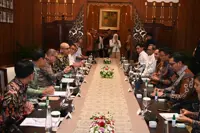
Meanwhile, President Widodo and governors from across the country inaugurated the site with a ceremony on March 14.
West Java governor Ridwan Kamil said: "We need to think about who will live here. If we only rely on civil servants, it would be too quiet a place. The city must have adequate facilities that would make non-civil servant residents want to reside here."
West Papua governor Dominggus Mandacan praised the new capital 's location, saying it would make travel more convenient.
"We, in eastern Indonesia today, need to spend five hours to fly to Jakarta. The new capital would only require us to spend two to 2.5 hours," he said. - The Straits Times/ANN
Already a subscriber? Log in
Get 20% OFF The Star Digital Access
Cancel anytime. Ad-free. Unlimited access with perks.