Tibet railway in focus as China vows change for landlocked Nepal, in move sure to worry India


By Amber WangBen Zhao

China will help landlocked Nepal boost connectivity via road and rail, Foreign Minister Wang Yi has said, in a move that experts say will raise strategic concerns for regional rival India.

Addressing the International Conference on Nepal’s Reconstruction, Wang also pledged continued Chinese support for rebuilding the country after the devastating earthquake of 2015 and urged closer cooperation under the Belt and Road Initiative.

“China will make solid progress in the feasibility study of a cross-border railway project, improve the trans-Himalayan multidimensional connectivity network, and help Nepal realise its dream of changing from a ‘landlocked country’ to a ‘land-linked country’,” Wang told the conference via video link on Wednesday.

Do you have questions about the biggest topics and trends from around the world? Get the answers with SCMP Knowledge, our new platform of curated content with explainers, FAQs, analyses and infographics brought to you by our award-winning team.

He also called for deeper belt and road cooperation on issues ranging from trade, investment and energy supplies to infrastructure and climate change, to help the Himalayan nation with its economic recovery.

‘Himalayan Quad’: is China about to start its own security bloc?

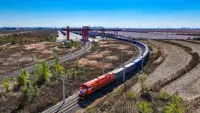
The US$8 billion cross-border railway – from Shigatse, or Xigaze, in south Tibet to Nepalese capital Kathmandu – is expected to boost the economy of Nepal, the second poorest country in Asia after North Korea. It is also an important part of China’s ambitious belt and road strategy in South Asia.

It was among 20 bilateral deals signed during Chinese President Xi Jinping’s official visit to Nepal in 2019, aimed at improving infrastructure connecting the two countries.

Experts say that the two sides’ renewed support for the project – stalled by engineering and environmental challenges – was clearly targeted at India’s dominance over its smaller neighbour.

Professor Madhav Nalapat, vice-chair of the Manipal Advanced Research Group, said the problem with the railway was that, while it had strategic value, it would have limited practical use as there was a lack of demand for trade on the route.

“Nor will there be much passenger demand,” Nalapat said. “Hence the view of many in India that the actual purpose of the railway is to speed up the entry of troops from China into Nepal [which borders India].”

Relations between Beijing and New Delhi have worsened since June last year, when Chinese and Indian troops engaged in a deadly hand-to-hand skirmish on their disputed border in the western Himalayas.

“There is a gap between China and India’s positions in South Asia, with India’s penetration of South Asian countries being much higher than China’s,” Lin Minwang, deputy director of the Centre for South Asian studies at Fudan University, said.

“China can help boost the economies of South Asian countries and, at the same time, enhancing relations with China is a way [for Nepal] of expressing dissatisfaction towards India.”

The Tibet-Kathmandu rail project has been opposed by India amid rising competition with China for strategic influence in the Himalayas, which saw authorities in Nepal agree to fast-track a rail connection from Kathmandu to the Indian mainland last year.

Rajeev Ranjan Chaturvedy, associate professor at Nalanda University, said India was concerned about the China-Nepal railway project’s potential ecological impact.

Why Nepal is still rebuilding, half a decade after the earthquake

During Wednesday’s conference, Wang also pledged continued support for Nepal’s battle against the Covid-19 pandemic and for its post-quake recovery, while emphasising that aid should not come with strings attached.

“China supports Nepal’s leading position in rebuilding international cooperation. All parties should respect Nepal’s sovereignty, security and development needs and should not attach any political strings to assistance to Nepal,” he said.

For the latest news from the South China Morning Post download our mobile app. Copyright 2021.

Get 20% OFF The Star Digital Access

Monthly Plan

RM 13.90/month

RM 11.12/month

Billed as RM 11.12 for the 1st month, RM 13.90 thereafter.

Best Value

Annual Plan

RM 12.33/month

RM 9.87/month

Billed as RM 118.40 for the 1st year, RM 148 thereafter.

Follow us on our official WhatsApp channel for breaking news alerts and key updates!
China , Tibet , Nepal , India. Railway

Next In Aseanplus News

Seoul hosts Asia's only stop in world's first professional dance league
Nationwide promotion for more than 5,600 police officers
Bangkok–Phitsanulok high-speed rail project set for cabinet push
Indonesia's layoff wave fuels calls for urgent business support and economic reforms
Over 40 cars, including 11 Rolls-Royces, linked to S$3bil Singapore money laundering probe up for closed-bid auction
Forest City cooperating with cops after massive scam raid
A US citizen deleted his phone’s data. Now he faces a felony charge
China builds up rail freight with Europe
20 foreign nationals charged in Johor Baru over scam syndicate
Sri Lankan expert calls for stronger SCO media, think tank ties

Others Also Read