China-Russia nuclear energy cooperation has strategic significance


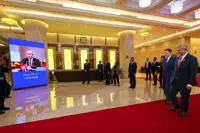
Xi and Putin on Wednesday witnessing the groundbreaking ceremony of the bilateral nuclear energy cooperation projects via video link on May 19, 2021. - Xinhua

BEIJING (Global Times): Chinese President Xi Jinping and Russian President Vladimir Putin witnessed via video link the groundbreaking ceremony of four advanced nuclear reactors powered by Russia's third-generation nuclear technology in China on Wednesday (May 19).

Observers said Wednesday that the start of construction on the four new nuclear reactors, the biggest China-Russia nuclear energy cooperation project to date, marks a milestone in China-Russia nuclear energy cooperation and is further proof that the two countries are moving closer in the face of escalating US sanctions and restrictions.

Nuclear cooperation is of great strategic significance due to its direct relation to energy security and national security, as well as global governance and challenges like climate change and nonproliferation.

Cooperation between the two major nuclear powers and permanent members of the UN Security Council is of global significance, Chinese experts said.

The four nuclear generating units - two at the Tianwan Nuclear Power Plant in East China's Jiangsu Province and two at the Xudapu Nuclear Plant in Northeast China's Liaoning Province - have a reported combined power generation output of 37.6 billion kilowatt hours a year upon completion, and will reduced carbon emissions by 30.68 million tons.

The event on Wednesday saw China's fleet of nuclear power reactors that are approved for or under construction become the world's largest, increasing to 23 from 19.

Xi put forward a three-point proposal at the ceremony.

First, he called on both sides to adhere to the principle of safety first and set a model for global nuclear energy cooperation.

Second, Xi suggested the two countries deepen scientific and technological cooperation on nuclear energy by sticking to the driving force of innovation.

Third, he called for adherence to strategic collaboration to promote the coordinated development of the governance system of the global energy industry.

Putin said at the ceremony that all agreements between Russia and China reached at the top level are being implemented, with many other large initiatives having been implemented, apart from construction of the new power units of the Tianwan and Xudapu nuclear power plants, TASS reported.

Putin considers cooperation in peaceful nuclear development an important element of the whole complex of the China-Russia strategic partnership, which is of a deep, genuinely friendly and mutually beneficial nature.

The beginning of the construction of the four units demonstrates the major cooperation outcomes in high-end equipment manufacturing and science and technology innovation and will boost the upgrading of practical cooperation between the two countries, Chinese Foreign Ministry spokesperson Zhao Lijian said Tuesday.

Lin Boqiang, director of the China Center for Energy Economics Research at Xiamen University, told the Global Times on Wednesday that the launch of the four Russian-technology-powered nuclear power plants in China will be a boon for Russian nuclear energy technology exports, should countries be interested in developing third-generation nuclear power plants.

Although accounting for only 2 per cent of China's installed capacity, nuclear power generated about 5 per cent of electricity in China in 2020, showing their comparative advantage to wind and solar energy.

However, Lin noted that there is an upper limit in the number of nuclear reactors China can build on its soil, at around 150, while the country is projected to have 75 units by 2025. There are currently 49 nuclear power reactors in operation in China.

China-Russia energy cooperation and energy trade are expected to provide more impetus to the two countries' goal to further increase bilateral trade. China and Russia have set a goal to lift bilateral trade volume to $200 billion by 2024.

Amid continuous US sanctions and restrictions against Russia and China, cooperation between the two countries bears a special significance.

"China-Russia nuclear cooperation has a great political and strategic significance. It's even more strategic than military cooperation," Yang Jin, an expert at the Institute of Russian, Eastern European and Central Asian Studies at the Chinese Academy of Social Sciences, told the Global Times on Wednesday.

In the past, China also has engaged in nuclear cooperation with some Western countries, including other three permanent members of the UN Security Council - the US, the UK and France.

"But due to geographical limitations and the changing attitude toward China caused by political power transitions in the West, some cooperation projects with Western countries are not very sustainable and have great uncertainties," Yang noted.

China-Russia nuclear cooperation is far more sustainable and stable, because of the political stability and consistency within the two countries, so the cooperation level and mutual trust between Beijing and Moscow in this field are much better than their ties with the West, Yang said.

In terms of nuclear technology or the capacity to use nuclear energy peacefully, China and Russia are complementary and have unique advantages and higher reliability than other countries in this field, experts said.

Li Xin, an expert in Eurasian Studies with the Shanghai University of Political Science and Law, said,"Russia has some of the world's best technology and China could tap it to replace US techology given the latter's escalating crackdowns and restrictions in recent years. For Russia, China has funds and some technologies to offer."

Li said China's advantages lie in space technology and the digital economy, particularly e-commerce.

In recent years, bilateral cooperation has achieved big strides in the natural gas trade, the Arctic liquefied natural gas project, 5G, cloud services and smart transportation.

Trade between China and Russia returned to positive growth in the first four months of this year despite the negative effect of the pandemic, with January to April trade reaching US$40.21 billion, a year-on-year increase of 19.8 percent, China's Ministry of Commerce said last week.

With improved trade, the ministry predicted bilateral trade will reach a new high in 2021.

In addition to energy and resources, trade in Russian agricultural products, food, poultry and beef witnessed huge growth in 2020, according to media reports.

"The restrictions launched by the US and its allies against China and Russia were doomed to fail. China and Russia will achieve more developments with or without Western participation," Yang said.

China is the world's testing ground for third-generation nuclear technologies, and the event puts the Russian VVER-1200 technology in competition with China's homegrown third-generation Hualong One technology, as well as those developed by Westinghouse and Europe-based Orano.

Lin noted that when the first nuclear units utilizing the American AP1000 and French EPR third-generation nuclear technology were being implemented in China, both projects saw unbearable delays and cost the project owners a fortune.

"The nuclear unit using China's homegrown Hualong One technology is so far the only third-generation reactor project that was completed in time, and it begs the question as to how the Russian VVER-1200 units will be completed in China and if there could be delays," Lin said.

Nuclear energy cooperation is a sector that requires strategic trust. China-Russia nuclear energy cooperation dates to the 1950s and experts said that Wednesday's event shows that cooperation between China and Russia is keeping abreast with the times and continues to yield new fruits.

In contrast, China's nuclear energy cooperation project with the UK, at Hinkley Point, has seen little progress.

Nuclear cooperation between China and Russia will not only benefit the two countries but will also contribute to global governance in the fields of fighting the energy crisis, reducing carbon emissions and will provide fairer solutions for nuclear nonproliferation issues, said experts.

Many sensitive and long-standing nuclear issues like those pertaining to Iran and North Korea are related to the peaceful use of nuclear power. Technology cooperation between China and Russia could provide more flexibility for these countries to find fairer solutions, rather than letting the US use its technological advantages and sanctions to bully others and cause deadlocks or reversals, Yang noted. - Global Times

Get 20% OFF The Star Digital Access

Monthly Plan

RM 13.90/month

RM 11.12/month

Billed as RM 11.12 for the 1st month, RM 13.90 thereafter.

Best Value

Annual Plan

RM 12.33/month

RM 9.87/month

Billed as RM 118.40 for the 1st year, RM 148 thereafter.

Follow us on our official WhatsApp channel for breaking news alerts and key updates!
China , Russia , energy , nuclear , cooperation , Xi , Putin

Next In Aseanplus News

Ketan Agarwal murder: Siya took 1 crore from fiance, gave it to boyfriend Chetan
Hong Kong proposes reforming sexual crime laws
Brunei Darussalam Food Authority to take over food safety responsibilities in Tutong, Temburong
Bangladesh sentences Singaporean tycoon for financial crime; his lawyers say he was not charged
Asean News Headlines at 10pm on Monday (June 29, 2026)
Hong Kong’s Lai, astronauts mark one month in orbit with baked pumpkin
Michelle Yeoh's husband Jean Todt on why it took 19 years for them to get married
Vietnam's Hue to invest US$3.1mil restoring walls at Imperial Citadel
Johor polls: Bersatu will not tell members to back Barisan in seats Perikatan is not contesting
‘Over 12 Indian LPG vessels passed through Hormuz without any tolls’: Indian minister ensures uninterrupted gas supply

Others Also Read