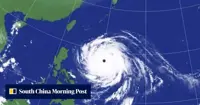
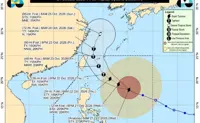
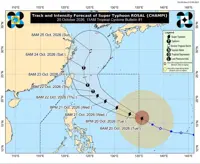
Cars damaged after a gymnasium collapsed at the height of super Typhoon Goni after it hit Tabaco, Albay, in Manila, on Nov 1, 2020. - AFP
SINGAPORE, Nov 3 (The Straits Times/ANN): What's the story and why does it matter?
Parts of the Philippines were devastated by Super Typhoon Goni on Sunday (Nov 1), the 18th such storm to hit the country this year. More than 30 million people were affected, with about a million evacuated from their homes. At least 20 people had been killed as of Tuesday afternoon. More than US$30 million worth of crops were damaged.
Goni is forecast to make landfall in central Vietnam on Wednesday night, a region already reeling from Typhoon Molave and several other storms in recent weeks. The destruction caused by the storms has claimed some 160 lives in Vietnam. Molave cost Vietnam an estimated US$430 million in economic losses.
Another storm, Atsani, is gaining strength in the Pacific Ocean and looks set to hit the Philippines later this week.
These natural disasters are crimping efforts to bring the Covid-19 pandemic under control in affected countries.
How are typhoons formed?
Typhoons, hurricanes and cyclones are large rotating storms that form over tropical waters. They can pack wind speeds of at least 120kmh. Storms formed in the Western Pacific Ocean are called typhoons; those that form in the Atlantic or Eastern Pacific are known as hurricanes, while those in the Indian Ocean and South Pacific are termed cyclones.
Warming ocean waters intensify these storms as they provide them with more heat and therefore energy. The stronger the storm is when it makes landfall, the more deadly and destructive it is.
Where and when do they strike?
Typhoons usually form more than 10 degrees north and south of the equator, and move towards the poles and away from the equator.
The Philippines, being the first major landmass facing the Pacific cyclone belt, gets hit by an average of 20 raging storms a year. Vietnam, Cambodia, Thailand and Laos often also lie in the path of such storms. Beyond those countries in South-East Asia, Japan, South Korea, China and India are also prone to being hit by typhoons.
Typhoon season usually starts around June and peters out by November. In recent years, however, some of the strongest typhoons have hit closer to the end of the year.
A picture from a drone shows floodwater in the aftermath of Typhoon Goni in Baao, Camarines Sur, in Philippines on Monday (Nov 2). - Reuters
What do the different category levels mean?
The intensity of a typhoon is measured by its maximum sustained wind speed. Damage caused by high winds and heavy rains, however, increases disproportionately - meaning, a 15 per cent increase in intensity results in a 50 per cent rise in destructive power.
The most common classification method is the Saffir-Simpson scale, which categorises storms across five levels, with a Category 5 storm (sustained winds of at least 252kmh) being the strongest.
Another classification, from the Joint Typhoon Warning Centre, defines a super typhoon as one with a sustained wind speed of at least 241kmh, which is equivalent to a strong Category 4 storm or higher on the Saffir-Simpson scale.
Super Typhoon Goni, a Category 5 storm with gusts of up to 310kmh, is the strongest storm to hit anywhere in the world so far this year.
How are warnings issued, and how do various countries cope?
Tropical storm warnings vary from country to country. In the Philippines, signals are raised at least 36 hours ahead of any making landfall, and TV and radio stations play a part in disseminating the information to rural households. In some parts of rural China, village leaders and volunteers even go door to door to alert villagers about approaching typhoons and flooding risks.
Generally, residents are evacuated from areas deemed most at risk, with the military on standby. Boats are brought back ashore, outdoor boarding and hanging signs are taken down, and people and businesses are advised to secure their doors, windows and roofs to prevent damage.
How are typhoons named?
The World Meteorological Organisation maintains lists of names to be used for tropical cyclones. The names have to be short, distinctive, and relevant to their cultural and geographic areas so that they are easy for people to remember, hence facilitating disaster risk awareness.
For the Western Pacific/South China Sea basin, where a wide variety of languages are spoken, names on the WMO's lists are contributed by countries in the region.
If a typhoon is particularly destructive, that name is retired from the list and will not be reused again. One recent name retired was Super Typhoon Haiyan in 2013, which devastated parts of South-East Asia and killed some 6,300 people in the Philippines alone. - The Straits Times/Asian News Network