
KUALA LUMPUR: The recent case of a terminally ill American woman who ended her life to prevent further suffering sparked global debate on the subject, including Malaysia.
Britanny Maynard, 29, who had end stage brain cancer, died on Nov 1 by taking a fatal dose of barbiturates prescribed to her legally by a doctor, under the state of Oregon’s Death with Dignity Act.
Although euthanasia or assisted suicide is illegal in most countries of the world, there are also legal avenues for the terminally ill in Malaysia to issue an advance medical directive (AMD) to determine the treatment they want or do not want.
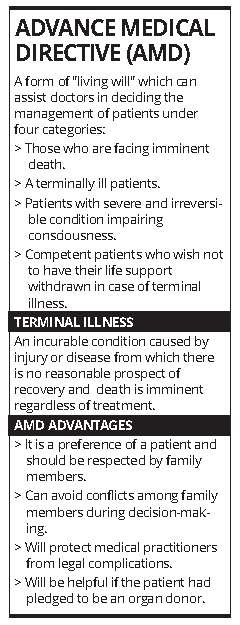
The AMD, or “living will”, gives such patients a greater say in how they want to die before they lose their decision-making capacities and provide doctors guidelines to implement their wishes.
A patient could even give doctors instructions that in the event of rapidly deteriorating health, they would not want to be resuscitated.
Hospital Kuala Lumpur’s (HKL) head of Anaesthesiology and Intensive Care Services Datin Dr V. Sivasakthi said in cases where death was imminent, it would be good if Malaysians could be proactive in getting their end-of-life papers and help their next-of-kin in making crucial decisions such as removal of life support.
She said an AMD would assist doctors decide the management of such patients in a clear and organised manner.
“Sometimes, there will be clashes between the family members over what is the best for such patients.
“For instance, if a widowed woman is warded in the Intensive Care Unit (ICU), her eldest son, may decide for withdrawal of life support but another child may decide otherwise.
“We have to wait till both arrive at an amicable decision on the best plan of management,” she said.
Dr Sivasakthi said there could also be a clash of opinions between the doctors involved in treating the patient.
“A clear directive can ensure that appropriate care is given to the patient,” added Dr Sivasakthi, who is also president of the College of Anaesthesiologists.
She said there were four categories of patients involved in such decision making scenarios: Those facing imminent death, terminally ill patients, those with severe and irreversible conditions impairing cognition and consciousness and competent patients who state his or her wish not to have life support withdrawn in the case of terminal illness.
She stressed that AMD was not the same as euthanasia, which was the deliberate ending of life of a person suffering an illness by unnatural means.
Dr Sivasakthi said currently, doctors explained the condition of such patients to their family members and obtained their consent for the withdrawal of life support.
This group of patients include those suspected to be brain dead. (Brain death is a state when the function of the brain as a whole, including the brain stem, is irreversibly lost.)
She said the need for AMD was becoming increasingly important as there were nine suspected brain dead patients in HKL’s Neuro ICU in 2011, 18 in 2012 and 16 last year.
As for the general ICU, 299 deaths were reported in 2011, 288 in 2012 and 221 last year while 59 cases of brain dead patients were warded there over the past three years.
Malaysian Medical Association (MMA) president Dr H. Krishna Kumar suggested that the Malaysian Medical Council (MMC) come up with an advisory over the use of AMDs.
“It is better to incorporate the guidelines under the rules and regulations under the Medical (Amendment) Act 2012 instead of creating a new law which can take a long time,” said Dr Krishna, adding that there were already 150 laws governing the healthcare industry in Malaysia.
Related stories:
Patients can also write a living will on how they wish to be treated
Already a subscriber? Log in
Get 20% OFF The Star Digital Access
Cancel anytime. Ad-free. Unlimited access with perks.