
Vultures snack on death, merrily munching away on rotting flesh that would make other animals ill. So how do they do it?
The answer, apparently, lies in their guts.
In a study published in the journal Nature Communications on Nov 25, scientists say that after analysing two North American vulture species – black vulture and turkey vulture – they found the birds possess a ferociously acidic digestive system and intestines loaded with two fiendish kinds of bacteria.
In the black and turkey vultures, this gastrointestinal one-two punch effectively knocks out much of the potential disease-causing microbes populating the carrion that the birds eat, says the researchers. “The vulture gastrointestinal passage is a hostile environment,” confirms co-researcher Lars Hestbjerg Hansen, a microbiologist at the Aarhus University in Denmark.
Common in many parts of North America, the turkey vulture, also called a buzzard, is covered with black feathers, has a featherless head with red skin, and boasts a wingspan of nearly 1.75m. Meanwhile, found in southeastern US, the slightly smaller black vulture, with a 1.45m wingspan, sports black feathers and a wrinkled featherless head with dark grey skin.

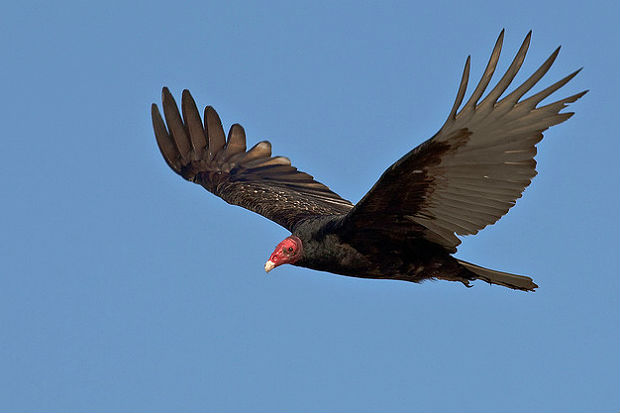
These two species are members of a group called the New World vultures that also includes the huge California condor and Andean condor.
Although vultures are more than happy to consume virtually any dead vertebrate – mammal, bird, snake, fish – even they don’t like their food too far gone. “They prefer recently deceased organisms rather than extremely putrid carcasses. For example, day-old road-killed deer are perfect,” says ornithologist Gary Graves of the Smithsonian Institution’s National Museum of Natural History in Washington, also a co-researcher.
The researchers examined the community of microbes, or microbiome, living in the guts of 50 vultures of the two species. The most common bacteria – Clostridia and Fusobacteria – turns out to be widely pathogenic to other animals. For example, Clostridia can cause a world of woes – botulism, gangrene and tetanus – in humans.
The researchers also found that the stomach acid of vultures is very strong and kills a good deal of the bacteria gobbled up by the birds with the rotting meat. “The majority of the food-ingested microbes will not survive these harsh conditions,” says co-researcher Michael Roggenbuck, who works as a microbiologist at the University of Copenhagen. – Reuters
Already a subscriber? Log in
Get 20% OFF The Star Digital Access
Cancel anytime. Ad-free. Unlimited access with perks.