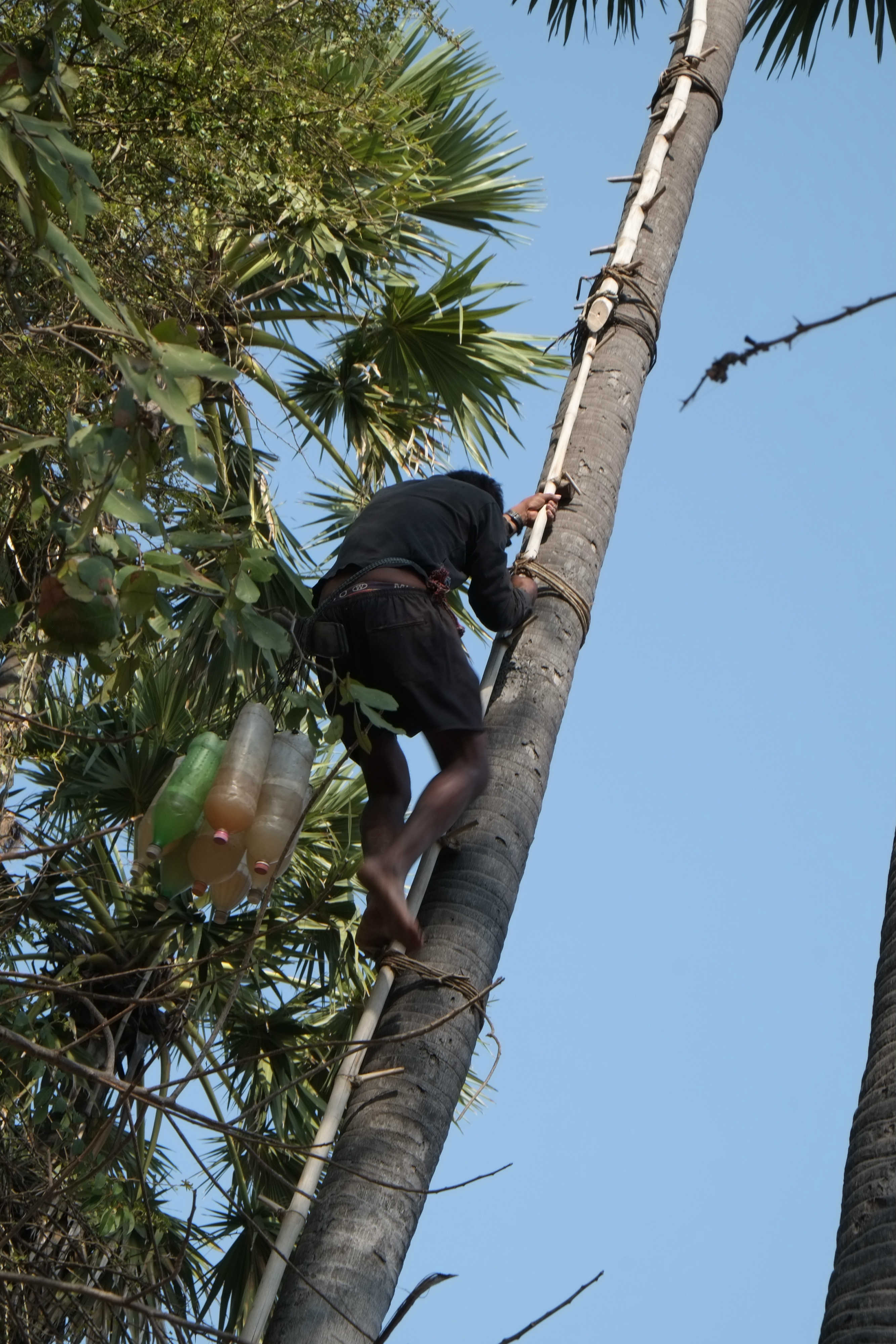
At the first light of day, Meng Chek deftly scales up a nearly 10m-high palm tree with a parang and a bunch of recycled plastic bottles hanging from his waist. He does this by using an old bamboo that has been secured to the tree trunk, and by using the dried offshoot stems as footholds. It takes him only a few minutes to reach the top.
When he reaches the top, Meng Chek cuts off the young palm stem and allows the sap to drip into the bottles that each contain a pol pal wood chip he had dropped in earlier. The chip, he explains, would bring out the sweetness in the juice. Half an hour later, Meng Chek comes down with the bottles half-full with sap.
He does this with ease as he does this twice everyday, which he has been at since he was a teenager. Tapping palm sap to make coconut palm sugar has been a tradition for several generations at his village of Kampung Battambang in Pursat, about a 3½ hour drive from Phnom Penh.
Pursat is the 4th largest district in the west of Cambodia, where coconut palm sugar production is a common livelihood.
The palm tree is the national tree of Cambodia, and grows wild on roadsides and intermittently on rice fields. The law forbids the felling of these trees, which are considered common property for tapping. It is by mutual understanding that one does not tap from a tree that has been tapped by someone else.
Meng Chek, 54 and a third generation palm sugar producer, came to live in Kampung Battambang when he married his wife Chann Sory, 60. Since then, he has taken over tapping from the same trees than Chann Sory’s father had been tapping for years.
Soon after removing the pol pal chips from the bottle, he takes a gulp of the light yellowish liquid before pouring the rest into a huge kuali over a high log fire. Here, Chann Sory takes over the process by stirring the liquid with a long wooden paddle until it reaches a rolling boil.
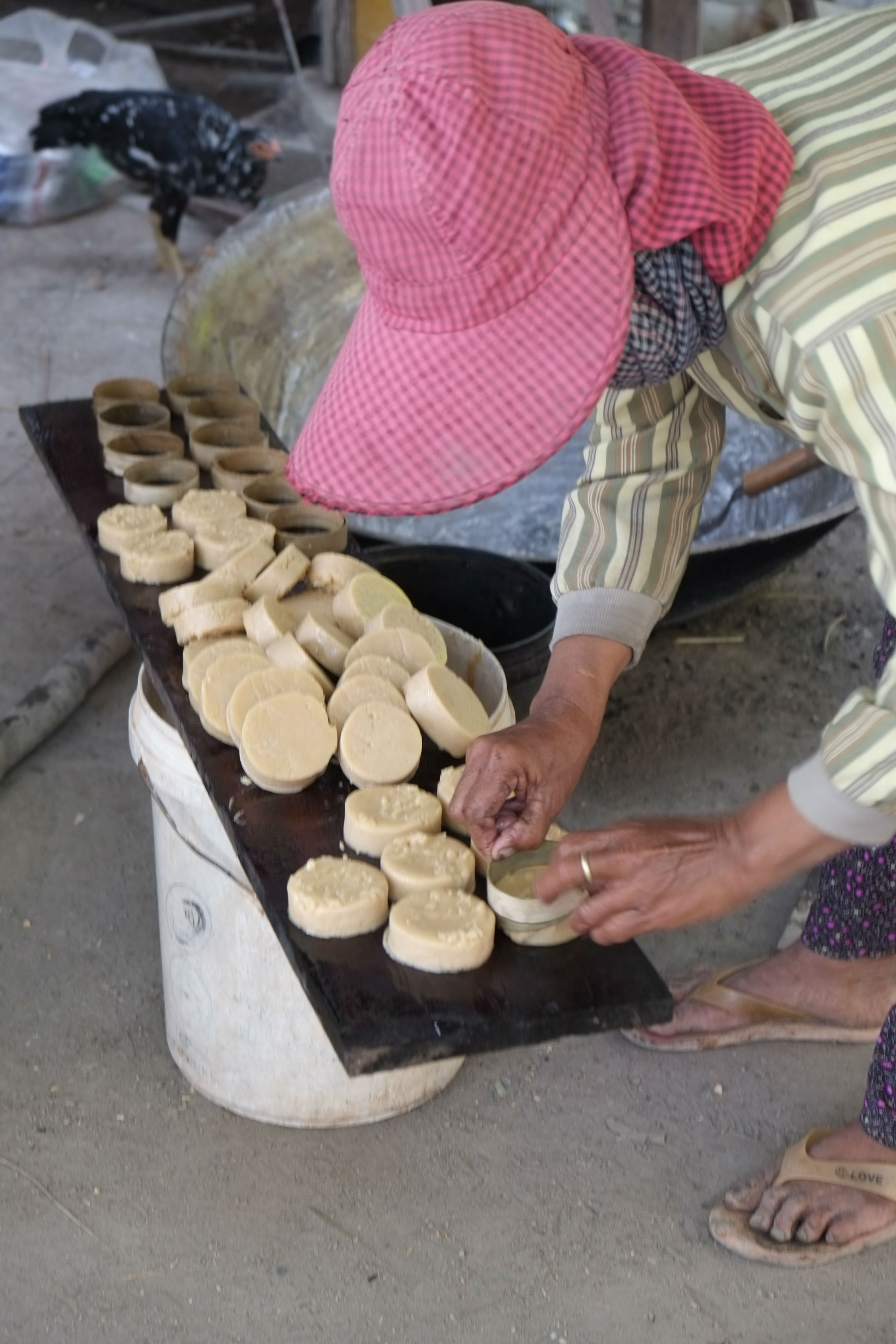
About an hour and a half later, the liquid begins to thicken. The heat is lowered to prevent the thick caramel-like sugar from burning. Chann Sory continues to stir for another hour until the sugar turns into a sufficiently dry paste.
It is then transferred into a pail to cool before it is sold to middlemen and individual buyers. The warm crumbs sticking to the bottom of the kuali taste deliciously like caramel, with the aroma of fresh toasted coconut. This yellow liquid “gold” today is a popular natural sweetener that is touted to be a superfood of the century, with numerous health benefits.
Palm sugar is a natural sweetener that has been used in India and many South eastern countries for thousands of years. It is high energy burning, which means it helps to increase metabolism and is slowly absorbed by the body, thus avoiding sugar levels to shoot up. This in turn helps with the management of diabetes, hyperglycemia and hypoglycemia.
Although there is a growing demand for palm sugar in the marketplace, producers are unhappy that they have not been paid fair prices by middlemen. The fair price for a kilo of raw palm sugar varies from US$0.41 to US$0.70. But the producers get much less than this.
“We don’t mind doing this for a living but it is hard work, the hours are long and the money is little,” says Chann Sory, who has one son out of four children, who produces palm sugar.
The disinterest of the younger generation is not the only challenge that the industry faces. Wood that is needed to fire the stove for cooking the palm sugar is also depleting because certain companies have acquired logging rights in their area. This cuts off their source of firewood and pol pal wood.
“I can go farther into the jungle to collect them but I am getting old and this is very difficult for me,” Meng Chek says.
The recent focus on business in Cambodia has brought businessman like Malaysian Chang Kwok Chuan to Cambodia in search of agricultural products like rice and palm sugar for export. “Producing palm sugar is a labour intensive process. We need a large volume to make it economically viable for export. The quality of palm sugar in Kampung Battambang is good,” Chang says.
Already a subscriber? Log in
Get 20% OFF The Star Digital Access
Cancel anytime. Ad-free. Unlimited access with perks.