
A herd of elephants wanders into a plantation in search of food, trampling crops and people alike, while security guards and workers risk their lives in a scramble to chase them out.
Stories of such human-elephant conflicts are not new, with figures from the Wildlife and National Parks Department (Perhilitan) Peninsular Malaysia receiving 6,230 reports of such cases between 2020 and 2025.
In some instances, this can even turn deadly for both the elephants and farm workers. Various reports over the last few years have documented cases of elephants being shot and poisoned, while other incidents saw farm workers trampled by intruding herds.
Typically, workers are tasked with chasing the elephants away with lights and noise. In a 2023 Bernama report, farmers used firecrackers and bonfires to scare them away, though this is not always successful.
According to Tham Tat Wai, co-founder of Satok Bridge Digital, the frequency of such incidents has pushed some plantation owners to stop using parts of their land over fears of constant elephant intrusions.
“The unfortunate side of things is that people have actually died in workplace accidents.

“From what we know (at) one of the sites we had, a foreman was actually trampled to death just a few meters away from where we were supposed to actually install our system. Things like this can actually be avoided using technology,” Tham says.
Deterring conflict
As part of a hackathon organised by the Science, Technology and Innovation Ministry (Mosti) in 2022, Tham’s Satok Bridge Digital developed GajahSafe, an artificial intelligence (AI)-powered system designed to deter elephants.
The solution won the hackathon and went on to be deployed across several palm oil plantations in states such as Johor and Pahang, which are prone to elephant intrusions.
The system functions by playing loud sounds to frighten elephants away when they are detected on camera. While this may sound like an over-complicated solution for a seemingly simple problem on the surface, a lot more thought went into its development than meets the eye.
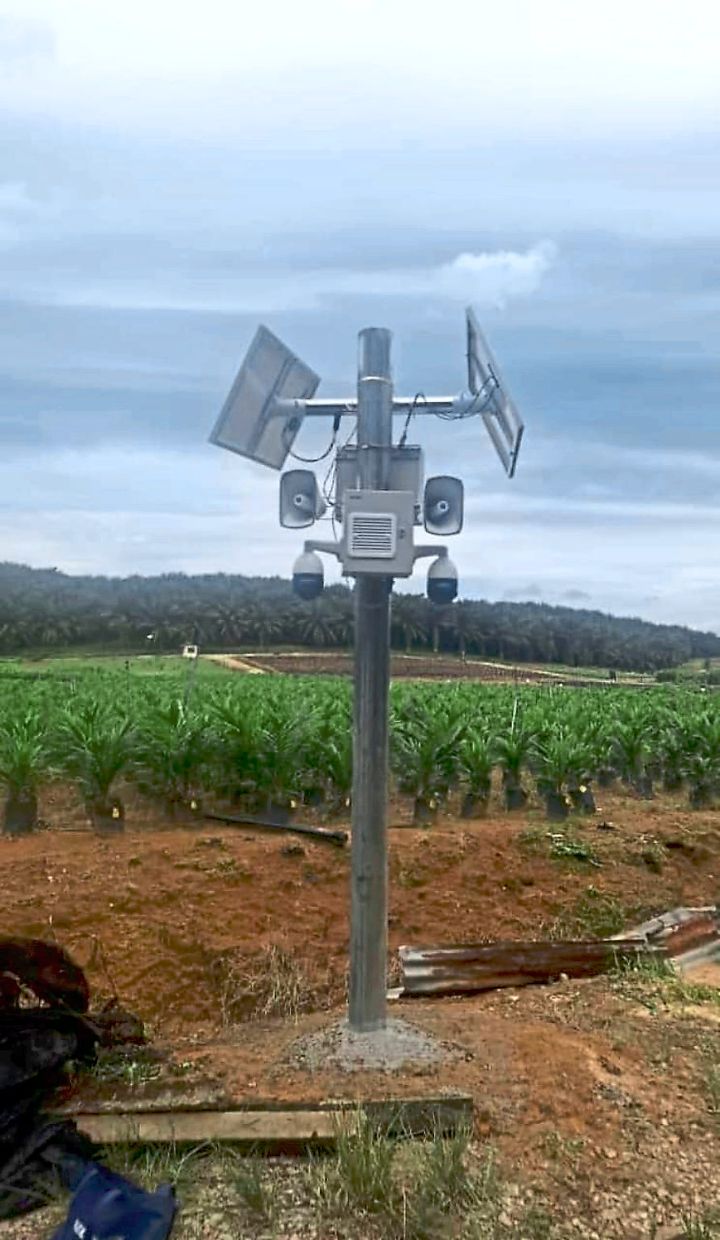
“The AI is actually broken into two separate detections, in a sense. The first AI detection is to see whether it is an elephant or not. And the second layer of AI is actually to see whether we’ve seen this herd before.
“Why we want to do that is because, in the elephant’s mentality, there is something called habitualisation, where elephants are very smart creatures that get used to the sounds that they actually hear.
“If they hear the same sound over and over again without having a proper deterrent, like people actually shooing them away, or there’s no threat coming from that, they actually get used to the sound, and they understand that there actually isn’t a threat moving forward,” he says.
This means that when the system detects the same herd of elephants, it will then rotate out the sounds being played with another from its soundbank. These sounds range from tiger calls to the clanging of metal pots, and are usually higher-pitched to trigger a fight-or-flight response.
While a standard motion detection-based system would be able to play sounds when movement is detected, it can also cause false positives due to other wildlife present in the environment.
Satok Bridge Digital is not alone in deploying AI in an effort to protect Malaysia’s wildlife, with World Wide Fund for Nature (WWF) Malaysia having kicked off research on the technology’s use in the detection of orang utan nests in Sabah back in 2023.
According to Donna Simon, manager for Orangutan Conservation under WWF Malaysia’s Sabah Landscapes Programme, the need for such an AI-powered tool stemmed from the difficulty in monitoring orang utan populations in sprawling and remote forests.
“Traditional surveys can require significant time, expertise and resources, while manually reviewing thousands of drone images is labour-intensive.
“AI offers an opportunity to process imagery more efficiently, enabling researchers to assess orangutan populations over larger areas and more frequently than would otherwise be possible.
“Better and faster information can help support conservation planning, habitat management and long-term population monitoring,” she says.
The system was developed in collaboration between Simon and researchers from Universiti Malaysia Sabah and the Sabah Forestry Department, utilising drones that fly up to 120m over ground while capturing images of the forest canopy.
Nests in the images are then manually annotated by a human to create a dataset that will be used to train deep learning (DL) AI models in recognising the characteristics of nests.
Refining results
Tham says that since the sites where GajahSafe is deployed are home to animals aside from elephants, a lot of motion would be detected by the system. This would cause it to constantly play sounds, giving the elephants a chance to acclimate and disturb the sleep of those living on the farm.
“Only when we can give a 100% or a 95% accuracy rate of, ‘Hey, this is an elephant, you should do something about it’, then that’s when we will start playing things.
“It’s not to say that other wildlife aren’t allowed on the plantation; it’s just that elephants cause too much destruction within a palm oil plantation.”
He adds that Satok Bridge Digital has received requests for tiger and panther detection to provide alerts to farm managers to take precautions.
The system is further supported by an Internet of Things (IoT) element, with an electric fence monitoring system that provides early warnings to farmers in the event of an intrusion.
Tham says some of Satok Bridge Digital’s projects in Johor opt to deploy just the early detection system as a standalone to save costs, which is usually the biggest obstacle in the way of adoption.
“What happens is that if the elephant pushes the poles or there is a discharge from the electric fence to see that something got zapped or there is no more charge, it will actually send an alert to the farmers to actually go and do the deterrence manually.
“This bridges that gap between understanding that there is an intrusion and not knowing there’s an intrusion whatsoever,” he says.
Tham adds that while electric fences are commonly used in elephant deterrence, some have learned how to circumvent them by picking the fences up or using other ways to avoid the shock, making an early warning notice to farmers when this happens a necessary part of the system.
Under the hood
He adds the GajahSafe AI system runs on edge computing, with all the needed algorithms and detection models being run on-site. Each deployment consists of an all-in-one box containing two cameras and two speakers, solar panels, and the computing equipment mounted on a metal pole.
According to Tham, it was designed to minimise the footprint of any deployments in an area and make it easier for farmers to independently install them down the line.
“In the future, when we start scaling this, our main idea is that it will actually be very plug-and-play and easy to install for everyone else,” he says, adding that affordability down the line is a major focus.
When a detection occurs, the GajahSafe system can be configured to send a notice of an intrusion through WhatsApp, Telegram, or even email, he adds.
“The only information it sends out is if it has seen something, what time it’s seen, and it sends the video of the successful deterrence with the elephants running away, and things like that,” he says.
According to WWF’s Simon, findings from the nest detection models can be used to help conservation teams take more informed actions and focus on interpreting findings.
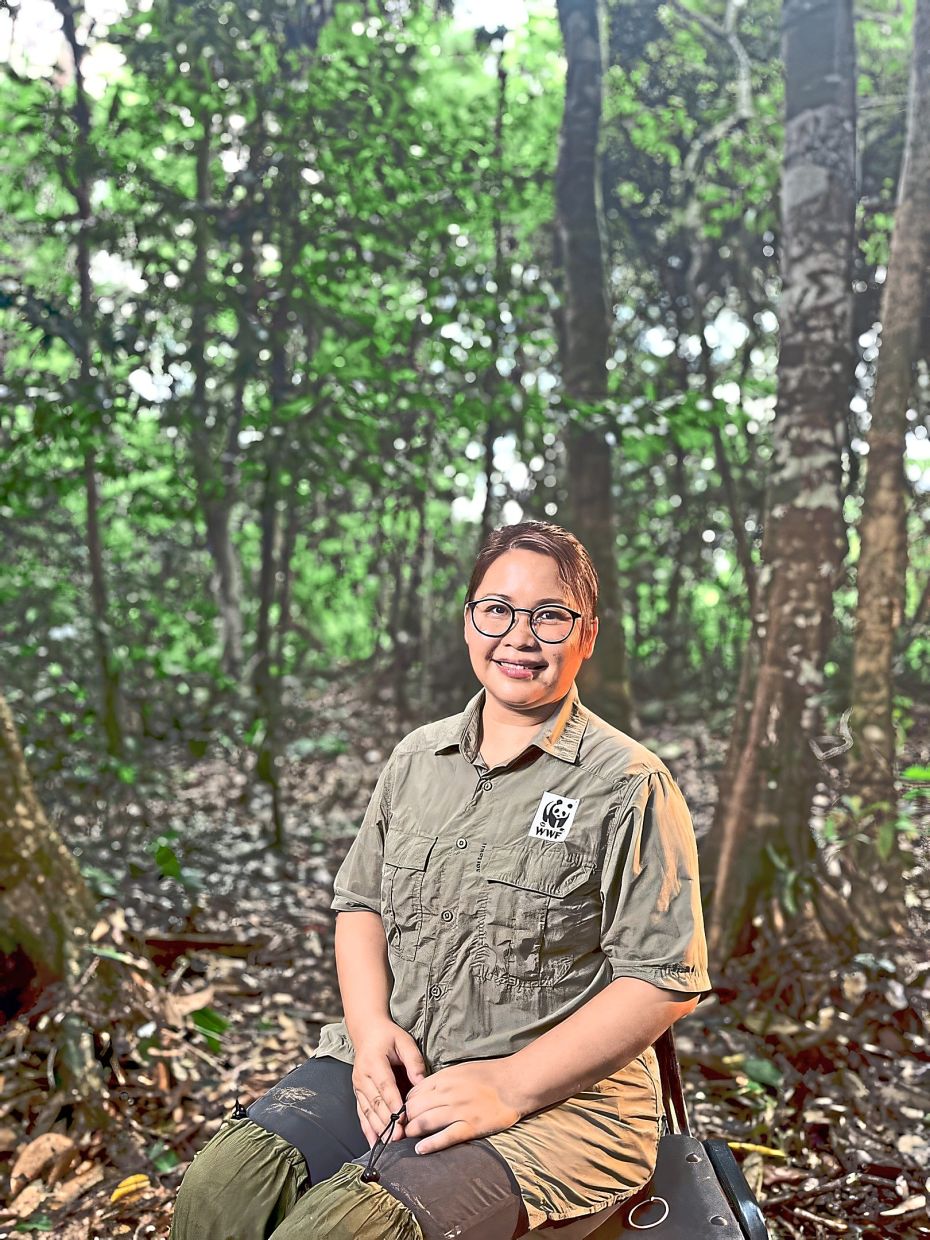
Initial models in the study saw the best-performing model achieve 99% accuracy in identifying images containing orang utan nests, but the team has since expanded its efforts to include object detection, which allows it to identify and locate nests within images, with the models achieving up to 84% accuracy, she says.
The latest study saw 9,650 drone images gathered in Sabah’s Bukit Piton Forest Reserve, further building the dataset for training and testing Red, Green, Blue (RGB) and Normalised Difference Vegetation Index (NDVI) image formats to improve detection performance.
Simon says that deploying the nest detection system involves three major factors, this includes the collection of high-quality drone imagery, building and managing datasets for analysis, and applying the trained AI model to identify nests in images.
“As with any monitoring technology, data quality is critical. Factors such as image resolution, flight conditions, forest structure and canopy complexity can influence performance.
“Models must therefore be tested and validated to ensure they perform reliably under different environmental conditions. However, obtaining sufficient images of orang utan nests remains challenging, particularly because orang utans are critically endangered and their nests can be difficult to locate and capture in drone imagery.
“These limitations highlight the importance of developing robust models that can perform reliably even with limited training data,” she says. After models are tested against each other, the one that performs best is selected.
A key thing Simon points out that humans are still needed to review and refine the model in cases where it incorrectly identifies or misses a nest. There’s also the need for both researchers and conservationist “to validate findings, interpret results and translate them into conservation actions”, Simon says.
“AI comes into play during the image analysis stage. Through training, the model learns patterns associated with orangutan nests and can then apply that knowledge to new images.
“This enables large quantities of data to be analysed much more quickly than would be possible through manual review alone.
“The goal is not to replace conservation scientists, but to provide a tool that helps them process information more efficiently and at a larger scale,” Simon says.
She adds that “successful implementation requires a combination of technology, ecological expertise and long-term monitoring”.
Data is crucial
The GajahSafe system is built and assembled locally, with Tham saying that the underlying AI model was entirely trained by Satok Bridge Digital using its own datasets.
When deployed in a new location, there is also an initial period where data is gathered to further build the dataset and allow the system to be more accurate to this specific environment, he says.
According to Tham, the team developing GajahSafe would also download footage of possible elephant sightings to train the system. This involved manually identifying and labelling elephants in the videos, including instances where it was difficult to identify due to poor lighting, distance or other issues.
Initial deployments, when the system was initially launched back in 2022, took up to five months to refine the algorithm and get the system up to speed, but now it usually takes around a month to be running at full capacity.
“Now, when we go on deployment to new sites, we take the existing parameters we have, and we adjust accordingly to what the new site is like. That allows us to save more time because we already have a rough footprint of what it should be like. There’s a good benchmark for us to kind of adjust accordingly,” he says.
Something that Tham highlights is the need to ensure this data is secured and encrypted, “because if it falls into the wrong hands, it becomes a map for where all these elephants are coming and going. So it’s easier for poachers to kind of track them down.
“We don’t share any information between the farms as much as we can. We only consolidate it on the backend and only extract the data as and when needed by researchers, Perhilitan, or the Agriculture and Food Security Ministry (KPKM),” he says.
Things to come
Tham is now looking to expand the system to Thailand, having made the first GajahSafe installation in the country recently. This will allow the team to gauge if the system can perform in an environment outside of Malaysia.
“We’re also trying to see whether our parameters here can be translated over, or do we have to kind of retrain it based on what they have over there.
“This is a new adventure for us, in a sense, because all of a sudden we will see whether Malaysia’s standards of environmental complexity will actually stand up as an Asean standard or not,” he says.
While Tham hopes to expand into other countries with frequent incidents of human-elephant conflict, he stresses against casting blame on both the elephants and farmers.
“Globally the way to actually scare elephants out of your farm is actually to make sure they don’t leave at all by shooting them or by poisoning them. So that’s actually why we see there’s a dwindling amount of elephants globally,” he says.
Tham believes that this is a matter of survival for both parties. Elephants come into plantations in search of food because this used to be their habitat, while the farmers are trying to protect their livelihoods.
“We have to see it from both sides. And one thing that we are actually very, that we’ve seen very clearly is that both sides aren’t actually in the wrong.
“A lot of these farmers actually spend their life savings in nurturing all these palm oil trees, in hopes that they will be able to support their family. And imagine one herd of elephants coming in and decimating it overnight.
“That is their entire life savings gone. That’s how they put food on the table. All of a sudden, that is something that is at risk. So obviously, if someone threatened us with our jobs or our livelihood, we will also retaliate in a way that we think is appropriate.
“So our job moving forward in terms of effectiveness is to ensure that things like this will never come up as an alternative. We are aiming to create a system that is effective in a way that we can create that coexistence that violence is never the second option,” he says.
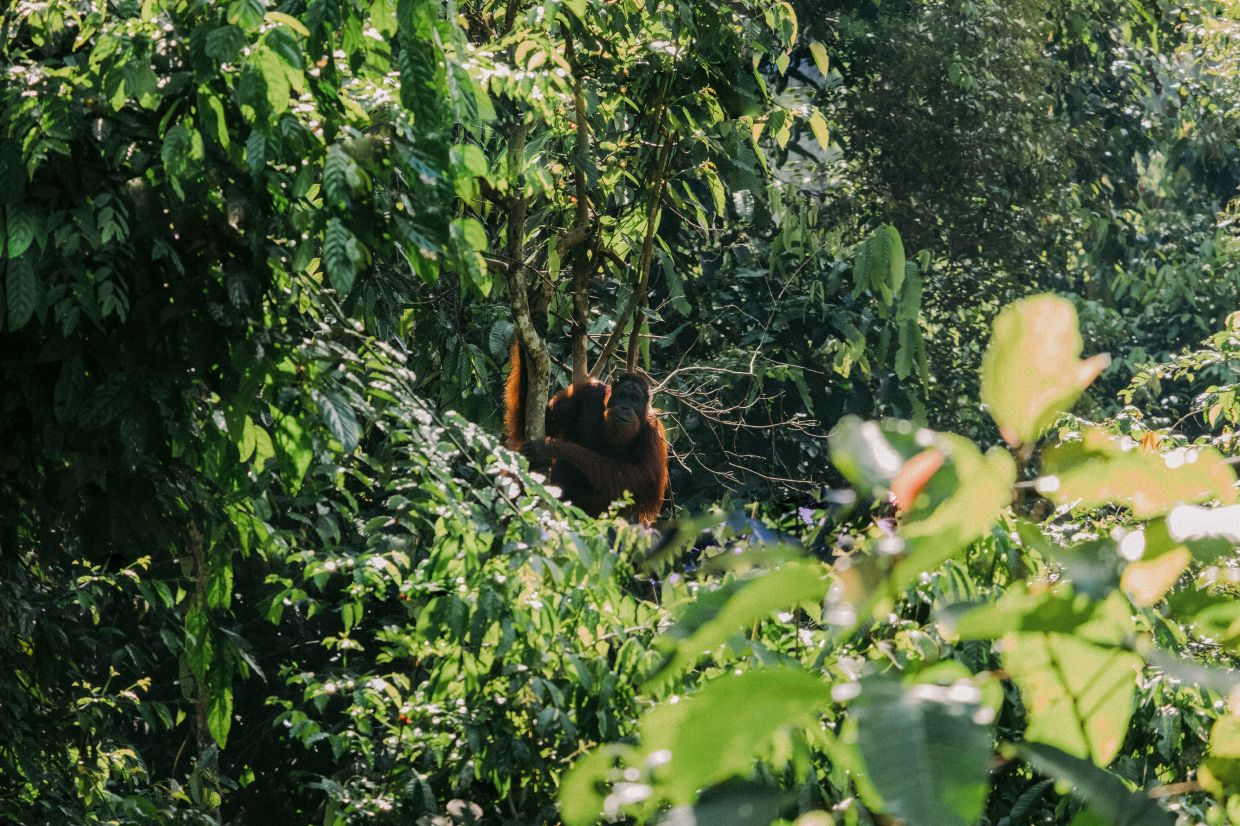
Meanwhile, Simon says the next step for WWF Malaysia’s orang utan nest identification system is improving to where it can automatically detect a nest’s exact location and precisely count the number of nests in a larger dataset.
“We are now exploring how well these models perform across different orangutan habitats, while also optimising drone survey parameters, such as flight altitude and sensor type, to improve nest detection.
“Ultimately, we aim to translate automated nest detection into reliable orang utan population estimates, making monitoring faster, more efficient and less resource intensive,” Simon says, adding that the end goal is to empower conservationists with better information to support their work.