Navigating the massive star-shaped junction around the Arc de Triomphe in Paris is among the most hair raising experiences in European driving.
A phalanx of cars, vans, motorcycles and trucks manoeuvres across lanes without formal markings, funnelling haphazardly into 12 avenues that spread off the Place Charles de Gaulle. Adding to the anarchy is a unique rule that road users driving into the swirling traffic have the right of way.
The result is a stop-start jumble of vehicles nosing into gaps with motorcyclists hunting for tiny spaces to squeeze through. A nightmare for autonomous driving systems, you might think.
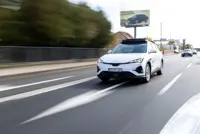
But ensconced in a Jaecoo 7 SUV guided by Chinese startup Momenta Global Ltd’s automated driving technology, I could let the car work it out for itself. It threaded smoothly through the chaos, negotiated its way around the roundabout and picked an exit without once asking for human intervention.
Paris may be a particularly tough place to test smart-driving technology, though many European cities are equally challenging. Cyclists appear out of nowhere, lanes are blocked, and traffic rules can be more complicated than maps suggest.
In separate drives organised during the Paris Motor Show, I tried out systems slated for regulatory approval from Tesla Inc and Xpeng Inc. They also handled much of the work without human intervention, though they each had specific ideas of what constituted good driving.
Taking on the congested roads and impatient drivers in the French capital, I got a glimpse of how advanced driver-assistance systems can make urban traffic safer and less exhausting. It also laid bare the challenge of fine-tuning systems for different locations.
For Chinese brands expanding in Europe like Jaecoo-maker Chery Automobile Co, adding advanced tech will be a boost to their offering of attractive EV technology at affordable prices. Among competitors is Tesla’s supervised driving technology that’s still awaiting European Union approval.
At the Paris show, Tesla also presented its Cybercab robotaxi, in a sign of how the region is inching toward deployment of fully driverless vehicles, well behind the US and China.
Trials are limited so far to cities including the Croatian capital Zagreb, where China’s Pony.ai, Uber Technologies Inc and Verne are testing cars without a safety driver on a limited run. In London and Munich, Wayve Ltd and Waymo LLC are testing vehicles in specific settings.
So how did the three cars compare? After driving through Paris, I can report they all did well, with notable differences. It’s also important to point out that the rides weren’t a controlled comparison.
I rode in the Tesla for just eight minutes, while the longest drive was about an hour in the Jaecoo 7 on a more complex route. The tests don’t establish a pecking order, but demonstrate how many routine driving tasks even in Europe’s chaotic cities can be handled by machines.
Equipped with Momenta’s R7 driving model, the Jaecoo outing included peak traffic at the Arc de Triomphe. It completed the route without a single intervention. It was impressive, though not flawless.
When traffic lights lacked a countdown, the car sometimes braked abruptly. When another vehicle blocked its lane, it awkwardly moved around the obstacle at the last second.
Tesla’s Assisted Driving program had the shortest audition, and the easiest run of the three. Yet the smooth ride indicated a mature system that slowed well ahead of pedestrians and gave way to a cyclist approaching from behind.
It did confuse a flashing right-turn amber light, missing a specific French traffic rule. And it braked suddenly, instead of proceeding with caution, prompting intervention.
Xpeng’s Navigation Guided Pilot was the model driver of the group. While Chery’s Momenta allows for speed roughly 10% above the limit, blending in with surrounding traffic, Xpeng’s LO3 didn’t push beyond what’s legal.
It also slowed down for yellow lights, and left enough space for cyclists before red ones. Braking was gentle before coming to a firmer stop. It moved aside in a tunnel to let faster traffic pass and navigated construction zones and roundabouts without difficulty.
But the car tested my patience, undershooting the 30km limit on narrower roads. And sticking to the rules isn’t always best when that means becoming a slow-moving roadblock in racing traffic.
Xpeng has said it plans to bring its next-generation NGP driver-assistance system to Europe from 2027, subject to regulatory approval. Chery hasn’t yet set a timeline while it continues with testing and validation.
"The only metrics to gauge whether an autonomous driving system is successful is whether or not it fit to the local environment and whether or not local people want to use it,” said Liu Xianming, head of the General Intelligence unit of Xpeng, which oversees the self-driving technologies. – Bloomberg