A swarm of drones zooms across the night sky, leaving trails of colourful lights that twist and shift into fanciful shapes, familiar symbols, and even the Malaysian flag, before recreating the iconic moment when the country’s first Prime Minister, Tunku Abdul Rahman Putra Al-Haj, proclaimed the nation’s independence.
Such airborne displays have become a familiar sight whenever a major national celebration rolls around, with this year’s National Day festivities seeing no less than three shows in central Kuala Lumpur alone.
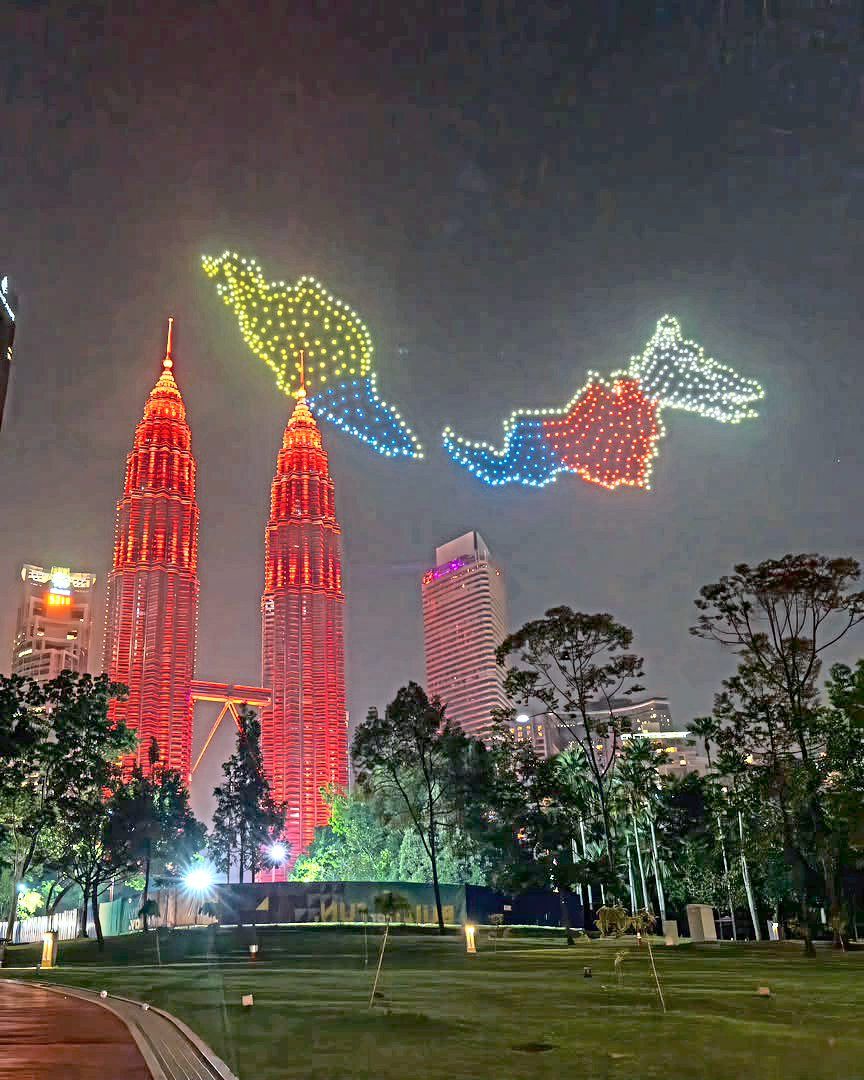
Drone show provider Novas Drone staged two of those performances on National Day this year, right as the clock struck midnight, with one held at Dataran Merdeka and the other at KLCC Park.
A Novas Drone spokesperson told StarLifestyle that the brief showcases took a month of planning and preparation, involving an entire team pooling their expertise together to create the show from scratch.
“On the night of August 30, we deployed a combined fleet of 1,600 drones across the city: KLCC featured an intricate, synchronised dual-fleet formation of 1,100 units – operating in an 800-plus-300 configuration – while Dataran Merdeka hosted a 500-drone display,” he says.
Another National Day showcase, this time at the iconic Bukit Bintang crossing and performed by Drone Sifu, involved 600 drones which were used to tell the story of the country’s development from independence to the modern day, according to company director Kathir Denez.
Kathir, who has a background in drone cinematography and has worked on films such as Pascal, says the ability to tell stories is a major advantage of drone shows.

“In most of our drone shows, we try to tell a story. For the National Day show, we didn’t want to just show random symbols related to Malaysian identity. We wanted everything, from design A to design Z, to have a continuation,” he says.
The show depicted the life of a Malaysian since independence, from a child waving the national flag and living in wooden “papan” houses to adulthood, as landmarks such as the Petronas Twin Towers and Menara Merdeka 118 symbolised the country’s development.
Dancing drones
So what makes the drones used in these light shows so special? Typically, when drones come to mind, people picture aircraft equipped with high-resolution cameras, obstacle sensors and manual controls. The ones used for these shows, however, are quite different.
“Standard consumer drones are essentially flying camera rigs built for manual, individual flight. Performance drones strip away cameras and heavy stabilisation gimbals altogether to shed weight and maximise battery efficiency.
“In their place, each drone carries an ultra-bright, multi-watt full-colour RGB LED module. Instead of an aerial camera, each unit functions as an individual ‘flying pixel’ within an enormous 3D digital sky canvas,” the Novas Drone spokesperson says.
He further says that a consumer drone also usually relies on the standard global positioning system (GPS), which can have an accuracy margin of around two to three metres, which may be good enough for open-air videography, but it’s a different story when it comes to flying 1,600 drones in close proximity.
Light-show drones use real-time kinematic (RTK) positioning instead, allowing for centimetre-level accuracy.
“Individually, a show drone is often comparable to or slightly less complex mechanically than a top-tier cinematic drone because it lacks cameras.
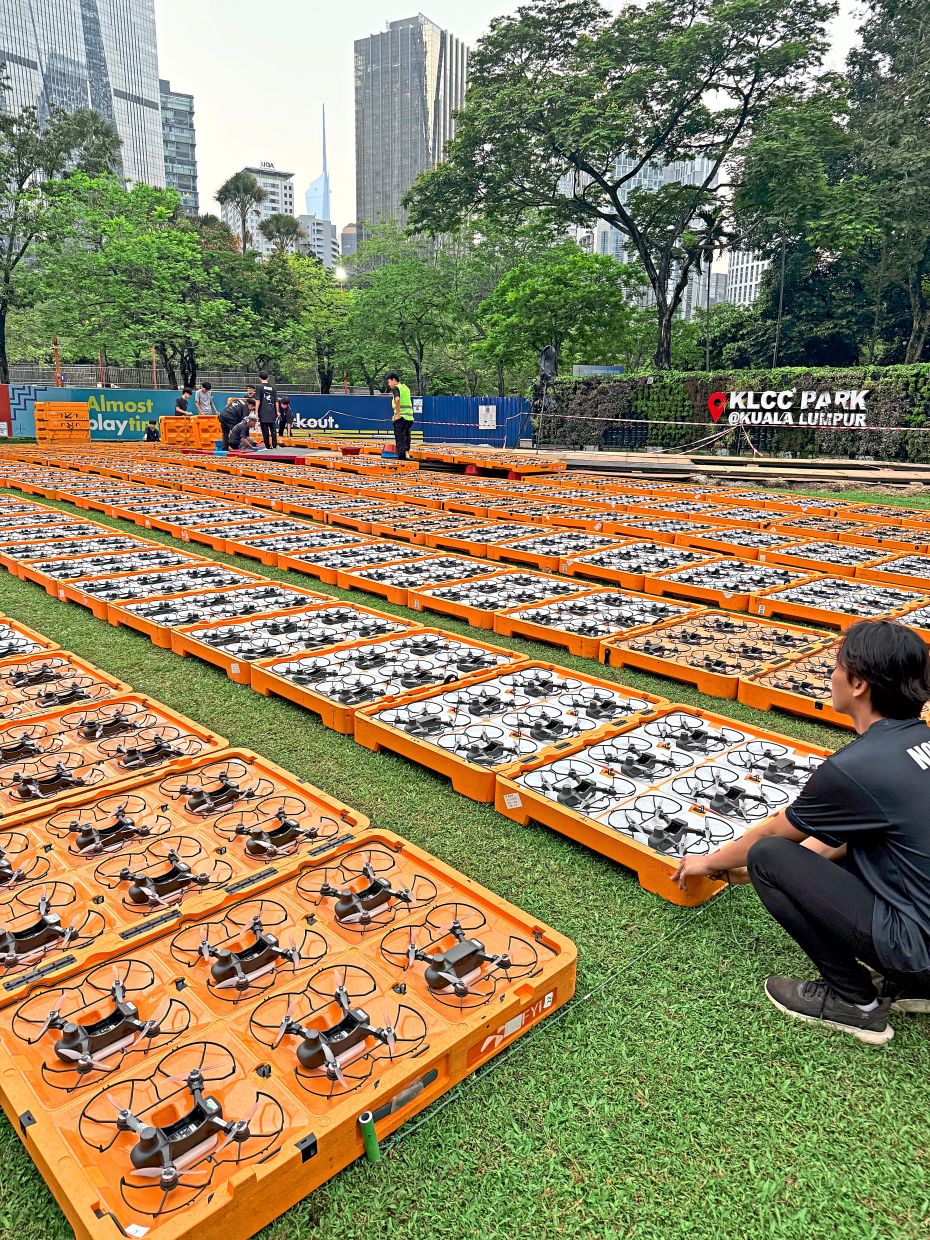
“However, you cannot buy or deploy just one. A turnkey light-show fleet requires proprietary swarm software licences, heavy-duty RTK ground stations, redundant mesh networking hubs, rapid battery-charging arrays, and rigorous transport casings.
“So while a single unit is streamlined, the investment in a synchronised multi-hundred or thousand-drone operational fleet is substantially higher,” he says.
Despite not being equipped with the same feature set as the average drone used for photography and videography, that does not mean these performance drones do not have any safety measures in place.
“Consumer drones often rely on obstacle-avoidance sensors to stop mid-air. In a dense swarm, that would trigger a chaotic chain reaction. Instead, show drones run deterministic flight scripts backed by layered, fail-safe protocols.
“If a unit loses RTK lock, detects localised wind shear beyond limits, or suffers a motor issue, its lights cut instantly, and it quietly glides out of formation to an emergency landing corridor without endangering the rest of the fleet,” the Novas Drone spokesperson says.
Meanwhile, Drone Sifu has taken a different approach for its fleet of drones, opting to co-design and co-manufacture its own models to better suit Malaysian urban environments.
“We see Kuala Lumpur is a concrete jungle. So, we need to tune the design and make sure, although there are a lot of buildings, when we’re going to take off between the buildings, we should not have any multipath issue,” Kathir says.
A multipath issue refers to how GPS signals can bounce off tall buildings before reaching a drone, potentially causing positional inaccuracies or delays.
While there are already drones on the market with flight controllers and GPS components designed to deal with such conditions, Kathir says there is another reason behind the decision to develop their own models: reducing reliance on third-party manufacturers.
He believes that going solely with off-the-shelf models means that providers become reliant on third-party manufacturers for their hardware, software, and components.
This means that when a model is discontinued, or replacement parts such as battery are no longer being made, there is no choice but to upgrade to a newer model.
“We don’t want to deal with that, so we worked with our partner to co-design and co-manufacture our own drones. We made prototypes with our 3D printer and tested them, before we started manufacturing last November.
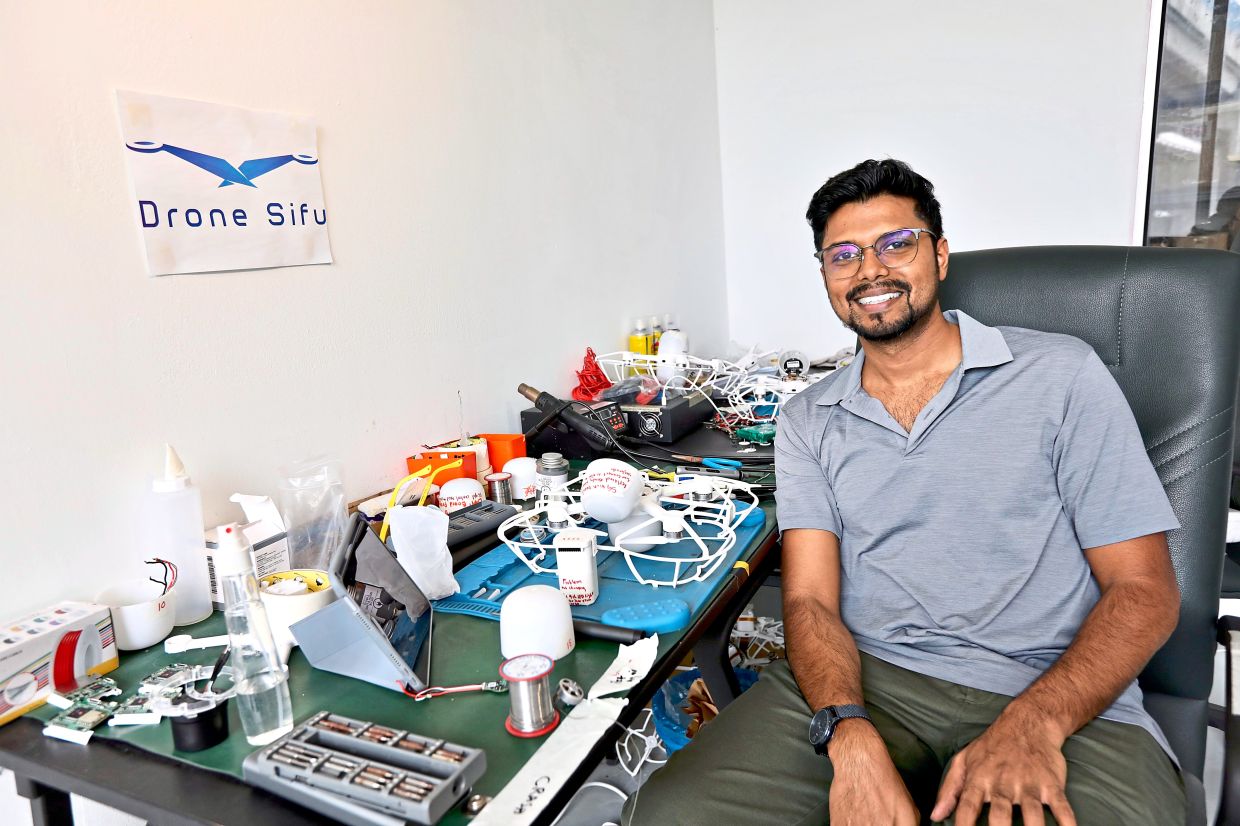
“It’s not cheaper (than buying off-the-shelf), but in the long run I see this as being beneficial to us,” he says, adding that this means that the drones can be adapted and updated as needed for their use case in Malaysia.
These drone models have already been in use by Drone Sifu since March this year, with 1,500 units in its growing fleet.
Developing and maintaining this fleet, however, requires a specific set of technical skills, according to Kathir.
“First we need software engineers, and you need to have mechatronic and electronic engineers with you. And then drone pilots who have knowledge and have experience from developing the drones from scratch,” he says.
For Kathir, being able to fly a drone is not enough. Pilots also need to understand how drones are built and what components could be responsible for a particular fault or problem.
Pilots also monitor conditions while the drones are in flight, and if they determine the weather is getting too extreme, they have the ability to end the show and have the drones land.
On show days, while it’s mainly about running the software and having the drones perform well, those on the ground still need to understand what defects cause what specific malfunction and, more importantly, how to fix them on the fly.
“The drone industry is very new, so we are still short of talents. So I would say that the authorities should push local drone players to develop local talents rather than relying on foreign expertise,” he says.
Kathir adds that the company could eventually offer the drones to other Malaysian drone-show providers, with the long-term goal of Drone Sifu becoming part of the ecosystem to help develop the local low-altitude economy.
Formations and flight paths
Each member of the Novas Drone team serves a specific duty in turning ideas and concepts into reality, according to the company’s spokesperson.
This includes the creative and visual directors, who are graphic designers with an understanding of spatial awareness and scale, since they’re not just creating designs intended for a flat computer screen or TV.
“Designing for the night sky is completely different from designing for a flat computer monitor – you’re working with points of light in a 3D canvas viewed from 360°,” he says.
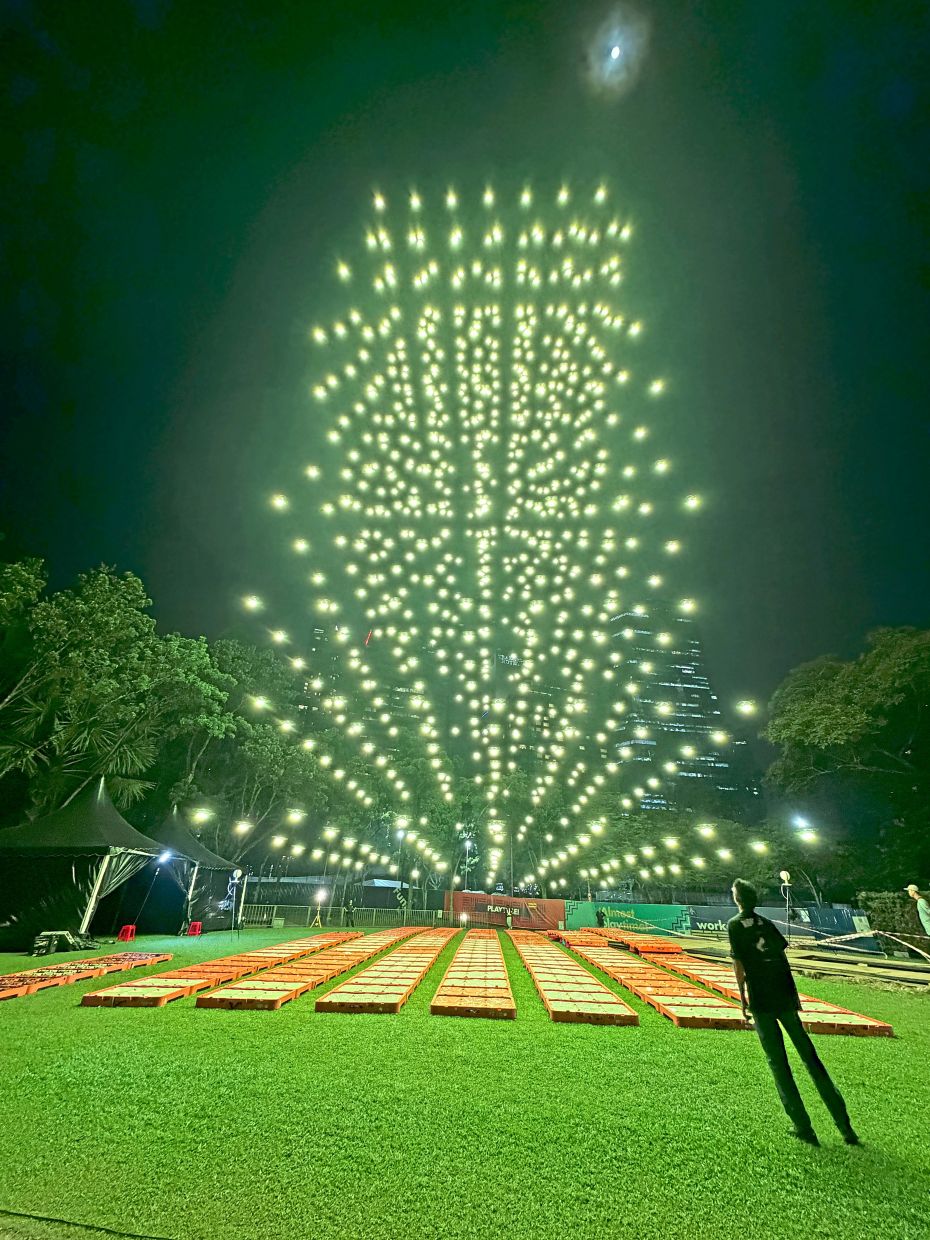
There are also the 3D animators and trajectory choreographers, who use specialised 3D software to calculate the exact pathing for each and every drone that will be performing at a given show.
The radio frequency and hardware systems engineers focus on the technical infrastructure that keeps the swarm operating reliably, particularly in challenging environments such as Kuala Lumpur’s dense urban landscape.
Meanwhile, the on-site operations crew and safety marshals handle the groundwork involved in setting up for a show, pre-checks before takeoff, and responding quickly should something unexpected happen during a performance.
At the same time, the flight director and ground marshals will need the situational awareness to make split-second safety decisions or initiate geofenced failsafes.
While much of the safety system is automated, ground control maintains a manual kill switch in case of other safety concerns or if an unauthorised aircraft breaches the airspace. This switch can freeze a performance mid-air, or instruct the drones to perform a coordinated emergency landing.
While some may assume these fleets of drones would also need an equally large number of pilots to control them while in the air, the truth is that every single motion they make is actually pre-programmed in advance.
The Novas Drone spokesperson says that each five-to-ten-minute drone show follows a four-stage engineering and creative process developed by the company.
This process starts off with evaluating a drone show site’s feasibility and assessing the risks involved.
“Before we even think about visuals, our flight operations crew inspects the ground and the air. We map out safe launch and landing grids, establish emergency drop zones, and survey the surrounding architecture.
“In dense urban centres like Kuala Lumpur, this stage is critical – we have to scan the local radio-frequency environment to ensure our control signals won’t be disrupted by nearby telecom towers, WiFi networks, or skyscraper reflections,” the spokesperson says.
Meanwhile, other considerations during the site visits include how many drones can fit within a given area, along with the surrounding environment, according to Kathir.
“So location determines how many drones we can use for the show, and whether it is suitable for our hardware and software. Are there any embassies or other sensitive locations nearby?
“Especially when you’re flying in the city, there are so many embassies here and there that wouldn’t want our drones nearby,” he adds.
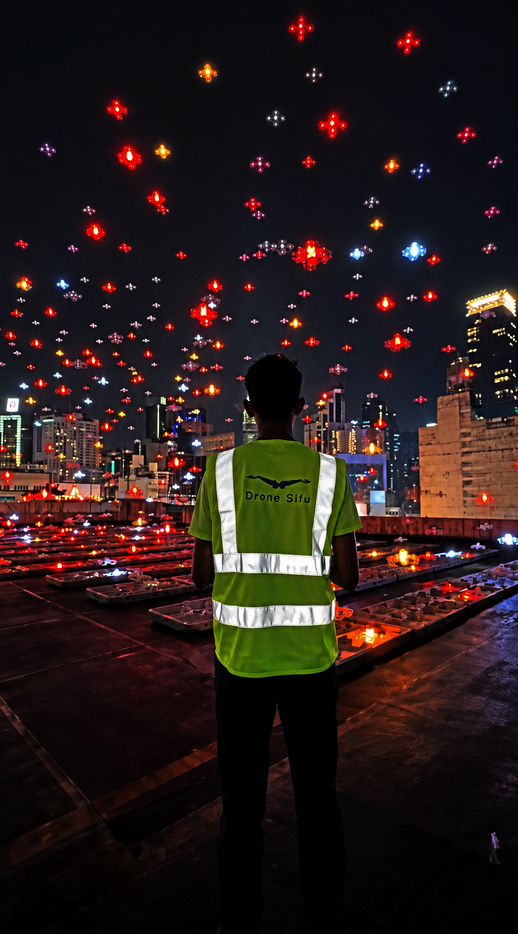
If the location is suitable to hold a drone show, Kathir adds that his team will then start developing the storyboard and design, while also incorporating the core design elements that clients want.
When it comes to storyboarding, the Novas Drone spokesperson says the company’s team works with the show’s organisers to decide what story they want to tell.
“For National Day, every formation had to carry cultural and national resonance. The Novas Drone creative studio translates broad themes – like national unity or historic symbols – into digital 2D sketches to see how the narrative will flow across the sky,” he says.
In the third stage, those digital 2D sketches are modelled in 3D and the lighting is choreographed, marking the most laborious step of the process, where choreographers then set the flight paths for each individual drone.
This involves assigning each drone its own flight coordinates, speed envelope – the range of speeds it can safely operate at – and precisely timed lighting cues. The software also runs collision-avoidance simulations to ensure the drones maintain safe distances from one another, even when performing complex motions mid-air.
Once all that is done, all that’s left is for the ground team to set up RTK-GPS ground stations, which deliver positioning data to each drone unit used for the show.
Before take-off, the team runs a series of pre-flight checks covering battery health, motor responsiveness, propeller integrity, sensor telemetry, signal quality, and live wind speeds.
“Once air traffic control gives us the green light, it’s one single click. From that moment, the entire swarm executes its autonomous flight choreography in complete synchronisation,” he says.
As for what sets drone shows apart from traditional fireworks, the Novas Drone spokesperson says both have their place.
While fireworks make an impact through sound and bright colours, drone shows can display icons and familiar visuals that people recognise, and use them to tell a story.
In some cases, the two can even be combined, with drones equipped with pyrotechnics integrated into a drone light show.
“When spectators see a massive Wau Bulan glide overhead, or a realistic portrait form in the clouds, it triggers a completely different emotional reaction than a regular burst of sparks. It is personalised, meaningful storytelling,” he says.
For Kathir, as drone shows become more common, simply putting designs in the sky is no longer enough to impress onlooking Malaysians.
“Back then, in the early days, when people saw one design up in the sky, it was enough to be a wow factor, and everyone’s happy.
“But now, people have seen more and more drone shows, so we have to think about what we are going to show in the sky so that people do not get bored.
“Drone shows are not a new thing any more. The content that is delivered through the drone show is the main factor now,” Kathir says.