
Something sinister controls New York City.
A fearful Dylan Faden, out of a seven-year coma but still barefoot in gray pajamas, sees a massive eye in the sky that is looming, watching, perhaps surveilling. Around him, Manhattan is full of dilapidated buildings. Some appear unfinished, like an incomplete Lego project. Hundreds of birds are stuck in a kind of rumbling Möbius strip that stretches as far as the eye can see.
In the science-fiction world of Control Resonant, one of the fall’s most anticipated video games, almost everything feels like a waking nightmare: somewhat familiar, somewhat peculiar, often surreal. The visuals can make the player want to flee, even though Dylan needs to help fix this universe – and redeem himself from terrible past deeds.
If the extraordinary world that Finnish studio Remedy Entertainment has created sounds as dreamlike as a David Lynch production, there is a reason.
“I watch ‘Twin Peaks’ once a year,” Mikael Kasurinen, the game’s director, said in Los Angeles. Lynch adds elements to his stories that turn them upside down in unpredictable ways, Kasurinen said, adding, “He puts something in front of us that is utterly terrifying – and it comes out of nowhere.”
A feeling of “true fear” is what Kasurinen thinks players will experience in Control Resonant, a sequel to Control, which has sold more than 6 million copies since 2019. Judging from the gameplay, such fear happens fairly often. A nonplayable character’s utterance that “The value of pi is shifting!” can cause apprehension. So can the enemies that are seen as shadows that wail and groan, just as the sound of growling and breaking glass fills the ears. Then, a blood-red devil-like enemy reveals himself, chopping at you with long, misshapen blades.
Kasurinen leans forward and gestures while delving into what is important to Remedy’s storytellers. “There are layers to the experience that are hidden away for people to dig into, try to understand, speculate on,” he said. “That includes not just the players, but the characters within the world as well, who can also be equally confused, trying to figure out what is happening and why.”
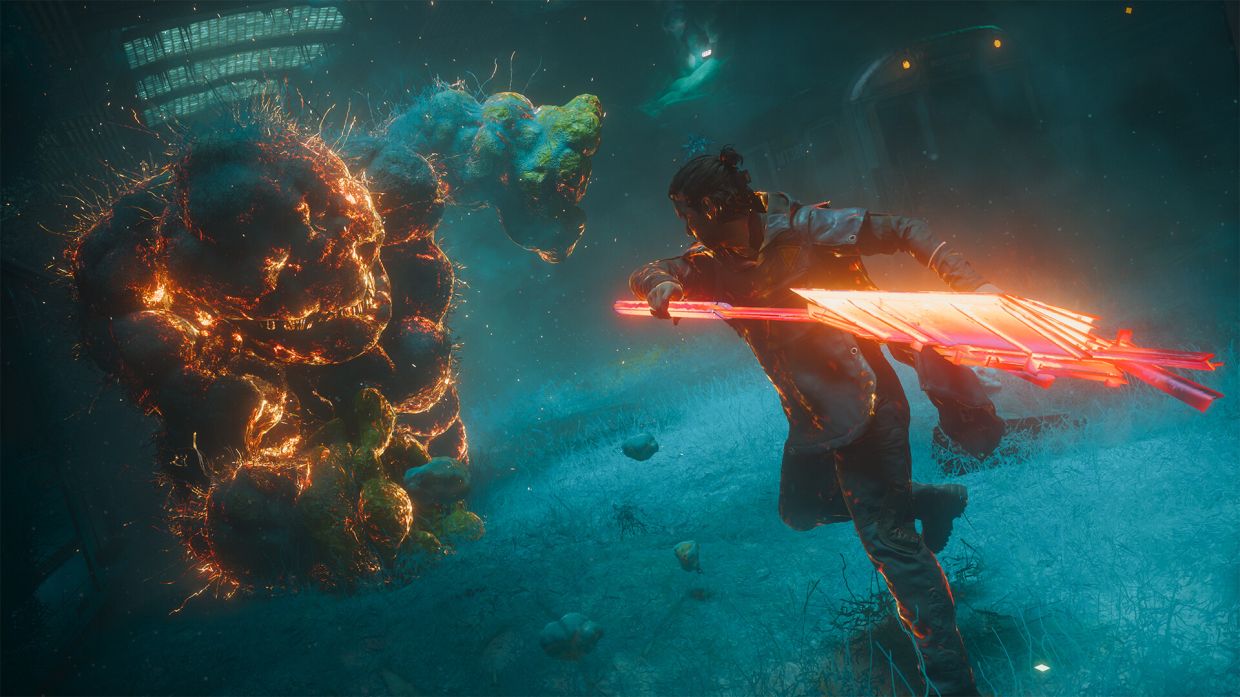
The game’s art director, Elmeri Raitanen, who has worked at Remedy for 17 years, recalled during a video call how the designers rented a studio in Helsinki to create some of the trippier visuals. They recorded the way a Tesla coil sparks, shooting on film through prisms before rendering what became a giant kaleidoscopic eye that looks as if it was made by the gears of a Spirograph.
Raitanen said his team was inspired by the earliest processes of Industrial Light & Magic, an effects division of the production company Lucasfilm. The result is a visual experience in the game that combines digital and analogue experimentation, creating something recognisable that may still cause a player to wonder how it was done.
Raul Siqueira, the game director of next year’s Tomb Raider: Legacy of Atlantis, by Crystal Dynamics, said: “It’s hard to not get immediately sucked in by Control Resonant’s art direction. Their brand of surrealism and paradoxical architecture is very unique and something you can stare in awe for hours.”
It is this combination of the familiar with the unfamiliar that is a hallmark of Remedy’s connected universe.
A quirky scientist from the Alan Wake series, by writer-director Sam Lake, also appears in Control Resonant, as if a portal between the games were breached. Control Resonant can be as psychologically taxing and bizarre as Alan Wake, Kasurinen said, but it is more like a supernatural disaster that is happening in a defined space. “Underneath the surface,” he said, “there are strange, supernatural things lurking that affect our world in different, unexpected ways.”
Lake wrote the first iteration of Control, which featured Dylan’s sister, Jesse, as its main character. In that game, something as simple as a slide projector unleashed a power that caused all of the adults in the town of Ordinary, Maine, to disappear.
Control was about altered items and objects of power, Raitanen said, so the music was droning and electronic. The music and sounds in Control Resonant, which is about learning how to be human, are more acoustic and acappella. When Dylan is in the process of a transformation, players hear Vilma Jaa’s dark, fiery folk march Manalan Mailla.
Kasurinen conceived the narrative arc for Control Resonant. Its antagonist, a faceless force or sensation called the Hiss, has overtaken the world but “doesn’t quite know how to shape our human reality,” Kasurinen said. When the Hiss does try to reorder reality, chaos and violence are involved.
As an analogy, it is almost as if all of our qualms and suspicions about artificial intelligence failed to imagine just how bad it could become. “Here’s this kind of a symbolic, thematic, unnerving feeling that is trying to create something perfect,” Kasurinen said. “But it’s always kind of failing at it.”
Dylan is not just a cookie-cutter hero trying to save the world. He has been denied any sense of humanity. “He was captured as a kid, he hasn’t lived a normal life, and he lost his parents,” Kasurinen said. “He has no friends. He’s been a test subject. He’s been possessed by a strange evil force.” As the story unfolds, it explores what makes people human and what makes aliens unknowable.
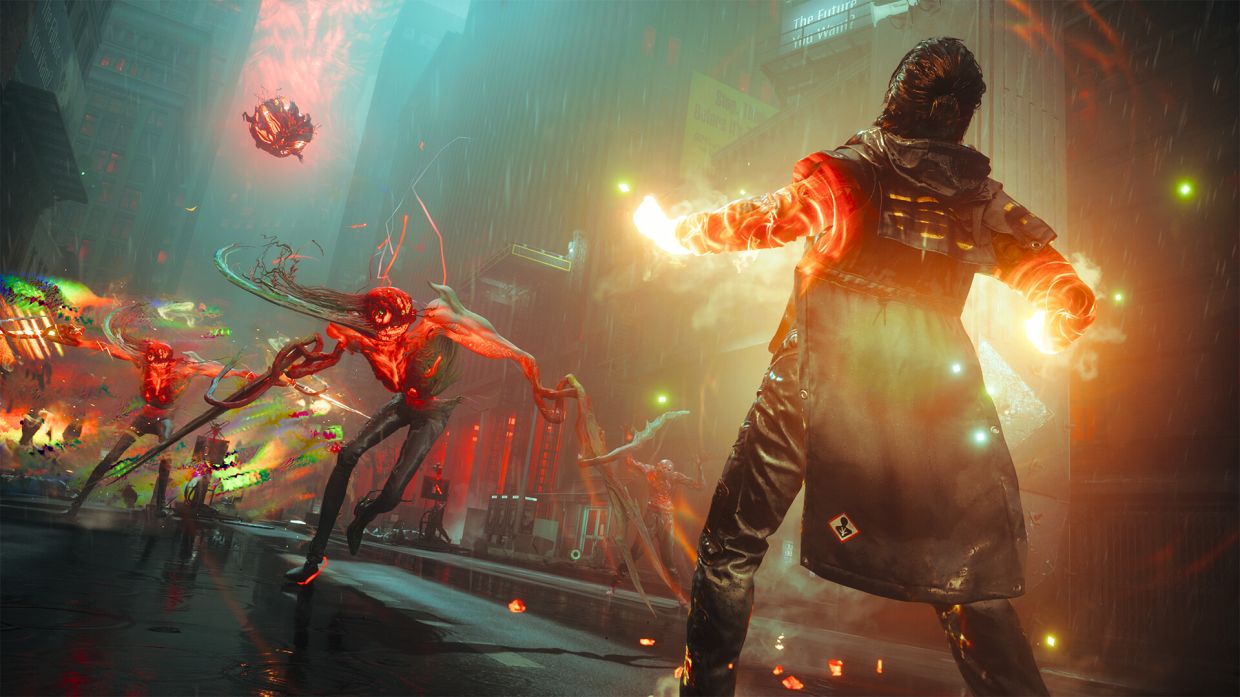
Because of the gnawing emotional travails that Dylan experiences, the actor who played him, Sean Durrie, went through some of his own anxiety.
“I had to live in a rather dark frame of mind,” he said, adding, “But part of the story is learning not to dwell in those emotions or let them overtake you.”
Durrie noted how Dylan’s personality transforms in the sequel. “Dylan in Control is an angry soul that decided to let his intrusive thoughts win” and allowed evil to prevail, Durrie said. In Control Resonant, Dylan just wants to help. “Even if he doubts himself, even if it looks like he will fail, he’s learning what it means to be human again,” Durrie said. “It’s about vulnerability and resilience.”
As Dylan moves forward, he can loft himself over expanses from one building to the next, but not expertly like Spider-Man. He seems tentative, flailing – and if he does not make the jump, four blurry versions of him drop down into nothingness.
Abstraction that denotes tension and trepidation finds its way into the narrative as well. Before he meets an adversary who is portrayed as a beautiful artist’s somewhat fractured and enlarged head, Dylan travels through an art gallery displaying her paintings and sculptures.
When Dylan finally kills her, he does not feel victorious. He was affected by an unfathomable force that defies understanding. “He’s actually caused the deaths of hundreds of people, not by his own decision,” Kasurinen said. “He was taken over by this force.”
When the haunted Dylan readies another blow, he stops short. He looks into its eye, and it stares back at him, devoid of life. – ©2026 The New York Times Company
This article originally appeared in The New York Times.