A former Tesla Inc scientist who worked on Elon Musk’s Optimus robot unveiled plans to produce a lightweight humanoid robot for manufacturing plants, logistics warehouses and homes.
Rémi Cadene, the chief executive officer and co-founder of Paris-based startup UMA, said that his artificial intelligence (AI)-powered Northstar robot will target Europe first and is already talking to 50 potential customers about use cases. "Labour costs are very high and, given the demographic trends, there will be significant demand,” he said, in reference to the continent’s ageing population.
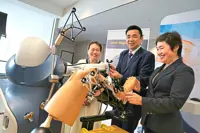
Cadene showed an early prototype of Northstar to journalists at UMA’s headquarters on July 6, poking the metallic humanoid with a stick to showcase its balance and responsiveness. The company aims to deliver a proof-of-concept by the end of the year, on wheels instead of legs, and covered in a flexible outer layer Cadene compares to workwear. The goal is to create something lightweight – about 40 kilograms (88 pounds) – so it can safely interact with humans.
Investors are increasingly looking to AI-powered robots to help automate industrial processes as working-age populations decline. Companies including Tesla and Figure AI are funding projects to harness advances in AI to improve robot capabilities. Several startups in Europe are also raising significant funding rounds, like Genesis in France and Neura Robotics in Germany.
Machine learning scientist Cadene co-founded UMA in October 2025 with former Google DeepMind researcher Pierre Sermanet, ex-Hugging Face engineer Simon Alibert and hardware designer Rob Knight. The startup has about 30 employees in Paris, London and Switzerland. AI pioneer Yann LeCun is an adviser and the company’s investors include French tech billionaire Xavier Niel and former F1 driver Nico Rosberg.
Venture Capital backers include Greycroft, Relentless, Unity Growth Fund, Red River West and Factorial, according to the startup’s website.
The robot’s AI "brain” is trained using a method called real-time learning, which allows it to watch a demo, learn a skill and get better at a new task, rather than being reprogrammed for every application. "This is how a child learns to tie his shoelaces, first by being taught how to do it, then improving by practising,” Cadene said. At the Paris lab, he showed robotic arms with computer vision picking and sorting plastic wall plugs by colour.
Cadene worked on Tesla’s Autopilot and Optimus before leaving to be the robotics lead at open-source AI platform Hugging Face. He said that personal robotics will reach mass adoption more quickly than smartphones did, a transition that took about 12 years, because the humanoids will be able to manufacture themselves. – Bloomberg