Rarely does a day go by without yet another headline purporting how the latest developments in cutting-edge technology, such as artificial intelligence (AI), are going to transform how people live and work.
This has even extended to the national defence sector, with the idea of future defence technologies changing the way that countries maintain national security.
Malaysia is no exception, having signed a Memorandum of Understanding (MoU) with South Korea at the Association of South-East Asian Nations (Asean) Summit last October, aimed squarely at strengthening defence procurement and technology development.
This is not limited to the mere buying and selling of equipment, according to Malaysian Defence Minister Datuk Seri Mohamed Khaled Nordin, who said last year that the collaboration is also about South Korea’s willingness to “share, transfer and help build our companies and our industry”.
He further highlighted that Malaysia has much to learn from South Korea, and highlighted the country’s advancements in aerospace, surveillance, cyber defence, and advanced manufacturing.
In South Korea, domestically developed national defence technologies have seen rapid growth, with Kim Youngdo, a digital communications officer with the country’s Defense Acquisition Program Administration (DAPA), emphasising the importance of prioritising homegrown national defence manufacturing and technology development during a media visit.
DAPA is the South Korean government agency charged with overseeing national defence manufacturing, acquisitions, exports, and research and development.
He adds that this can take the form of armament development through “acquiring technologies for areas lacking through methods such as international joint research and development” with foreign partners.
Such collaborations have already materialised with neighbouring countries, including Indonesia, which jointly developed the KF-21, a new multirole fighter jet platform indigenous to South Korea, with its mass production beginning at the end of March this year.
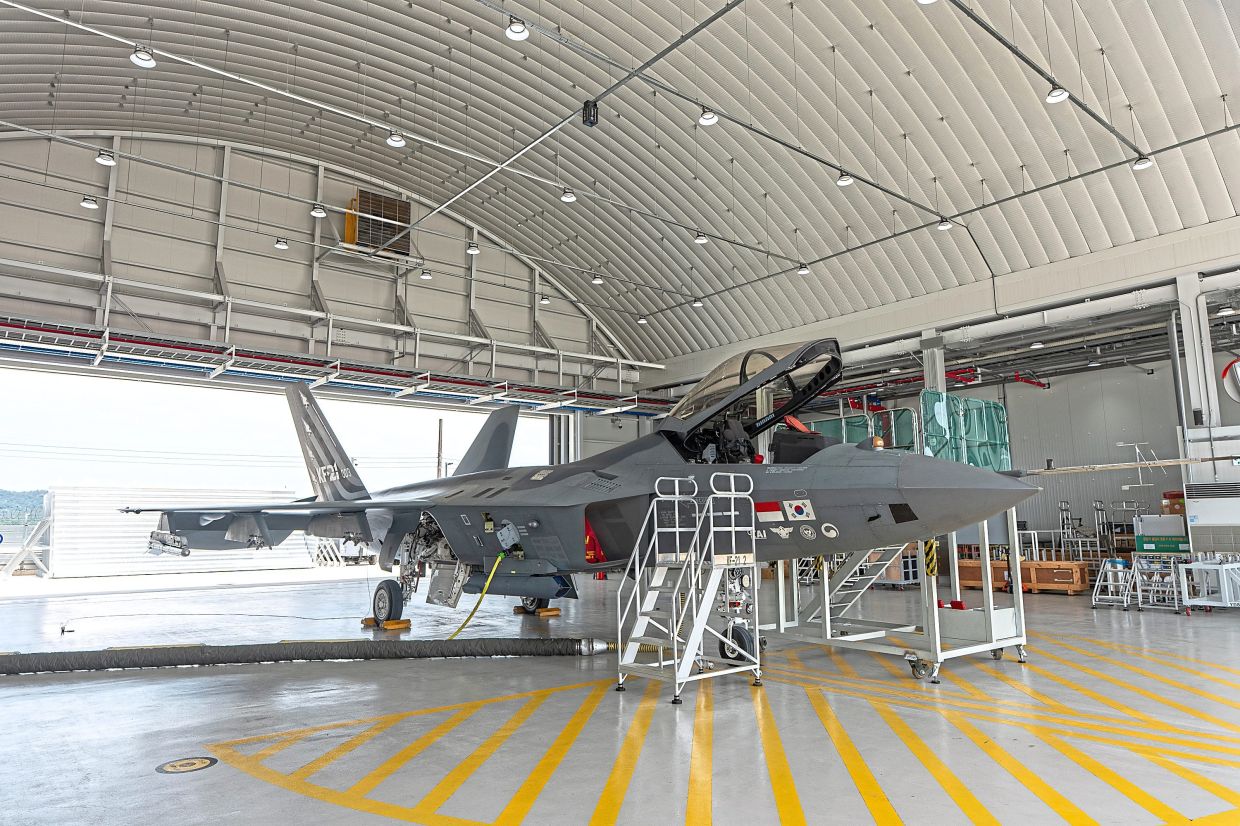
On the topic of aircraft, an official with Korea Aerospace Industries (KAI), a South Korean aircraft and defence manufacturer, said that with the upcoming initial shipment of four FA-50M light multirole fighter jets to the Royal Malaysian Air Force in October, there is an opportunity for further collaboration in terms of other programmes.
He adds that this would raise the need for maintenance for continued operations, which is known as a Maintenance, Repair, and Overhaul (MRO) programme, which would function as knowledge and technology sharing.
“If KAI provides that kind of facilities and technologies to the Royal Malaysian Air Force or government, then they can build their own local maintenance capabilities over time.
“In (the) case of the Royal Malaysian Air Force, they (can) retrieve some technologies and techniques from Korea. In the future, we (can) consider that kind of collaboration programme between two countries,” the official said to StarLifestyle during a media visit to KAI facilities in Sacheon, South Korea.
Autonomous advancements
He further says that such collaboration could encompass both civilian and military aircraft, aerospace software and AI, to even unmanned aerial vehicles (UAVs), adding “including the education and training”.
On the topic of AI, Kim says that the technology’s use in the national defence sector is being explored, with projects under the country’s Defence Innovation 4.0 initiative aiming to leverage cutting-edge science and technology across a variety of use cases.
This includes the large-scale investments in developing technologies under the umbrella of physical AI in the form of robots, drones, and stealth fighter jets through the Future Challenge Defence Technology Project.
The KAI official also described the company’s development of a KAILOT, or the KAI AI pilot, which aims to function as an autonomous UAV system which places them in a supporting role to fighter jets.
“So one manned aircraft with three AI UAVs can fly at the same time, so they can operate and cooperate in real time.
The “manned aircraft can assign missions such as deception, EW (electromagnetic warfare), ISR (intelligence, surveillance, and reconnaissance), and strike to a designated point.
“Then UAVs can move to the target and carry out the assigned missions. So that is one of the concepts being studied in our AI operating concept,” he says.
The KAI official highlighted that the company is also currently developing metaverse-based training systems, along with diagnostics systems intended for aircraft maintenance capable of comprehensively tracking and detecting all parts and conditions of an aircraft.
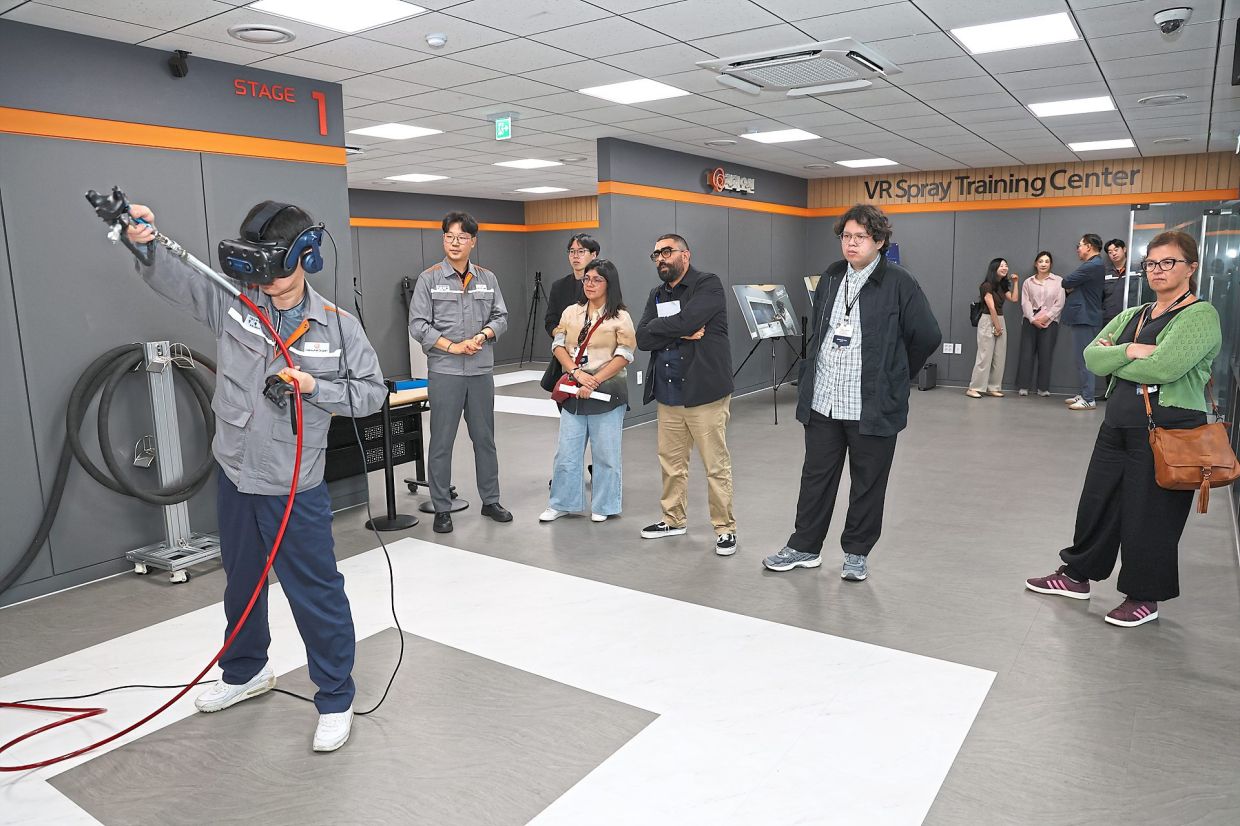
Similarly, South Korean shipbuilder and government defence and design contractor Hanwha Ocean has been incorporating modern technologies into its facilities and manufacturing processes.
For instance, the company’s virtual reality (VR) simulator centre, which was constructed last year at its main shipyard in Geoje, South Korea, is being used to train new staff in spray painting, blasting and grinding operations in ship manufacturing.
As part of an eight-week training programme, trainees undergo VR simulator-based modules developed in-house by the company. These training scenarios can even be customised depending on the specific task.
This includes settings for elements such as the equipment used, the size and shape of the work surface, seasonal conditions that affect drying times, and the viscosity of the paint mix. It is also equipped with an air hose to simulate paint being sprayed from the nozzle.
A key perk of using such a VR simulator instead of the real thing or production dummies is that it reduces prolonged exposure to dust, fumes, and other environmental concerns when compared to practical training.
Hanwha Ocean also offers a portable version of the simulator for deployment overseas to support training programmes and collaboration projects.
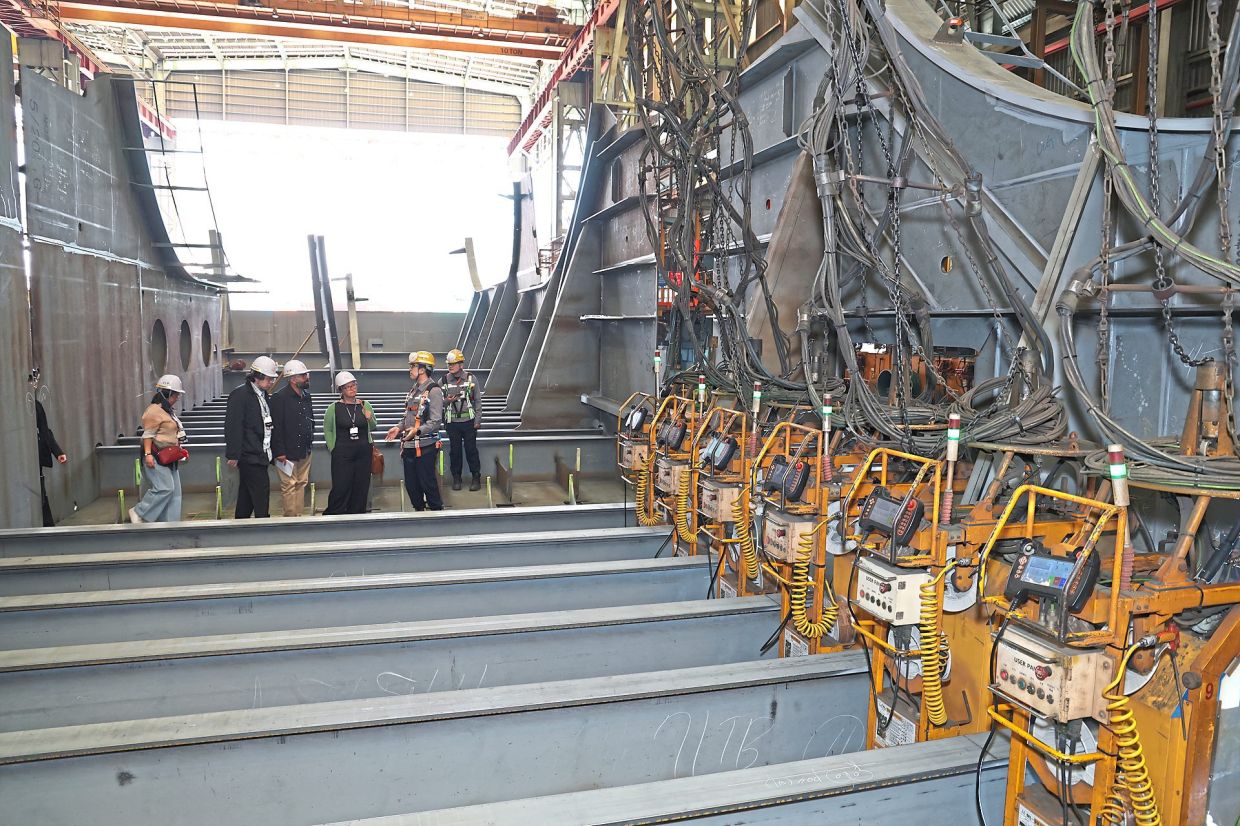
The shipbuilder also operates a smart shipyard supported by real-time production data and digital monitoring systems.
According to the company, some of the ship block welding work is automated using robots developed in-house, with robotic welding being up to four times faster than manual welding. A single operator can oversee as many as 10 robots simultaneously.
Other areas highlighted by the shipbuilder include its KSS-III Jang Yeong-sil submarine programme, which features a diesel-electric propulsion combined with lithium-ion battery technology, allowing it to remain submerged for over three weeks during missions.
Hanwha Ocean is further working on smart ship solutions, including autonomous and unmanned vessel technologies, and smart navigation systems that utilise maritime and operational data to recommend routes and support remote vessel operations.
Another shipbuilder, HD Hyundai Heavy Industries (HHI), has also utilised a digital twinning system in its Ulsan shipyard, which tracks materials, vessel parts, employees’ working state and safety requirements on the site, according to Jewon Yun, HHI’s Naval Ship marketing & sales manager of Middle East & Asia team.
This allows monitoring of the manufacturing process of vessels, and the state of the shipyard as a whole not only from the Ulsan office but also remotely from its R&D centre in Seongnam.
He further said that HHI has developed an AI-supported naval navigation system for route planning and voyage optimisation. He also introduced HHI’s berthing support system, which helps ships safely berth in unfamiliar or shallow ports.
“If you pick a destination, it’s going to calculate all the times and obstacles and show you the most effective route to get to the final destination.
“When berthing a vessel, it often operates in close proximity to land and port facilities, creating a risk of collision. Our berthing support system is designed to help prevent such incidents and improve safety during port operations,” he said.
HHI is also willing to transfer technology and knowledge to local shipyards in Malaysia. Recently HHI has signed the MoU with Lumut Naval Shipyard (Lunas) during the Defense Security Asia 2026 (DSA 2026) seeking for collaboration in Royal Malaysian Navy (RMN)’s programmes and for Transfer of Technology (ToT).
HHI said it plans to conduct it in phased ToT programme, with the end goal of Malaysia achieving self-reliance in building naval vessels.