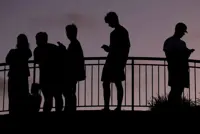
Late last year, Australia became the first country in the world to institute a nationwide ban on children younger than 16 having social media accounts.
Six months in, most indications are that the law has largely failed at keeping young teens off the platforms, in a disappointing start to an initiative carefully watched by parents and governments around the world.
But some Australian parents say the real effect of the law may be for the coming cohort of younger kids who were not yet on social media, and who may stay off because of the ban.
Take Naomi Parrish’s 12-year-old son, Ethan, who got a smartphone for Christmas the month the law took effect, and has been trying to persuade his mother ever since to let him download TikTok.
Several times a day, Parrish’s phone will buzz with requests for permission to download the app. He dug out an old whiteboard to write a list of reasons he should be allowed to have it. He wrote two letters pleading his case, decorated them with stickers and left them on the kitchen counter.
Parrish has held firm in this battle of wills, fending off his entreaties day after day – citing the country’s social media law.
“It’s given me a reason he can’t have it, and that’s powerful,” she said. “I’ve said to him, ‘It’s against the law, we’ll get fined.’”
A Bumpy Start
Australia’s eSafety Commission, the regulatory agency tasked with enforcing the law, reported in March that 7 in 10 parents whose children already had an account said the teens were still on one of the age-restricted services. Other surveys have reported similar findings.
Teenagers have described easy workarounds – drawing a moustache on their face for an age estimation scan, creating a new account with a fake birth date, or using a parent or older sibling’s account. Others said their accounts kept working without a hitch.
“The kids all laugh about it, ‘What a joke, we haven’t been taken off anything,’” said Lauren Hillier, 42, who said she had really looked forward to the law taking effect. She had hoped she wouldn’t have to be the lone “evil nasty mom” for being strict about her 13-year-old son and 15-year-old stepdaughter’s phone usage.
Her son still has access to Instagram and her stepdaughter remains on Snapchat, Hillier said, adding: “I don’t know a single person who’s lost an account.”
So far, these signs of fallibility haven’t deterred other countries that are planning on introducing similar laws. Last month, Britain’s online safety minister, Kanishka Narayan, travelled to Australia to learn about the implementation of the law as his country considers similar steps to protect children.
Changing the Norm
Much of the media, academic and regulatory attention around the efficacy of the law has been focused on young teens between ages 13 and 16 who were already using social media and were supposed to be weaned off it by the ban. (Most platforms already had in place a seldom-enforced minimum age of 13 in their user agreements.)
But parents with children under 12 who weren’t already on social media apps said the real beneficiaries might be the next generation, who will enter their teenage years with the ban already in place.
Bec Barton, a mother of two boys in Quakers Hill in western Sydney, said she was hearing conversations among parents on the sidelines of soccer practice and at school drop-off that feel like the beginning of a cultural shift. Parents were collectively choosing to withhold smartphones or social media accounts from their children, a move that could end up reducing the appeal for the next generation, she said.
The government intends to enforce the ban, which puts the burden on tech companies. They face fines of up to about US$34.8mil (AU$49.5mil/RM141.2mil). The eSafety Commission has said it has ongoing investigations into five of the 10 platforms covered by the law for noncompliance – Facebook, Instagram, Snapchat, TikTok and YouTube – and said it would decide on enforcement actions by the middle of the year. (Parents won’t be fined, despite what Parrish has been telling her son.)
Dany Elachi, a father of five in Sydney, founded a group called the Heads Up Alliance in 2022 so parents would have strength in numbers when it comes to holding off giving their children smartphones.
Australia’s law, if it worked perfectly, should have turned the whole country into an alliance, said Elachi, whose children range in age from 9 to 16. He said members of his group – mostly parents with children in primary school – expressed disappointment in the law not having more immediate effect. But he said it was always clear that the real change would have to come in individual households, and that the government would need to hold tech companies accountable.
“Ultimately, parents are realising this is one piece of the puzzle to keep the next generation of kids from addiction,” he said. “Parents still need to be gatekeepers.”
Strength in Numbers
Carol Greive, the mother to a 12-year-old son, Jimmy, said she has tried to build relationships with families who share her concerns about social media and nurture his interests in activities that don’t involve screens.
At their home in Newcastle, north of Sydney, she has also left self-help books around the house, including How to Say No to Your Phone, Busy Idiots and Raising Tech-Healthy Humans. And she introduced a financial incentive, telling Jimmy that if he manages to refrain from social media until his 18th birthday, he will get AU$2,000, about US$1,400 (RM5,681).
For Ethan, Parrish’s son, the allure of TikTok is strongest in the 35-minute daily wait for the bus after school. The 150 or so high schoolers mostly stare at their phones and “there’s no one to talk to,” he said.
Parrish said she was aiming to hold strong for another 3 1/2 years until his 16th birthday, and is hoping the law will mean more parents are in her corner.
If it hadn’t been for the ban, she said, she might have caved and allowed him on Instagram, where there seems to be helpful soccer content from coaches. But the law has given her confidence that her instincts are correct. Instead, he can entertain himself for hours hammering nails, toward his dream of becoming a carpenter.
“Still a no,” Parrish told him on a recent afternoon, for what she said felt like the millionth time. “I’m not giving in.” – ©2026 The New York Times Company
This article originally appeared in The New York Times.