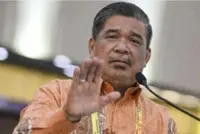
Datuk Seri Wee Ka Siong possesses one political asset that is often overlooked: an exceptional command of the Malay language.
In Malaysia's coalition politics, this is not merely a matter of communication. It is an instrument of political negotiation, persuasion and trust-building.
This distinguishes him from many Malaysian Chinese politicians. While many are proficient in Malay, relatively few possess the ease and confidence to debate constitutional, religious and political questions in fluent, idiomatic Malay before predominantly Malay audiences.
Wee Ka Siong can do so instinctively, making him one of the more effective Chinese political leaders in engaging Malay-majority parties directly.
It is this very strength, however, that creates a serious political conundrum for many Malaysian Chinese.
Many Chinese voters harbour reservations about the direction of PAS under Tan Sri Abdul Hadi Awang. Their concerns often centre on the party's advocacy of a greater role for religion in public policy, its conservative social positions, and its vision for Malaysia's future.
Whether these concerns are ultimately justified or not, they are genuine sentiments held by a significant segment of the electorate.
Yet Malaysia's coalition politics seldom allows parties the luxury of engaging only those with whom they agree. MCA has historically worked alongside a variety of political partners with differing ideologies.
As a senior MCA leader, Wee Ka Siong's responsibility is not simply to represent Chinese interests within his own community but also to communicate those interests directly to Malay political leaders – including those in PAS whenever circumstances require.
His command of Malay makes such engagement possible. He can argue, negotiate, disagree and clarify positions without linguistic barriers.
Indeed, one could argue that if MCA is to convey the concerns of Chinese voters to PAS, it is better that someone capable of expressing those concerns fluently and directly undertakes that task rather than leaving misunderstandings to grow.
Nevertheless, this places many Malaysian Chinese in a difficult position.
On one hand, they expect their political representatives to defend their interests vigorously.
On the other, they may feel uneasy when those same representatives engage closely with a party whose political vision differs markedly from their own preferences.
This tension reflects the realities of coalition politics rather than a simple contradiction. Engagement does not necessarily imply endorsement.
Negotiation is not synonymous with ideological convergence. In parliamentary democracies, political leaders frequently meet, negotiate and even cooperate on selected issues while continuing to disagree fundamentally on others.
The broader frustrations of many Malaysian Chinese also explain why this dilemma resonates so deeply.
Many are primarily concerned with economic opportunities, the rising cost of living, educational prospects, institutional integrity and good governance.
Small and medium-sized enterprises, where many Chinese Malaysians are active, continue to face global competition, inflationary pressures and technological disruption.
Their expectation is that political representatives will protect these interests regardless of whom they must engage.
Wee Ka Siong's ability to communicate across political divides therefore becomes both an advantage and a burden.
His linguistic fluency enables him to represent MCA in conversations that many others would find difficult to navigate.
At the same time, every engagement with Hadi-led PAS is scrutinised carefully by constituents who worry about the broader political implications of such interactions.
Ultimately, this is the paradox of Malaysian politics. In an increasingly fragmented political landscape, dialogue across ideological divides is often unavoidable.
The challenge for political leaders is to demonstrate that engagement serves the purpose of representation rather than acquiescence.
Wee Ka Siong's command of Malay equips him to undertake that difficult task, but whether his constituents interpret such engagement as prudent statesmanship or political compromise will remain one of the enduring questions facing Malaysian Chinese politics.
PHAR KIM BENG, PhD
Director
Institute of International and ASEAN Studies (IINTAS)
International Islamic University of Malaysia
Already a subscriber? Log in
Get 20% OFF The Star Digital Access
Cancel anytime. Ad-free. Unlimited access with perks.