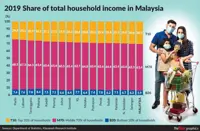
ACCORDING to the Department of Statistics Malaysia, the country’s absolute poverty rate stood at 5.1% in 2024 while hardcore poverty declined to just 0.09%. The average Poverty Line Income was estimated at RM2,705 per household per month, suggesting that fewer Malaysians are living below the minimum income threshold.
However, these figures tell only part of the story. Income provides a snapshot of earnings, but it does not reflect whether individuals can access essential services such as healthcare, education or safe housing.
It also does not capture whether households experience stability, dignity or meaningful opportunities for upward mobility. Two households earning the same income may live entirely different realities, with one being stable and secure while the other remains stretched and is constantly struggling to survive.
When poverty is measured solely in monetary terms, many of these lived struggles remain invisible.
As studies often emphasise, poverty is not just about what is missing from the wallet but also what is missing from a person’s ability to live with dignity, security and choice. This perspective highlights the importance of understanding poverty as a lived experience rather than a purely numerical condition.
The Multidimensional Poverty Index, developed by the United Nations Development Programme (UNDP) and the Oxford Poverty and Human Development Initiative, offers a more comprehensive framework. Instead of focusing only on income, it evaluates whether individuals have access to key dimensions of well-being, including education, health and living standards.
This broader approach is particularly relevant in Malaysia today. Although income poverty has declined, relative poverty remains significantly higher at 16.7%, based on a threshold of RM3,509 per month. This suggests that many households are living below what is considered a reasonable standard of living, even if they are not classified as poor under traditional measures. In other words, a growing number of Malaysians are not poor by definition but are far from secure in reality.
Perhaps the most pressing issue today is not extreme poverty but vulnerability among those just above it. The data reveals a clear disparity between urban and rural experiences, with urban poverty recorded at 3.7% and rural poverty at 9.9% in 2024. While poverty remains more visible in rural areas, urban households are increasingly experiencing hidden forms of financial strain driven by rising costs of living.
For many individuals, especially young working adults, earning slightly above the poverty line does not necessarily translate into economic security. A significant portion of income may be spent on rent, leaving little room for savings. Long commuting hours, limited access to affordable healthcare and the inability to build financial resilience are common challenges.
From a statistical perspective, these individuals are not considered poor, yet their lived experiences suggest otherwise. This raises an important question of whether we are measuring poverty accurately or simply measuring what is easiest to quantify.
Ultimately, poverty is not just about how little one earns but about how limited one’s choices are. It reflects the inability to access opportunities, withstand economic shocks and move forward with confidence.
It is a condition marked by constant compromise, even among those who may appear economically stable on paper.
As Malaysia continues its development journey, the challenge is no longer simply to reduce poverty rates but also to understand poverty more honestly and measure it more meaningfully. In the end, it is those lived experiences that should matter most.
DR NIK ZIRWATUL FATIHAH
Research fellow
Ungku Aziz Centre for Development Studies
Universiti Malaya
and SHUHAIDA SALLEH
Doctoral candidate
Universiti Sains Islam Malaysia
Already a subscriber? Log in
Get 20% OFF The Star Digital Access
Cancel anytime. Ad-free. Unlimited access with perks.