



Tan Sri Rahim Noor is remembered and respected as a no-nonsense officer who took the bull by the horns when things needed to be done.
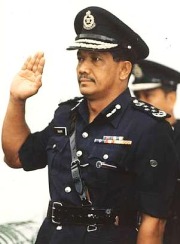 |
Tough job: A 1995 file photo of Rahim taking his oath during PoliceDay. His biggest achievement is in helping to overcome the communistthreat. |
FORMER Inspector General of Police Tan Sri Rahim Noor, one of the country's most respected IGPs, resigned from the force in 1999. Since then, he has kept a low profile but he recently shook off his mantle of privacy to speak about matters close to his heart, including how, as head of Special branch, he initiated the moves that led to the end of the communist threat, current dangers to our nation's peace and security, and the public's role in fighting crime and in this exclusive interview.
Below are excerpts of the interview:
Q: What have you been doing since you resigned?
A: I spend more time with my family and grandchildren besides looking for opportunities in the private sector and playing games. Golf takes a lot of my time too.
Two of my kids are still in college. I have more time to help them with their studies.
As for looking for opportunities in the public sector, I have joined a few friends and their companies apart from my own ventures in plantation.
Q: As IGP, you were regarded as a no-nonsense officer who tackled the bull by its horn?
A: I do not like to sit on problems. If it can be solved, or should be solved within a year, solve it by half.
When I took over as head of Special Branch in Jan 1986 (I never served in Special Branch until Tun Musa Hitam or the government at that time put me there), I called two of my deputy directors - Datuk Ghazali Mohd Yakob and Datuk Ang Phaik Ching - in to brief me on the communist problem.
They briefed me on the situation and the threat to our security. I listened, and I said: 'Hey! If we have other ways to solve this issue once and for all, can we do it?'
In 1986, they were not so many of them - only about 2,000 near the border in West Pahang, northern Perak, Kedah and Gua Musing.
Datuk Ghazali asked if I have any other method. I replied: 'What if we see Chin Peng? Handle the bull by the horn.'I said Chin Peng was an old man, 70 plus.
When Chin Peng was a young man, he was prepared to come out and talk to us in 1955. He was young, energetic and romantic with ideas, and very ambitious. Mao Zedong was still there and backing him. Now, logically, he wants to retire. Every human wants to retire.
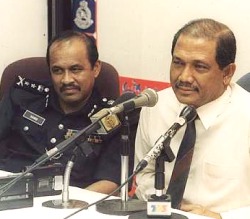 |
Part of the job: A file photo of DCP Hamid and Rahim answeringquestions during a press conference. |
I used that kind of logic. What if we can see him, talk to him and settle this once and for all? Ang said: 'Sir, it just cannot be that way. How can you negotiate peace with a defeated enemy? Normally you talk peace if you kalah (lose) or are almost losing.'
Nevertheless, after much discussion, we went ahead and three and a half years later in 1989 we signed the Hat Yai peace treaty in November.
Q. How do you view the security situation then and now?
A: I think we are now freer to move about. I am saying this particularly to the younger generation. We are free to move about, free from the threat of militant communism. That does not mean you cannot read about communism. Now you can find Mao Zedong’s pictures in pasar seni.
Previously, you would have SB people knocking on your door at night if caught with such pictures.
Today, in our country, we have religion being exploited by people. One issue that remains with us is religious extremism. It comes in various guises and forms.
In our country, people do not realise and understand what the Special Branch does in relation to this. When I was in service, we took action against Al-Arqam. The man on the street does not fully appreciate the full implication of the measures we took.
Al Arqam - at the height of their popularity - you saw them in town, the statements they issued, organising mass movements here and there, (and) their kindergarten (where) kids aged three to four were taught about cult worshiping.
When you have this in the country and you have something called al-Qaeda somewhere in the Middle East or Pakistan or the Afghan border raising the same issues, if you do not tackle or act against Al Arqam, then my own speculation (danger posed by them) is that they could easily become a reservoir of recruits for these people (al-Qaeda).
On the security of our country, we must never forget (that) we are always facing something. We (have) finished with the communist problem, now we have religious extremism.
Q: You feel the current threat is religious extremism?
A: Yes, in the worst form. I cannot, of course, rule out racial extremism, which is quite distinct from religious extremism.
But in the context of the situation now, I do not see much of it other than (among) some politicians sometimes, such as (at) the Umno General assembly a few years ago.
We are multi racial; we cannot deny that.
Q: Why do the public nowadays feel they are no longer safe? Even retired cops are getting robbed?
A: I think there are three or four sources of crime in our country. Firstly drug addicts. They account for a quite a considerable number of house break-ins, snatch thefts. If I am not wrong, they commit about 50%.
The other source are the illegal immigrants. They are becoming more and more violent/aggressive.
Then, of course, we have the habitual criminal offenders. You catch them today, put them behind bars and, given some time, they start again.
What I have heard is that 'polis pun dah takut nak buat kerja (policemen are afraid to do their job)'. I can tell you that they are not lazy and neither are they scared.
It is just that they are asking: 'If we want to be crime busters, who is going to protect us? We are left in the open.'
They too have families to take care of. I must say from my feedback that most of them are happy to do their job, especially to solve a crime. What I feel is that the gathering of intelligence is lacking. The question that they are lazy or lack training does not arise.
I think the most important point is that the public must have trust in the ability of the police to solve crime. They must support the police.
I must stress that you cannot use the softie way in investigating criminals. If you have a criminal in your custody you cannot say: 'Encik ke yang buat jenayah ini? Tolonglah cakap, saya cuma ada 10 hari di bawah Seksyen 117 (Sir, did you commit the crime? Please, I have only 10 days under Section 117 to hold you in remand and solve the case). The police do not have the time. Every day the police receive new reports. The force is also short of investigating officers and assistant investigating officers. Presumably, you may say that police are poor time managers.
This is police work as such.
Q: Do you think pressure from NGOs and human rights groups is hampering police work?
A: Yes, definitely. I have got so much feedback from members of the force, even from those retired (about this). At the end of it, I put it this way: we are in a global village, a world with no borders.
The idea of human rights is so prevalent in (America) the West. We are just starting here. To me, human rights is a kind of movement or ideology. As if the rights of an individual supersedes totally the right of every other citizen to live peacefully without crime. This is life in the West.
Whether we realise it or not it has overflowed to our shores. This is what the police are facing. The police are also human beings. There is check and balance. At the end of the day, the basic policing job is to protect the public.
Q: Do you think the Government should protect the men in blue?
A: I should think so.
Q: Has the setting up of Suhakam and the proposed IPCMC done more harm than good?
A: Basically, whatever the government does, it is of course for the better. Sometimes what we do may be counterproductive. If we were to look at the current constitution we already have a police commission, a judiciary commission, and military commission. These are instruments that can be used to improve the police service. As far as police discipline in concerned, we have article 140 in the commission to deal with such cases. Therefore, the government can use that section.
My view is that if we were to combine the NGOs in the running of the government it can become a political issue. I am not saying the government must ignore the voices of the NGO, granted the world is like this now.
Q: Does the presence of Human Rights groups worry the police?
A: I will put it this way. We are part and parcel of the world. The police cannot avoid such situations especially on human rights. It’s an ideology. They will have to speak up through the proper channel. There are three police associations. Bring it up. Speak up.
When I was IGP and chaired meetings or conferences, I liked my men to speak up and air out all grievances. Let us listen to their side of the story.
If that does not solve your grievances, carry on with your job and seek improvements to the terms and conditions of your service if you feel something is lacking here and there. Be positive. Speak up. Use the associations.
Q: Talking about manpower in the police force. Do you think the current manpower is sufficient to the public ratio?
A: No. Relatively speaking. I think with our current population of 25 to 26 million people we need between 100,000 and 120,000 policemen. But they must be backed with the latest technology and logistics. The force must be well managed logistically.
They must keep up with time (state of the art). Proper communication systems must be in place. A general without it will be a blind general. Our intelligence gathering to fight crime is important. The detective world is all about surveillance. Our Special Branch was world class during the communist time. I am not sure about the CID now. Intelligence gathering on crime and the underworld is very important while efficiency of the IO and AIO must be enhanced. In-service training is very important.
Equally important is public participation. They more or less are the other half of the coin. The Japanese are good at this. Here, people run away when they see a crime for fear of being called by police for questioning or to be witnesses.
For them it is the police’s job. Public awareness is sorely lacking. You are the people the police are serving. If you do not interact with them, how are they going to serve you well? Emulate the Japanese. They care for their neighbours. If they feel anything untoward, they report it. They are not being busy bodies. The Japanese call it the Koban system (neighbourhood system). Singapore adopted it and it is quite successful. We had the Salleh system. The public must also play their part.
Q: Do you think public participation is sorely lacking?
A: I will say sorely. The public have their interest at heart. They must be security conscious. This is sorely lacking
Q: Do you think politicians should interfere in policing matters?
A: Good question. Tun Dr Mahathir Mohamad always stressed the independence of the civil service. He said: “We politicians set the policies through Cabinet and Parliament. You execute them. You must be independent of the executive. You just carry out.
“Whoever becomes the government (which ever party), you must obey."
As such, I feel, ideally, politicians should not interfere. They must trust the agencies concerned and in this case it is PDRM.
Then again it is not that simple. The politicians answer to their electorates. The public elects them. When they go back to their constituencies who voted them in the first place, they have to give answers. They (people in the constituencies) plead with the politicians to do something. They complain to the politicians that police arrived late at a crime scene. So how not to interfere when these are the voices of the people?
It is not that simple. You as the YB have to see the OCPD or the IGP, depending on which level you are. You interact. The relationship must be there. You cannot say you do not want to interact. You cannot adopt that kind of stand. Together we serve the public.
Q: What about interfering in investigations?
A: They cannot get involved in investigations. It is no good.
Q: Tan Sri, you played a major role in the surrender of the Communist Party of Malaysia. How did you get them to surrender?
A: Within the first week as director (of Special Branch), I called both my deputy directors for a briefing and we drafted a simple formula.
Number 1: I knew Chin Peng and company (the central committee) even if our country did not recognise them. We asked ourselves what face-saving devices we should offer them. How much could we relent to their request in order for them to agree to stop or end their struggle once and for all? They did not like to use the word surrender.
Number 2: Most important of all: whatever terms and conditions we were to achieve with the communists, it must not be at the expense of the government or the party in power.
Number 3: We must ensure the government won. It was the dollar’s worth. We discussed among the veteran’s in Special Branch. With these three strong strategies, we met the CPM in Phuket, Thailand.
From day one of the meeting, the sky was the limit for the CPM. They asked for the impossible. They started with asking for the destruction of the National Monument (Tugu Kebangsaan Negara).
For them (CPM) it symbolised the trampling of their comrades and communism. They wanted their party to be recognised and their soldiers to be absorbed into both the army and police force.
They also asked for land. They wanted between five and 10 acres of land for each of their men if they were not absorbed into their army or police. They too wanted to take care of their members. They wanted an assurance that their members would not be arrested under the ISA or Penal Code when they returned. Some of them were murderers, you know, and investigations were still going on. They also did not want to be known as those who surrendered. They wanted it to be known as a negotiated settlement.
On the question of weapons, they wanted it to be known as their weapons of struggle. That was one of the reasons that led to the failure of the Baling talks. They did not want to surrender or hand over the weapons during a ceremony, as it would be insulting to them. They also did not want any photographs taken. They would surrender them on their own. No reporters would be allowed and they would detonate the weapons indoors. They wanted it to be hush-hush.
The journey was tough and we needed patience. Rashid Maidin, the Malay element who died, was there throughout. Abdullah Sidi was there during the negotiations.
Chin Peng was not there but he kept in communication. He was somewhere in China at the time of the negotiations. We managed to solve it within five years. That was our formula.
Q: What would the reaction or outcome have been if the Baling Talks (1955) had been successful?
A: We have to see it from all aspects. We were in the process of nation building. The communist threat was bad. It cost the government a lot of lives, destruction as well as public money.
If the Baling talks had succeeded and as a result the CPM was dissolved, how would the public view Chin Peng?
History shows that Chin Peng was against the Japanese occupation. He fought alongside the British under Force 146 and battled the Japanese at that time together with our soldiers.
We must not forget Chin Peng’s role although his ideology was communism at that time. If the talks had succeeded, should we regard him as a hero or a patriot?
Q: Many Malaysians cannot overcome their fear of the CPM and are still worried. So, should Chin Peng’s application to come back be allowed?
A: My opinion is this: the Hat Yai agreement was signed on Nov 21 1989. There were two agreements - the main agreement signed in public and the other from Thailand as the communist was based in Thailand. Chin Peng and Rashid Maidin represented the CPM. The secondary agreement was about administrative arrangements for them to return.
One was signed by me as director of Special Branch and as one of the representatives from Malaysia and by CPM people including Chin Peng and Rashid Maidin.
Both agreements covered everybody including men from the lowest ranking (people’s army) until the highest. It covered everyone including Chin Peng. We kept our promises and CPM kept their part of the bargain. The Thai government also kept their agreement with the communist. There was a separate agreement between CPM and Thailand. They (the Thais) give them a lot of things in their territory. They gave land equivalent to six acres. Thailand even gave them PR status. I am not sure whether they got citizenship. They also gave them seeds and life stock. I am not sure whether they gave allowance, like we did. We were lucky in this whole issue; earlier Thailand had not bothered about the problem. Their National Security Council perceived the CPM as our problems.
The meeting in Hat Yai only started after we discussed with the Thais and their National Security Council. They also had their own problems at the border. Not only were they facing the communist problem but also the Islamic (threat) in Southern Thailand.
On Chin Peng's application to come back, I think as the agreement covered all, Chin Peng under the agreement is entitled to come back. According to the agreement, he was given one year to decide if he wanted to come back or not.
Q: How many times did you meet up with Chin Peng?
A: Chin Peng only came when everything was settled. He came to thank us for resolving the matter and to prepare himself for the signing. I think we met four to five times. After the agreement was signed, I never met him.
Q: What do you think of our 50 years of independence?
A: Fifty years of independence - relatively speaking, we have succeeded but we still have our shortcomings. Those in the younger generation take things for granted. It is only natural for us as humans. We must be thankful to the government and to our leaders for what we have. We have to ensure our unity is always there. This is the ingredient to our success. We succeeded not because of good government, but because the rakyat wanted development. Lee Kuan Yew once said: 'tTlking about development will not produce development unless the people themselves want development.' Thinking is one thing, he said.
We want development but must have political stability. There must be good security. Investors will not come if these are not in place. The younger generation must think what is going to happen to my country 50 years from now. It is important to have good security and political stability.
Q: How would you describe national integration or unity?
A: On integration, I am not satisfied. Last time it was better. In campus, when I organised events, a lot of Chinese and Indians were in the committee, and these guys would join in. Those days we thought differently. We did not categorise as Malays, Chinese and Indians. We all regarded ourselves as Malaysians. I have lived 64 years. If I am lucky I can live another 20 years. If I have the chance to be reborn, I would like to be reborn completely as a Malaysian. I do not want to call myself or have in my passport or identity card written Malay and religion so and so. If I am reborn, I would like it stated as 'Bangsa: Malaysian'; 'Religion: personal to me'; and 'Nationality: Malaysian'. Some people may think I am emotional or the Malays will find me “secular”. I am a Malaysian first. This is very ideal.
Q: Tan Sri, public perception is that corruption is very rife in the force. Why have we let this perception go on all this while?
A: First of all, Malaysia is far from free from this issue of corruption. Police now pin on their uniform 'Saya anti rasuah'. The point is that the police are doing something to remind the public not to corrupt them. When they put on the badge, the police are telling the public: I am reminding you that you are the ones who corrupt me. It’s a two-way traffic. I am telling you that corruption is a two-way traffic. The badge with those words is there to remind each other about the perception that exists.
The police throughout, from Tun Hanif’s time, tried their level best to get rid of this (corruption). A special section was created in Bukit Aman to handle this. They did as much as they could but this will go on.
From my own experience, both sides have got to play their role. To be honest, I think the public have a bigger role to play. In this area, the public should ask themselves, what kind of police force do they want? Do they want a police force that's relatively free of corruption? The public have to ask themselves these questions. In the final analysis, the police are serving you. There is a Chinese saying: 'A journey of a thousand miles starts with the first step.' We must take the first step. And for me, the public must take the first step. Ultimately, it is their money that pays off the policeman to prevent him from issuing a summons. If the public refuse to bribe and go to court to settle their summonses even for a RM200 fine, it will bear results.
To me this first step is lacking. To be very honest, I think the police have done a lot. Ask any policemen. We have done our best compared with other enforcement agencies.
Q: During your time, there were a few controversial issues mainly the allegation of being trigger-happy. How do you relate it to the present situation?
A: I will not say trigger-happy. We have got to stick to the story given by the police. Those days were worse than today in terms of criminal activities. One of the big issues then were kidnappings of well-to-do people. We tackled and solved the problem of kidnapping. Now the situation is more controlled. Yes, there still are kidnappings but it does not involve VVIPs.
Q: What do you think about the incident in Johor (where people took to the streets to demand for police action against crime?
A: In the final analysis, people want result. The Malaysian public as a whole, compared with Australians or Americans, are quite tolerant - but up to a certain point. When the limit of their tolerance has been reached, there will be a hue and cry here and there. When that happens, then something is wrong. The police have lost control of the situation and they are not doing their job. These are signs that the public are fed up. The police must take the cue from that. This has happened to all the IGPs. When too many things happen, people become confused. Newspapers, on the other hand, blow up such issues.
We must always go back to the public, as they are our customers. In business jargon, customers are always right. Be tolerant. Pretend they are always right. I used to tell my officers, if they start jumping and complaining, these are signs. Now it is even worse with the Internet. That is where leaders - from the top to the OCPDs - must go to the ground and find out why. Is intelligence lacking? We need that. I cannot say that police before were trigger-happy and now it is not the same. Police just need to be firmer.
Q: Tan Sri what do you think of IGP Tan Sri Musa Hassan’s leadership?
A: I know Musa in and out. He is a God-fearing man. I think he is sincere in what he does. He wants to do as much as he can during his tenure as IGP. He is doing it in his own way. Logically speaking, he is the man in charge. I think sincerity is quite rare in life today. I am not cynical. I am only speaking the truth.
He needs support. He needs full backing. If he gets cooperation from all parties concerned, in all areas, I think he will become a good IGP. This ingredient must be there. I have known him since before he became IGP.
I know he is very loyal. He is prepared to work hard. If you task him with anything, he will do it bermati-matian (until the very end). He is a man who does not put up a show.
Q: What is the highlight/ lowest point of your police career?
A: My contribution in helping to overcome the communist issue once and for all. That is my greatest achievement. And I managed to do some restructuring of the police forceWorst point: nothing except for that matter (with Datuk Seri Anwar Ibrahim).
Already a subscriber? Log in
Get 20% OFF The Star Digital Access
Cancel anytime. Ad-free. Unlimited access with perks.

