



Tan Sri Mohamed Rahmat recently called it a day after 40 years of a colourful political career during which he held various positions in the party and government. He talked to MERGAWATI ZULFAKAR about life as a private citizen, his childhood and his "fate" as an Umno man.
THE Thursday afternoon meeting at the Bukit Damansara home of Tan Sri Mohamed Rahmat turned out to be a three-hour chit-chat interspersed with interesting observations and comments by his wife, Puan Sri Salbiah Abdul Hamid.
After four decades in the party and government, it is understandable that she is trying to get used to having her husband around the house again.
Tok Mat, as he is fondly called by the press, teased his wife: “She’s getting fed up with me being around!”
Salbiah quickly replied: “Not really, but I can’t stand his smoking.”
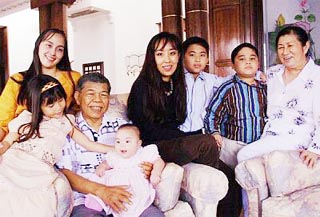 |
Mohamed at home with Salbiah and their daughters-in-law Sharifah Nuralia Syed Danial (left) and Rossana Jaafar Hussein, and grandchildren. |
The fondness between them was apparent, and Mohamed credited his wife for single-handedly bringing up their three sons.
“They are closer to her but scared of her. Discipline means brushing your teeth and praying; she made sure they did that,” said Mohamed, 66.
He was hardly at home, busy with life in the government and party – he was political secretary, parliamentary secretary, deputy minister, minister, Umno secretary-general and, his last post, Barisan Nasional secretary-general.
Despite the high profile, not much is known about Tok Mat except for his career.
Mohamed’s early years were difficult and sorrowful. He came from a family of 17 siblings. His mother died when he was 12. His headmaster father remarried and had four other children.
The family had to live on a meagre $200 income, so Mohamed had to sell kuih in Kampung Mohd Amin, Johor Baru, until he was in Form Three.
His mother was strict, insisting he must always be the top student.
“I was number two once, and she beat me and dragged me to school, tied me to a tree and asked everybody to jeer at me. I was so afraid that I worked harder and became the top student. After she died, I remember being number 29 in class because I had nothing more to fear.”
Mohamed had sat for a special exam at the age of six and was admitted to an English primary school, only to be “sacked” when the principal found out he was too young.
He continued to do well in his studies at a different school. He sat for the Cambridge examination and obtained Grade One in the science stream, a major achievement in those days.
His application for a state scholarship was rejected but that did not deter the young Mohamed from applying for a place at Universiti Indonesia. Under a cultural agreement between the two countries, five seats were offered to students from then Malaya.
“I was assured by the Education Ministry that my degree would be recognised, but when I came back with a degree in philology, it was not recognised,” he said.
His “sorrow” did not end there. He had to leave Jakarta just as he started his master’s programme because of the impending confrontation between the two countries.
“In Jakarta, 15 communist youths came to my rented house looking for me and more came back later to burn down the house when they could not find me.
“The truth is I had quarrelled with the landlady two days earlier and left. Diplomatic ties were severed by then and when I arrived at the old Sungai Besi airport, I was put under house arrest because I was accused of being a communist.”
Despite being under house arrest between 6pm and 6am and holding an unrecognised degree, Mohamed was offered a teaching job in Taiping. But first he had to get a certificate of education from Universiti Malaya. Again, fate was unkind. He secured a place but the ministry told him there was no scholarship, and he had to abandon his studies.
He managed to get a temporary job at Filem Negara but left after a year when he was not offered a permanent position.
His luck changed when he got a job with then Transport Minister Tun Sardon Jubir, who was looking for someone from Johor to be his political secretary.
“I was told there was no salary, just an allowance, and I could keep the job as long as the minister likes me.
“Back then, political secretaries and parliamentary secretaries had to buy their own cars. We did not have drivers, only deputy ministers and above enjoyed that perk. Today, they are spoilt, everything is provided.”
Mohamed never looked back.
In 1969, he contested for the first time to become a Member of Parliament. Before the general election, the Johor Barat Umno division was facing problems and Mohamed was told by Tun Dr Ismail Abdul Rahman, the Johor Umno liaison chief, to be prepared to contest.
He rejected the offer twice. The third time, after being summoned to see Dr Ismail, he accepted – and won.
“I was made parliamentary secretary to the Education Ministry where my boss, Tun Hussein Onn, gave me a free hand to handle education matters. He told his officers, ‘If anything Mat says, take it as coming from me’.”
He believes that the backing from Hussein helped him win the deputy Youth chief and supreme council posts in 1974, which he contested for the first time.
But a crisis was looming. Datuk Seri Harun Idris who was Umno Youth chief and Selangor Mentri Besar was aspiring to a higher post, and Mohamed found himself in between.
“To Hussein, there was no bargaining; you quit and face the law. To him, Harun had done wrong and he should face the law.
“I told Hussein this was a political problem and we needed a political solution. Hussein told me, ‘You can quit now and join Harun and do whatever you like’.
“He gave me a month to get Harun out of office. I tried to coax Harun to come to a settlement but he was playing a game. I told Hussein I gave up.”
Eventually, Harun was charged with two counts of corruption. He was sentenced to six years’ jail but received a royal pardon on Aug 30, 1982.
This episode, according to Mohamed, nearly cost him his job.
When Hussein was prime minister, Mohamed was his “golden boy.” But when Tun Dr Mahathir Mohamad took over, Mohamed was dropped from the Cabinet despite winning his seat in the 1982 general election.
“When Dr Mahathir told me to go to Jakarta, I told him I would, provided I was reinstated in the Cabinet.”
He was in Jakarta as ambassador with ministerial ranking for three years. “In 1987, Dr Mahathir invited me into the Cabinet.”
By this time, Umno was facing its biggest test – it was split into Team A and B. Then the party was declared null and void by the courts. Mohamed had to start a new party with RM274 collected during a meeting at Seri Perdana. Umno’s assets were frozen because of the court ruling.
“I was called Mahathir’s barua (lackey). I had to use whatever position to promote the leadership and the government. People were saying Malaysia was no good; let’s go elsewhere.
“I wanted to build loyalty. I launched the Setia campaign and followed up with Semarak – getting Dr Mahathir to go round the country and strengthen people’s support for the government.”
Mohamed wrote the lyrics of Setia and Sejahtera Malaysia, songs that were played over RTM day and night in those days.
“Once I was in the toilet of a hotel and I overheard someone whistling Setia. I thought ‘how dare this guy sing my song here?’ When I got out, I saw this Chinese boy singing the song and I thought to myself, ‘I did it’.”
Salbiah related instances of her husband crying during his political life.
“He cried during the Harun crisis. He cried again when he was dropped from the Cabinet the first time. But he did not cry after that,” she said, to which Tok Mat remarked he had conditioned himself by then.
“I asked him, ‘why are you crying?’ He refused to tell me. I could only sympathise with him,” added Salbiah.
Now that he has retired, Mohamed is “lepak-ing” with his family.
But politics won’t go away: his eldest son, Nur Jazlan, is the pro tem Pulai Umno division head, taking over from Mohamed who had served there since 1969.
“People think he got the job because he is my son. It is not a trade-off. When I told Datuk Seri Abdullah (Ahmad Badawi) I wanted to retire, he told me not to be the pro tem head, and to leave it to the deputy (Nur Jazlan) so that it would be easier for the person to be considered for the elections.”
Tok Mat has no regrets. He considers it a rare feat having served under five prime ministers.
He is, after all, a survivor.
Already a subscriber? Log in
Get 20% OFF The Star Digital Access
Cancel anytime. Ad-free. Unlimited access with perks.

