Negative as it may sound, that’s what the last decade of inaction clearly shows.
MY eyes and nose itch a lot these days. I thought I could escape the effects of the current haze by staying indoors, but it’s not working.
It came upon us about three months ago and now it’s been declared as the worst in 11 years since 2015.
I will accept the experts’ opinion on that, but I remember writing about the haze in 2019 and again 2023, and I did so because it was bad enough for me to gripe about.
In both columns, I focused on the type of masks that would be helpful in filtering out the pollutants. My beef was that people were being advised to mask up but were not told which types to wear.
In 2019, well-meaning government officials were even supplying school children with the wrong type of masks – the surgical ones that we grew very familiar with during the Covid-19 pandemic.
As fear of the virus receded, those masks had more or less disappeared from public spaces, but the haze has brought them back.
We see more people masking again even in enclosed places like the malls. Unfortunately, these loose-fitting masks can shield us from microbes and bodily fluids but not necessarily from haze pollutants.
The air pollutant index (API), which governments use to monitor air quality, measures chemicals like carbon monoxide, ozone, nitrogen dioxide and sulfur dioxide, and particulate matter (PM) like fine dust or PM2.5 and PM10 in the air.
Particles that are PM10 are smaller than 10 microns (or 0.01mm) and can cause eye and throat irritation as well as breathing difficulties. These are airborne dust that’s got me rubbing my eyes and blowing my nose.
As the number tells us, PM2.5 are particles that are just 0.0025mm in size and are more dangerous as they can enter our lungs and get lodged deep inside, with the potential to cause cancer and other serious health problems.
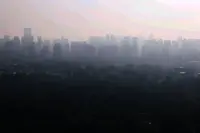
These are particles that are swirling around us, blurring our skylines, reducing visibility and turning our sun red. They are the result of slash-and-burn land clearing and forest and peat fires that are raging in Sumatra and Kalimantan.
When it comes to masking against pollutants, the South Koreans are experts at it. That’s because they wear masks a lot due to the unhealthy levels of fine and yellow dust that affects most of the country, especially during spring and winter.
Their Ministry of Food and Drug Safety give masks KF ratings.
KF stands for Korean Filter and the number shows its effectiveness. Hence, a mask with a KF80 can block out 86% of fine dust while KF99 means it’s almost 100% effective.
China uses the KN rating system under its Standardization Administration. A KN90 mask will filter at least 90% of particles at 0.3mm in size, KN95 at least 95% of particles, and KN100 at least 99.97%.
The United States uses N95 certification, which is the gold standard, while in Europe it is FFP2.
So, if we want to mask against the haze, what we should be looking for are respirators with such ratings. These are tight-fitting to ensure no air comes through without passing through the filter material and not seep in around the edges.
And its material provides the necessary high filtration needed to block out at least 80% to 95% of airborne particles.
The problem with these masks, however, is that they are made of thicker material and are more structured and rigid, making them less comfortable to wear for long periods, especially in our climate.
So if wearing the right mask when going out is so unpleasant, are we safe to just stay indoors?
Well, it appears indoor air quality can also be pretty bad. At least that’s what my daughter has discovered. She is asthmatic and expecting her first child, so she is buying air purifiers for her home.
These high-tech devices have API readings and she was shocked to find how high the index was in her 35th floor condo.
The purifier worked but once switched off, air quality worsened almost immediately.
That happened even with her doors and almost all windows closed. It appears that outside air seeping in through whatever cracks and openings bring in a huge amount of dust.
That explains why my eyes are smarting in my home with my rather old and weak air purifier. Do I cough up to buy a new one?
Well, if the haze is predicted to last till year end or even till early 2027, it may be an investment I cannot avoid if I want to save my lungs.
I’m sure air purifiers are already selling like hot cakes. My daughter has to wait till next week to get her second one.
What is so frustrating is that there really is so little ordinary folks can do to improve the situation.
Our hope for cleaner air rises whenever it rains heavily. But that hope is soon dashed because it is not raining where the fires are burning.
According to David Hutt, writing for dw.com, Germany’s state-funded public service international broadcaster, Asean has not learned the lessons from the catastrophic haze in 2015.
Indeed, Indonesia’s dry season is made worse by this year’s El Nino that is one of the most powerful and severe on record, but Hutt’s contention is that little to nothing has changed in a decade on how governments have tackled this longstanding issue.
As we have learned, there is a regional transboundary haze pollution agreement, but it lacks enforcement, punitive measures and because individual governments are left to interpret and implement it independently. It leads to uneven, inconsistent compliance.
Much as we want action now, it will be a whole month before the 49th Asean Summit convenes in Manila on Nov 16 and foreign ministers will discuss how to tackle haze.
That truly vexes me. The haze is a transboundary disaster and should be treated as such. Both Malaysia and Singapore have offered aircraft, equipment and personnel to help Indonesia put out the fires, but they have met with no response.
This is in spite of Indonesia itself having seen sharp rises in acute respiratory infection cases and its schools have been forced to close.
The full economic cost of this haze has yet to be calculated for affected countries, but it has already impacted our Visit Malaysia Year.
Tourism across South-East Asia has been affected by flight disruptions, adjusted itineraries and visitor cancellations.
Mint Leong, president of the Malaysian Inbound Tourism Association, was quoted by TTG Asia as saying the haze had affected tourism activities for several months with visitors increasingly reluctant to spend time outdoors.
She added that the haze had affected visitors’ sightseeing experiences, particularly at attractions where visibility and photography are important, and that overseas agents are asking their Malaysian counterparts whether conditions remain suitable for travel.
There is no doubt the haze will eventually disappear as the dust literally settles. The anger will dissipate, too, until the next haze season hits us. And hit us it will, because if Asean could not fix the problem in the last 10 years, what are the chances it will now?
I used to think I can safely wait it out at home. But now that it’s proven that indoor air can be no better, it looks like air purifiers will be the inevitable, necessary home device, like water filters.
Well, what’s another filter that we need in our filthy world?
The views expressed here are the writer’s own.
Already a subscriber? Log in
Get 20% OFF The Star Digital Access
Cancel anytime. Ad-free. Unlimited access with perks.