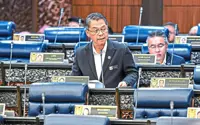
KUALA LUMPUR: Malaysia will only begin collecting revenue under the Global Minimum Tax (GMT) after June 2027, despite implementing the tax regime on Jan 1, 2025, says Deputy Finance Minister Liew Chin Tong.
He said the collection timeline was based on the financial reporting periods of multinational groups subject to top-up tax, with the deadline for filing and payment set at 18 months after the end of their consolidated financial statement period.
"The implementation of GMT is expected to have a positive impact on the country's financial position," he said in the Dewan Rakyat on Monday (Nov 23).
Liew was responding to Lim Guan Eng (PH-Bagan), who asked how much revenue had been collected since GMT was implemented and whether taxes on micro, small and medium enterprises (MSMEs) would be reduced to 15% to ensure fair competition with multinational companies.
He explained that GMT, introduced by the Organisation for Economic Co-operation and Development (OECD) and G20 countries, was aimed at addressing profit shifting by multinational companies to jurisdictions with low or zero tax rates.
The framework requires multinational groups with annual global revenue of at least €750mil to pay a minimum effective tax rate of 15% in each jurisdiction where they operate.
“More than 135 countries and jurisdictions agreed to introduce GMT in October 2021, with approximately 65 having implemented the rules as of October 2026,” he said.
On MSMEs, he said the government had announced a one-percentage-point reduction in income tax rates under Budget 2027.
“From the 2027 year of assessment, the rate for the first RM150,000 in chargeable income will fall from 15% to 14%, while the rate for income between RM150,001 and RM600,000 will decline from 17% to 16%.
“The reductions are expected to provide tax savings of up to RM6,000 per MSME, helping reduce operating costs and improve cash flow,” he added.
In a supplementary question, Lim raised concerns over long-term tax holidays granted to foreign investors, claiming that such incentives had undermined Malaysia's domestic steel industry.
He claimed Malaysian operators, who controlled 85% of the industry in 2016, had seen their share reversed, with foreign companies now controlling 85%.
Lim also claimed that MA Steel was the only remaining local steel company and urged the government to review incentives to protect domestic businesses.
Responding, Liew said the government had introduced the New Incentive Framework on March 1, 2026, requiring investments to undergo assessments involving six scorecards.
“The criteria include economic complexity and the employment of more local workers, with incentives granted only when the required scores were met,” he said.
Liew expressed hope that the framework would prevent situations such as those highlighted by Lim from recurring.
Meanwhile, Datuk Awang Hashim (PN-Pendang) asked whether the government would consider expanding the chargeable-income band eligible for a 15% tax rate to benefit more growing MSMEs.
Liew said the government was generally open to proposals but would provide written data on the estimated fiscal cost and number of beneficiaries.