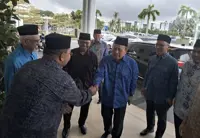
KUALA LUMPUR: The recent developments in Negri Sembilan following a challenging year have underscored the importance of constitutional provisions and safeguards in resolving matters involving state institutions, says Tunku Ali Redhauddin Tuanku Muhriz, the son of Yang di-Pertuan Besar Tuanku Muhriz Tuanku Munawir.
Speaking at the Malaysia Legal Forum 2026 on Tuesday (Nov 17), the Tunku Besar Seri Menanti of Negri Sembilan said recent steps taken to resolve issues in the state were a welcome development.
"This past year has taught me that the constitutional provisions most of us never read are the ones that matter most on the day they are needed, much like the boilerplate clauses in a contract.
"I speak today in a personal capacity but I am also my father's son. It would be wrong for me to argue them from this podium and I will not," he was quoted as saying in his keynote address titled 'Fiscal Federalism in Malaysia: Rebalancing Revenue, Responsibility and Regional Development'.
Meanwhile, commenting on the country's fiscal framework, he said the Federal Constitution has given states significant responsibilities but a limited revenue base, leaving them heavily dependent on federal transfers.
He noted that income tax, corporate tax, sales and service tax, customs duties and petroleum revenue are under federal jurisdiction, while federal transfers to all 13 states amounted to about 3% of its budget.
He said the arrangement limits the ability of state governments to finance development and fulfil their responsibilities, adding that constitutional guarantees must be honoured and all states should be treated fairly.
While acknowledging Sabah and Sarawak's special constitutional position under the Malaysia Agreement, he stressed that other states should be treated on equal terms, regardless of the political coalition governing them.
Tunku Ali also proposed a host-state dividend, allowing states to receive a fixed share of growth in federal tax revenue collected within their territories, alongside greater borrowing flexibility and increased ecological fiscal transfers.
He said the National Finance Council should meet more frequently, while federal grants should be determined through transparent, published formulas and a proposed independent grants commission.
"A mature federation is not one in which the federation and the states never disagree. It is one in which disagreements are managed through trusted institutions and promises are kept even when it is inconvenient to keep them," he said.
He added that a strong federation required both a capable federal government and empowered state governments, stressing that fiscal authority was essential for states to take responsibility and be held accountable. – Bernama