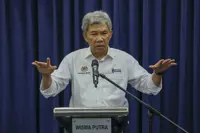
MANILA: Myanmar's rejection of proposals involving Asean's special envoy and regular progress reports has presented the regional bloc with another dilemma as it struggles to reach the consensus required to make decisions, says Datuk Seri Mohamad Hasan.
The Foreign Minister said Myanmar had questioned the need for Asean to continue appointing a special envoy, arguing that the position was no longer necessary following elections in the country.
"Myanmar rejected it and even said there was no longer a need for a special envoy because they had held elections.
"They said, 'why is there a need for a special envoy anymore'?" he told Malaysian media at a press conference here on Saturday (Nov 14).
Mohamad said Malaysia, however, maintained that the special envoy remained an integral part of Asean's Five-Point Consensus (5PC), which was adopted to address Myanmar's political crisis.
He said any decision to discontinue the role would have to be made by Asean leaders at the heads of government level.
"But for us, that is part of the 5PC. If the position is to be abolished, it has to be decided during a meeting of the heads of government," he said.
Mohamad said Myanmar had also rejected a separate proposal concerning progress reports on developments in the country.
He said the two proposals had been discussed through non-papers, but Myanmar objected to both.
"Myanmar didn't agree. They said, 'why must you do a progress report on us? This is our internal issue'," he said.
As a result, Mohamad said Asean had been unable to reach an agreement, given that the regional grouping operates on the principle of consensus.
He acknowledged that Asean faced limitations in addressing the Myanmar crisis, including constraints under its charter.
However, he said the bloc was also mindful of the consequences of exerting excessive pressure on Myanmar.
"We do not want to pressure Myanmar so much that it eventually leaves Asean. We do not want that. We want Asean to remain intact," he said.
Mohamad said Asean leaders had adopted an approach of more frequent engagement with Myanmar during the 48th Asean Summit in Cebu in May to prevent the country from becoming increasingly isolated.
He said engagement had extended beyond Myanmar's military authorities to include various stakeholders, with nearly 40 groups involved in the country's longstanding internal conflicts.
Mohamad also said some Asean member states had proposed examining how the 5PC could be aligned with Myanmar's own five-point roadmap.
However, he stressed that continued hostilities against civilians remained a major obstacle to Asean fully accepting Myanmar's proposals.
"They should stop this kind of thing," he said, calling for a ceasefire, inclusive engagement with opposing parties and inclusive elections.
Mohamad said Asean leaders also wanted progress reports that could be reviewed and presented by the special envoy at ministerial and leaders' meetings.